
Views: 0 Author: Site Editor Publish Time: 2026-10-23 Origin: Site


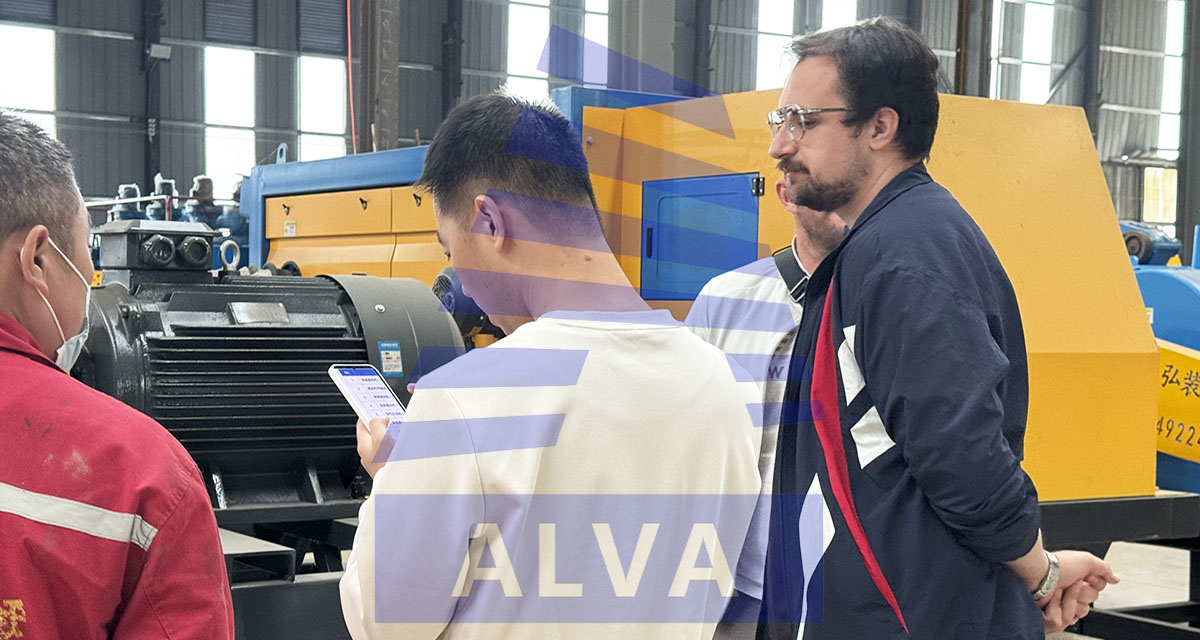
Recently, a delegation from a European woodworking enterprise visited the Linyi production base of Shandong Alva Machinery Group for a multi-day on-site inspection and technical exchange, focusing on the complete veneer peeling production line and the subsequent plywood manufacturing process. This visit was a systematic on-site verification trip arranged by the client after multiple rounds of online technical and commercial communications. It aimed to confirm the manufacturing quality of the complete line, the coordinated operation status of the equipment, and the compatibility with downstream plywood processes. The Group set up a dedicated reception team consisting of staff from the technical, production, quality inspection and commercial departments to support the client throughout the inspection.
Shandong Alva Machinery Group has long been engaged in woodworking machinery manufacturing. Its product portfolio covers the full production procedures including log sawing, log rounding, veneer peeling, veneer drying, glue spreading, lay-up, pre-pressing, hot pressing, edge trimming, sanding and automatic stacking. A full-process quality control system has been established in production, ranging from raw material procurement and component processing to complete machine assembly and finished product inspection. All procedures are implemented in strict accordance with established operating standards. The core focus of this European client’s inspection was the Group’s equipment configuration and process integration capacity in the two major links: veneer preparation and plywood forming.
Upon entering the production workshop, the client delegation first inspected the overall layout and process interfaces of the veneer peeling production line. Following the actual flow direction of logs in the workshop, the Group’s technical engineers explained the equipment configuration and operation logic workstation by workstation. The continuity of the veneer production line directly determines the raw material supply rhythm for subsequent plywood production. The client paid close attention to material transfer between processes and the matching relationship among different equipment.
The log saw workstation is the first processing step after logs are fed into the line. This equipment cuts logs to fixed lengths, providing log segments with uniform specifications for subsequent rounding and peeling. The client watched the sawing operation on site and learned about the saw blade feeding mode, log clamping structure and flatness of cutting surfaces. The technical team explained that the cutting accuracy of the log saw directly affects the centering efficiency of the subsequent rounding process and the thickness consistency of veneers produced in peeling. For this reason, corresponding precision control measures are adopted in both structural design and assembly.
The log rounding workstation receives the sawn log segments for debarking and rounding. While the equipment was running, the client observed the rotary cutting process of log segments inside the rounding machine, focusing particularly on the adjustment of tool rest position, dual-roller drive structure and adaptability to log segments of different diameters. The quality of rounding determines the feeding conditions for peeling. The roundness uniformity of logs and the completeness of surface debarking both influence the thickness stability of peeled veneers. The client exchanged ideas with technical staff about the feed control of the tool rest and waste discharge route, and checked the surface condition of log segments after rounding.
The veneer peeling workstation serves as the core unit of the veneer production line. The client witnessed the whole process in which the rounding-treated log segments are processed into continuous veneers by the peeling machine, including clamping and positioning of log segments between chucks, feed cutting of the peeling knife and continuous veneer output. Engineers introduced the design considerations of the peeling machine regarding the applicable log length and diameter range, as well as the operation of the veneer thickness adjustment mechanism. The client checked the surface smoothness of veneers during peeling, back crack control and remaining log core status, and discussed peeling parameter settings for different wood species.
Located downstream of the peeling process, the stacking workstation undertakes automatic stacking of continuously discharged veneers. The client examined the action logic of the vacuum suction stacking mechanism during veneer conveying, gripping and placing, and learned about negative pressure maintenance of the suction system, lifting control of the stacking table and alignment of veneer piles. The automation level of stacking directly affects labor input in veneer preparation and transfer efficiency of semi-finished products. The client enquired about the matching between stacking cycle time and upstream & downstream production capacity, and verified the stable continuous running performance of the equipment.
After the workstation-by-workstation inspection of the above four main procedures, the client observed the coordinated operation of the whole production line to verify whether the material flow — from log feeding, sawing, rounding, peeling to veneer stacking — is continuous and rhythmically coordinated. Combined with the on-site operation conditions, the Group’s technicians explained the signal connection method and interlock control logic among individual machines, as well as the buffering and fault tolerance strategy for upstream and downstream equipment when a workstation waits for materials or stops briefly.
Veneers produced by the veneer line are the raw material base for plywood manufacturing. After checking the peeling equipment, the client shifted focus to the subsequent plywood forming process, and systematically reviewed the full workflow from veneer drying to finished board output. The core principle of plywood production is veneer lay-up, where adjacent veneer layers are arranged with perpendicular grain directions. Through glue spreading, lay-up, pre-pressing, hot pressing, edge trimming and sanding, the boards are bonded and shaped.
At the veneer drying stage, technicians told the client that freshly peeled veneers have relatively high moisture content and must be dried to meet the requirements of follow-up gluing procedures. The key of drying control is to bring veneer moisture content evenly within the specified process range, while avoiding warping or cracking caused by improper drying speed. The client learned about the feeding and discharging mode of drying equipment, heat source configuration and capacity matching scheme with the peeling section.
Glue spreading and lay-up are critical procedures that decide the interlayer bonding quality of plywood. The client inspected how the glue spreader applies adhesive onto veneer surfaces, including glue distribution on rollers and control of coating uniformity. The technicians explained that glue dosage needs to be adjusted according to veneer thickness, wood species and adhesive properties. Uneven coating may cause local glue starvation or excessive glue thickness on the mat, which impairs bonding strength after hot pressing. At the lay-up workstation, the client learned the operation specifications for staggered grain arrangement of veneers, together with control requirements for veneer joint positions and mat edge alignment.
Pre-pressing is carried out after lay-up and before hot pressing. The client watched the pre-press apply pressure on the mat to squeeze out air between layers and preliminarily compact the mat. The technicians illustrated that pre-pressing stabilizes the mat structure before it enters the hot press, reduces interlayer displacement during transfer and shortens exhaust time in hot pressing. The client discussed with engineers how pre-pressing pressure and holding time affect the forming state of the mat.
Hot pressing is the stage with the most concentrated process parameters in plywood forming. At the hot press workstation, the client observed the adhesive curing process of the mat under combined heat and pressure. Technicians introduced the coordination among three core parameters: hot pressing temperature, pressure and time, as well as the adjustment scheme of hot pressing cycles for boards of different thicknesses. Hot pressing not only cures the glue layer, but also presses the mat to specified density and thickness. Therefore, the stability of hot pressing parameters directly determines the physical and mechanical performance of finished boards. The client checked the temperature uniformity of hot platens, pressure holding capacity of the hydraulic system and operation rhythm of the loading & unloading mechanism.
Edge trimming and sanding are performed after hot pressing for dimension trimming and surface finishing of finished boards. The client watched the longitudinal and transverse edge saw cut the four sides of hot-pressed boards neatly, and learned the control methods for sawing precision and edge straightness. At the sanding workstation, the client saw how the sander calibrates board thickness and improves surface smoothness. Technicians explained the influence of abrasive belt configuration and feed speed on sanding quality. After edge trimming and sanding, boards go through finished product inspection, grading and packaging.
After the on-site tour, both sides held a technical exchange meeting in the Group’s conference room. Based on on-site observations and records at each workstation, the client delegation raised targeted questions about complete-line technical details, process interface solutions and future capacity expansion plans. The Group’s technical team responded item by item and provided matching configuration solutions for the veneer line and plywood line capacity balance, which was the client’s major concern.
During the exchange, the client stated that this on-site inspection helped them form an intuitive evaluation of Shandong Alva Machinery Group’s manufacturing strength in veneer peeling and plywood equipment. The client recognized that the process interfaces of each workstation on Alva’s veneer production line work smoothly under coordinated operation. The material flow from log saw, rounding machine, peeling machine to stacker is clear, and the actual equipment performance is consistent with the description in the previous technical proposal. The plywood production line features a complete process arrangement covering glue spreading, pre-pressing, hot pressing, edge trimming and sanding, with control points fully reflected in equipment configuration. The client also spoke highly of the on-site management standards and quality inspection procedures of the Group.
On the basis of the inspection results, the client clearly expressed the intention to purchase the complete veneer peeling production line and supporting plywood production equipment. Both sides held preliminary discussions on equipment configuration plan, delivery schedule, installation & commissioning arrangement and after-sales service, and reached agreement on core matters to push forward substantive cooperation in the next phase. The client mentioned that after finishing the internal evaluation report of this visit, they will further confirm the specific terms of the cooperation framework with the Group.
This visit by the European client marks a practical achievement of Shandong Alva Machinery Group in promoting complete-line equipment cooperation and exchanges in the European market. The process experience and quality control procedures accumulated in manufacturing lay a solid foundation for the Group to undertake turnkey projects integrating veneer preparation and plywood forming. The Group stated that it will keep optimizing equipment configuration plans and technical support systems according to the client’s actual production conditions, to ensure the equipment can reach the expected operation status after delivery. Both parties agreed to maintain regular technical communication and advance follow-up work in accordance with the agreed milestones.


