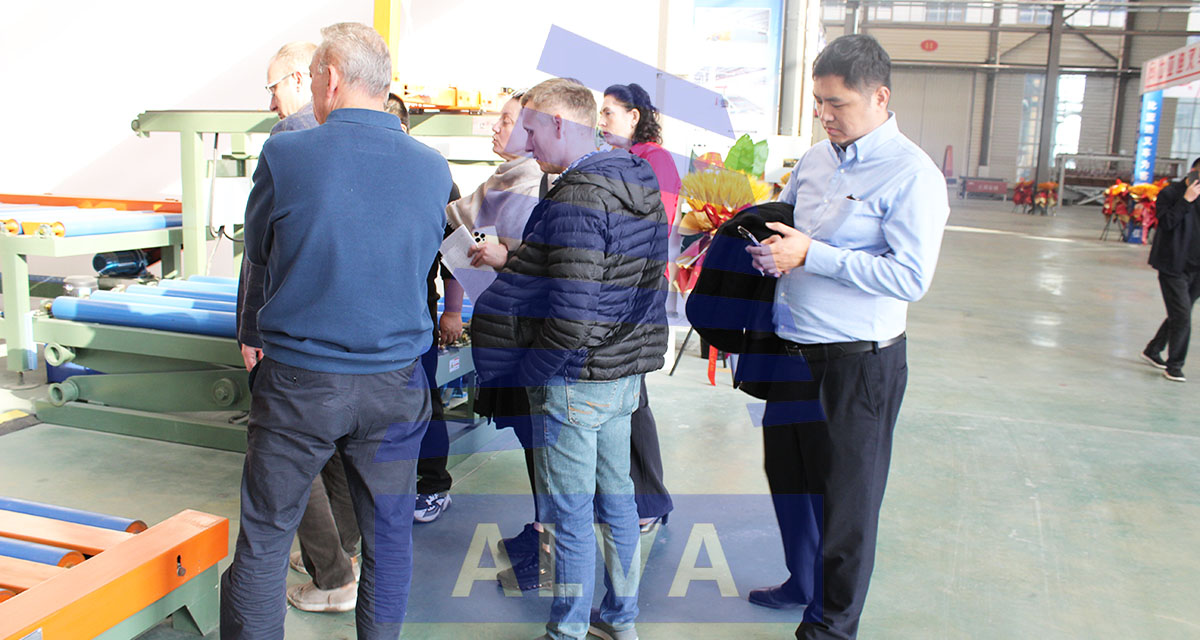
Recently, customers from Central Asia visited Shandong ALVA Machinery Group for an on-site inspection and business exchange, focusing on woodworking machinery and veneer peeling production lines. Representatives from ALVA's management, sales, and technical departments welcomed the visitors and introduced the company's development, manufacturing operations, woodworking machinery product range, and veneer peeling production solutions.
During the visit, the customers were accompanied through the production workshops to learn about the manufacturing process, equipment structures, and overall configuration of the veneer peeling production line.
The visit represents another practical opportunity for ALVA Machinery to strengthen communication with customers in the Central Asian market. With the continued development of the global wood processing industry, demand for woodworking machinery is becoming increasingly diversified across different countries and regions. Wood resource utilization, veneer processing, plywood manufacturing, and production automation have become important areas of interest for woodworking enterprises.
For machinery manufacturers, understanding the production environments, processing practices, and actual requirements of different markets is essential to developing international business and improving product and service capabilities.
Central Asia has an established wood processing industry in certain markets. Countries in the region differ in terms of raw material availability, processing capacity, product structure, and equipment operating conditions. As local woodworking enterprises place greater emphasis on production efficiency, product quality, and equipment reliability, machinery suitable for different production requirements has become increasingly important.
During this visit, the customers showed particular interest in the overall configuration of ALVA's veneer peeling production line, the coordination between individual processing stages, equipment operating principles, and practical applications.
ALVA's team introduced the relevant machinery and explained the production process based on the equipment displayed in the workshop. Technical discussions were also conducted to address the customers' questions.
Through face-to-face communication and on-site inspection, both parties gained a better understanding of each other's business requirements and product interests, creating opportunities for further discussions on equipment configuration, technical solutions, and potential cooperation.
2. Visiting ALVA's Production Workshop to Understand Its Manufacturing Operations
For woodworking machinery buyers, equipment selection is closely related to production planning, equipment maintenance, and long-term manufacturing operations. Therefore, understanding a manufacturer's production environment, machining processes, assembly procedures, and quality management practices is an important part of supplier evaluation.
Accompanied by ALVA's representatives, the Central Asian customers visited the company's production workshops to learn about the manufacturing of woodworking machinery.
The team introduced the main stages involved in equipment manufacturing, including component machining, mechanical structure fabrication, complete machine assembly, equipment commissioning, and pre-delivery inspection. This enabled the customers to gain a clearer understanding of the processes involved in manufacturing woodworking machinery, from individual components to complete equipment.
Woodworking machinery integrates mechanical structures, transmission systems, electrical control systems, and processing technologies. The performance of a machine depends not only on the quality of individual components but also on structural design, machining accuracy, assembly procedures, and coordination between different systems.
Different machines have different structural characteristics and manufacturing requirements. For log peeling equipment, the machine frame, transmission system, feeding mechanism, knife installation, and control system must be designed and manufactured according to the specific operating requirements.
The coordination between these components directly affects equipment operation and veneer processing results.
During the workshop tour, customers observed the manufacturing and assembly conditions of the equipment and learned about ALVA's production organization and manufacturing procedures.
ALVA's representatives also introduced the mechanical structures and operating principles of different machines according to the customers' interests. Questions concerning equipment selection, production line layout, and practical applications were discussed with reference to the company's products.
The production workshop is not only a place where machinery is manufactured but also an important window through which customers can understand a manufacturer's capabilities.
By visiting the actual production environment, customers can compare the information provided in product documentation with the equipment and manufacturing processes on site, allowing them to evaluate the machinery more comprehensively.
ALVA Machinery continues to emphasize the relationship between manufacturing processes and customer requirements. Through ongoing improvements in production management, equipment manufacturing, and assembly and commissioning procedures, the company aims to provide woodworking machinery that meets the practical requirements of customers in different markets.
3. Focusing on the Veneer Peeling Production Line and Understanding the Complete Processing Workflow
The main focus of this visit was ALVA's veneer peeling production line.
Veneer peeling is an important process in plywood manufacturing. It involves processing prepared logs into continuous sheets of veneer with the required thickness and dimensions.
The quality of rotary-cut veneer affects subsequent processes such as drying, grading, gluing, lay-up, and hot pressing. Therefore, the mechanical structure, cutting performance, operating stability, and coordination of the veneer peeling equipment are important considerations in production line design.
During the workshop tour, ALVA's technical team introduced the main equipment components and processing workflow of the veneer peeling production line. The customers were shown how logs move through the production process, from initial feeding and preparation to rotary peeling, veneer cutting, sorting, and stacking.
A complete veneer peeling production line is not simply a single rotary peeling machine. It consists of multiple machines configured according to log specifications, processing requirements, factory layout, and subsequent production processes.
Different machines perform specific tasks. Through coordinated feeding, positioning, cutting, peeling, conveying, and stacking operations, the production line forms an integrated processing workflow.
Depending on the actual configuration, a veneer peeling production line may include a log storage platform, log saw, log loading machine, log rounding machine, veneer peeling machine, veneer clipper, and veneer stacking machine.
These machines work together to complete log preparation and veneer production.
Log Storage Platform: Providing an Organized Raw Material Supply
The log storage platform is an important part of the front end of a veneer peeling production line. It is mainly used for temporary log storage, arrangement, and material supply, providing an organized connection to subsequent processing equipment.
In actual production, logs may differ in length, diameter, shape, and stacking condition. Without an appropriate material handling arrangement, the process of feeding logs into the production line may affect production continuity.
A log storage platform helps organize the supply of raw materials and ensures that logs can be transferred to subsequent processing stages in an orderly manner.
Its configuration should be determined according to the log supply method, workshop layout, and overall production requirements.
For enterprises planning to establish a continuous veneer peeling production line, an organized raw material supply system is an important foundation for production efficiency.
Log Saw: Preparing Logs for Subsequent Processing
The log saw is used for log cutting, length adjustment, or other preliminary processing operations. Its specific function depends on the production line configuration and the customer's raw material requirements.
Before entering the peeling process, logs may need to be prepared according to the operating requirements of the equipment. Log length, end conditions, and overall dimensions can affect subsequent feeding, rounding, and peeling operations.
Proper configuration of the log saw helps coordinate preliminary log processing with subsequent production stages and improves the organization of the entire workflow.
During the visit, ALVA's representatives introduced the structure and function of the log saw and explained its relationship with the subsequent peeling process.
Log Loading Machine: Improving Log Feeding and Material Handling
The log loading machine connects the preliminary processing section with subsequent equipment. Its main function is to transfer logs to the designated processing position.
Traditional manual handling requires considerable coordination between operators and increases the workload involved in moving logs between different processing stages.
By installing suitable mechanical loading equipment, logs can be conveyed, lifted, and supplied according to the production line layout, helping improve the connection between different operations.
Different types of log loading machines have different structural characteristics and applications. Automatic log loaders, step-type log loaders, and semi-automatic loading systems can be selected according to raw material conditions, equipment layout, and automation requirements.
During production line planning, the log loading machine must be properly coordinated with the storage platform, log saw, and log rounding machine to ensure that logs enter the next processing stage smoothly.
Log Rounding Machine: Preparing Logs for Veneer Peeling
The log rounding machine is an important preliminary processing machine in a veneer peeling production line.
Naturally grown logs do not always have regular shapes. They may contain bark, curved sections, irregular ends, and uneven outer surfaces. If logs enter the peeling process without appropriate preparation, these conditions may affect processing stability and veneer quality.
The main function of the log rounding machine is to process the outer surface of logs into a cylindrical shape suitable for subsequent veneer peeling.
During this process, the feeding mechanism, cutting tools, operating stability, and log positioning system all play important roles.
Proper rounding provides suitable raw material conditions for the veneer peeling machine and helps improve the coordination of the production process.
ALVA's representatives introduced the operating principles, machine structure, and practical applications of the log rounding machine. They also explained the relationship between log rounding and veneer peeling.
Through on-site observation, the customers gained a clearer understanding of how irregular logs are processed into cylindrical logs suitable for veneer production.
Veneer Peeling Machine: The Core Equipment of the Production Line
The veneer peeling machine is the core equipment in a veneer peeling production line. It processes logs into continuous sheets of veneer through the relative movement between the rotating log and the peeling knife.
The peeling process involves log clamping, spindle or roller transmission, knife installation, feeding control, and coordination between different mechanical structures.
The operating condition of the machine and the condition of the peeling knife directly influence the processing results.
During rotary peeling, the log rotates while the peeling knife cuts the wood surface under controlled processing conditions. As the log continues to rotate, the wood is continuously peeled away to form veneer sheets.
Veneer quality is generally evaluated from several aspects, including thickness consistency, surface smoothness, continuity, and the presence of cracks or damage.
Different wood species, moisture content, log diameter, and internal wood structure can all affect the peeling results.
Therefore, equipment configuration and production operation must take into account raw material conditions, knife selection, processing parameters, and equipment maintenance.
During this visit, the customers paid particular attention to the mechanical structure, operating principles, and position of ALVA's veneer peeling machine within the complete production line.
ALVA's technical team explained the equipment's operating process, coordination between different components, knife adjustment, and processing requirements.
These discussions provided the customers with a better understanding of how the veneer peeling machine works and its role in the production process.
Veneer Clipper and Conveying System: Cutting and Transferring Veneer
After rotary peeling, continuous veneer needs to be cut, organized, and conveyed according to subsequent processing requirements.
The veneer clipper is mainly used to cut continuous veneer into the required dimensions, preparing the material for subsequent sorting, drying, and other processing operations.
During actual production, the clipper must coordinate with the operating condition of the veneer peeling machine.
The cutting process involves veneer conveying, length control, knife operation, and coordination with the control system.
After cutting, the veneer is transferred to the next processing stage through the corresponding conveying equipment.
An appropriate conveying and handling system helps reduce manual material handling and makes the production workflow more organized.
Veneer Stacking Machine: Improving Veneer Arrangement and Stacking
The veneer stacking machine is used to organize and stack processed veneer sheets.
After peeling and cutting, veneer needs to be collected and arranged according to production requirements before entering subsequent processes such as drying, grading, or further processing.
Through its conveying and stacking mechanisms, the stacking machine helps reduce repetitive manual handling.
Different stacking systems can be configured according to the production line layout and veneer specifications, allowing the equipment to connect with the preceding peeling and cutting processes.
For manufacturers looking to improve material handling and production organization, the stacking stage is also an important part of production line planning.
Through the introduction of these machines, the Central Asian customers gained a systematic understanding of the complete veneer peeling workflow, from log feeding and preliminary processing to rotary peeling, veneer cutting, and stacking.
4. From Individual Machines to Complete Production Lines: Focusing on Overall Configuration and Coordination
In the wood processing industry, individual machines perform specific processing tasks. However, for enterprises operating continuous production processes, coordination between different machines is equally important.
Establishing a veneer peeling production line requires comprehensive consideration of raw material conditions, production objectives, factory layout, equipment configuration, labor arrangements, and subsequent processing requirements.
First, log characteristics are an important basis for production line configuration.
Wood species, diameter, length, hardness, moisture content, and external shape may vary across different regions. These factors can affect log feeding, rounding, peeling, and veneer handling.
If the equipment configuration does not match the actual raw material conditions, problems such as unsuitable equipment selection or inefficient connections between processing stages may occur.
Therefore, the types and specifications of logs used by the customer should be understood during the initial production line planning stage.
Second, production capacity and product requirements determine the equipment configuration.
Different customers have different requirements for veneer products. Some place greater emphasis on veneer thickness and surface quality, while others focus on continuous production, raw material utilization, and automation.
The equipment configuration should be based on the customer's product types, production plans, and investment arrangements. Simply increasing the number of machines does not necessarily improve the overall production process.
Third, factory conditions and equipment layout are important considerations.
A veneer peeling production line involves raw material storage, machine installation, log conveying, veneer transfer, and subsequent processing areas.
Sufficient working space must be reserved between machines. Material transportation routes, operator access, and equipment maintenance areas should also be considered.
If the factory layout does not match the production line configuration, the overall production process may be affected even when individual machines have suitable processing capabilities.
Therefore, production line planning should be based on the customer's actual site conditions.
In addition, the operating rhythm of different machines must be coordinated.
Log loading, sawing, rounding, peeling, cutting, and stacking are connected stages. If the processing capacity of one stage does not match the others, material accumulation, equipment waiting time, or insufficient material supply may occur.
For this reason, production line design should consider not only the performance of individual machines but also equipment compatibility, conveying methods, and control logic.
During the visit, ALVA's representatives discussed these considerations with the customers, providing further insight into the configuration principles of a complete veneer peeling production line.
5. Focusing on Veneer Quality and Discussing Peeling Technology and Equipment Applications
Veneer peeling is a processing stage that requires careful coordination between machinery and operating techniques.
Equipment structure determines the basic processing method, while raw material conditions, knife performance, and operating practices jointly influence the final processing results.
During the technical discussions, the customers showed interest in veneer quality and the operating requirements of the peeling equipment.
Veneer thickness is one of the important processing indicators in rotary peeling. Thickness variations may affect subsequent plywood lay-up and hot pressing. Therefore, the machine must provide appropriate adjustment and control functions.
The peeling knife is another important factor affecting veneer quality.
The condition of the cutting edge, installation position, knife angle, and wear during operation can all influence the cutting process.
If the knife becomes worn or damaged, it may lead to poor veneer surface quality, thickness variations, or interruptions during processing.
For this reason, regular inspection, sharpening, and replacement of peeling knives are necessary parts of production management.
Wood characteristics also affect peeling performance.
Different wood species have different structural and physical properties. Log moisture content, internal defects, and external conditions may also vary.
For different types of wood, equipment settings and processing conditions should be adjusted according to actual production requirements.
In addition, routine equipment maintenance is important for maintaining long-term operating conditions.
During continuous operation, mechanical transmission components, bearings, guide mechanisms, knife mounting structures, and electrical control systems all require regular inspection.
Identifying and addressing abnormal conditions in a timely manner can help reduce the impact of equipment failures on production.
ALVA's technical team introduced these considerations based on the equipment displayed in the workshop, explaining the basic requirements for machine operation, knife maintenance, and routine inspection.
Through these discussions, the customers gained a better understanding of the fact that veneer peeling requires coordination between machinery, raw materials, and operating techniques.
6. From Veneer Processing to Plywood Manufacturing: Understanding the Application of Veneer Peeling Equipment
Veneer peeling production lines are an important part of plywood manufacturing.
The veneer produced by rotary peeling machines can be processed through subsequent operations such as sorting, drying, grading, gluing, lay-up, pre-pressing, hot pressing, trimming, and sanding to manufacture plywood products for different applications.
Therefore, veneer peeling equipment is not only related to the initial wood processing stage but is also closely connected with the production organization of downstream plywood manufacturing.
In actual production, factors such as veneer thickness, surface condition, and moisture content can influence subsequent processing.
Maintaining appropriate processing quality during the peeling stage helps support the smooth operation of drying, gluing, and lay-up processes.
For customers planning to establish plywood manufacturing projects, the selection of veneer peeling equipment should be based on the final product types and manufacturing requirements.
For example, manufacturers producing construction plywood, furniture boards, packaging plywood, or other panel products may have different requirements regarding veneer specifications, raw material utilization, and subsequent production processes.
Machinery manufacturers need to understand the intended applications of the customer's final products and provide suitable equipment configuration recommendations based on the complete manufacturing process.
Equipment selection should not be based solely on the basic specifications of an individual veneer peeling machine.
ALVA Machinery Group focuses on wood processing and plywood manufacturing equipment, with products covering log processing, veneer peeling, veneer handling, and plywood production.
Through the appropriate combination of different machines, ALVA can provide equipment configuration solutions according to specific project requirements.
The Central Asian customers' visit to the veneer peeling production line also provided an opportunity to discuss the relationship between veneer processing equipment and subsequent plywood manufacturing operations.
7. Understanding the Central Asian Market and Its Wood Processing Requirements
Central Asia is an important market direction for ALVA's international business development and customer communication.
Wood processing industries in different countries and regions vary in terms of raw material sources, product demand, production conditions, and equipment operating practices.
For Chinese woodworking machinery manufacturers, entering overseas markets requires not only manufacturing capabilities but also a thorough understanding of local customers' actual production requirements.
During this visit, the Central Asian customers focused on the practical applications and overall configuration of veneer peeling equipment.
Their interests also reflect the importance that overseas woodworking enterprises place on matching machinery with their actual production conditions.
For equipment buyers, purchasing machinery is not simply a product transaction. It also involves installation, commissioning, operator training, equipment maintenance, and production management.
For complete production line projects, equipment delivery is followed by on-site installation, mechanical and electrical connections, system commissioning, and relevant operating training.
The compatibility between individual machines and the overall operating condition of the production line must be carefully considered throughout project implementation.
Therefore, machinery manufacturers need to understand customers' factory conditions, log types, processing requirements, product plans, and project objectives from the initial communication stage.
Based on this information, appropriate equipment selection and production line planning can be discussed to better match local production environments.
In developing its international business, ALVA Machinery Group places importance on direct communication with overseas customers.
Through customer visits, on-site inspections, online discussions, and project follow-up, the company works to understand the actual requirements of wood processing enterprises in different markets and provide corresponding product information and technical communication.
The visit from Central Asian customers provided another opportunity for ALVA to learn more about the local wood processing market and discuss specific equipment requirements.
8. Developing Equipment Solutions Based on Customers' Actual Production Requirements
For woodworking machinery projects, customer requirements are the foundation of equipment solution development.
During the initial communication stage, ALVA generally needs to understand the customer's wood species, log specifications, target products, factory conditions, production organization, and automation requirements.
This information helps technical personnel determine the appropriate equipment configuration and arrange the main processing stages of the production line.
For a veneer peeling production line, different customers may use different log preparation methods and may select different types of loading machines, rounding machines, and peeling machines according to their production conditions.
Some customers plan to establish a relatively complete automated production line to reduce manual handling and waiting time between processing stages.
Others may wish to upgrade existing machinery and gradually improve their original production processes.
Different situations require different equipment solutions.
During solution discussions, it is important to consider more than machine names and basic specifications.
The processing range, installation conditions, equipment compatibility, and connections with existing machinery must also be clarified.
For customers planning to establish a new factory or production line, considerations include raw material storage areas, equipment installation areas, finished product handling areas, and the layout of subsequent processing sections.
For customers with existing production facilities, the current equipment and workshop layout should be carefully evaluated to avoid unsuitable connections between new and existing machinery.
During this visit, ALVA's representatives introduced the relevant equipment and production processes through on-site explanations and face-to-face discussions.
The customers also had the opportunity to raise specific questions regarding equipment structures, operating procedures, and configuration methods based on their own production requirements.
This customer-oriented communication approach helps reduce information gaps during equipment purchasing and makes subsequent project discussions more specific and practical.
9. Focusing on International Customer Service and Supporting Equipment Delivery and After-Sales Requirements
For overseas customers, purchasing equipment is only the beginning of a project. Successful installation, commissioning, and production operation are equally important.
For complete veneer peeling production lines involving multiple machines, equipment transportation, on-site installation, mechanical adjustment, electrical connections, and overall commissioning need to be properly arranged.
Before equipment delivery, manufacturing, assembly inspections, and related preparation work should be completed according to the project configuration.
For production lines consisting of multiple machines, attention should be given to the connection relationships, installation positions, and operating directions of the different equipment units.
After the machinery arrives at the customer's factory, installation should be carried out according to the production line layout and actual site conditions.
The foundation positions, leveling conditions, mechanical connections, and conveying directions of the equipment need to be checked in accordance with the relevant requirements.
Electrical installation and control system commissioning are also important parts of production line implementation.
Operating signals, control logic, and safety protection functions between different machines need to be inspected and confirmed according to the actual configuration.
After installation is completed, the production line needs to undergo appropriate commissioning based on the customer's raw materials and processing requirements to ensure that the machines operate in coordination with the planned workflow.
Operator training is another important step before production begins.
Customers need to understand basic operating procedures, routine inspection requirements, common troubleshooting methods, and necessary maintenance practices.
For overseas projects, language communication, technical documentation, on-site service arrangements, and spare parts supply may also affect project implementation.
ALVA Machinery Group pays attention to the practical requirements of overseas customers throughout equipment purchasing and operation.
The company provides support in equipment selection, solution discussions, manufacturing and delivery arrangements, and technical services.
By clarifying project requirements, strengthening early-stage communication, and improving delivery preparations, ALVA aims to help customers move forward with equipment installation and subsequent production.
This visit also provided an opportunity for both parties to gain a better understanding of their requirements regarding equipment purchasing, project implementation, and after-sales support.
10. Strengthening Understanding Through On-Site Visits and Promoting Cooperation Through Professional Communication
Compared with online product introductions, on-site visits allow customers to gain a more direct understanding of a machinery manufacturer's production operations.
By visiting the production workshop, customers can observe actual equipment structures and manufacturing conditions.
Through explanations from technical personnel, they can learn more about machine operating principles and production processes.
Face-to-face technical discussions also allow customers to evaluate equipment configurations and project implementation in greater detail based on their own production requirements.
For ALVA, customer visits are not only opportunities to introduce products and manufacturing processes but also important opportunities to understand overseas market demand, collect customer feedback, and improve product and service capabilities.
During the discussions with the Central Asian customers, both parties exchanged information regarding the equipment composition, processing workflow, and practical applications of the veneer peeling production line.
Through the on-site inspection, the customers gained a better understanding of ALVA's woodworking machinery products and manufacturing operations.
At the same time, the questions raised by the customers provided useful references for ALVA to further understand the production conditions and equipment purchasing priorities of wood processing enterprises in Central Asia.
International business development requires a clear understanding of customer requirements.
Customers in different regions may have different equipment selection priorities, production capacities, product structures, and investment plans.
Machinery manufacturers need to provide relevant product information and technical support according to actual project conditions.
ALVA continues to value communication with overseas customers. Through actual production environments, equipment demonstrations, and professional technical discussions, the company aims to provide customers with a comprehensive understanding of its products.
The visit from Central Asian customers, focusing on ALVA's veneer peeling production line and related technical discussions, further strengthened both parties' understanding of each other's business activities and product requirements.
In the future, ALVA Machinery Group will continue to focus on product development, manufacturing, and market services in the woodworking machinery industry.
The company will continue to pay attention to equipment applications in log processing, veneer peeling, and plywood manufacturing while improving product compatibility and project service capabilities.
ALVA looks forward to welcoming more customers from different countries and regions for business exchanges, on-site visits, and technical discussions, creating opportunities for closer cooperation and exploring the development and application of wood processing machinery together.
11. Building on Machinery Manufacturing and Continuously Expanding International Markets
Shandong ALVA Machinery Group is committed to machinery manufacturing, with a focus on wood processing and related production technologies.
The company aims to provide woodworking machinery and supporting production solutions for customers in domestic and international markets.
In the woodworking machinery sector, ALVA's product range covers log processing, veneer peeling, veneer handling, and plywood manufacturing equipment.
Through the combination and integration of different machines, the company can develop equipment configurations for log processing and veneer production according to specific customer requirements.
For wood processing enterprises, machinery selection needs to take into account processing requirements, equipment performance, factory conditions, and subsequent maintenance.
ALVA will continue to focus on manufacturing processes and the relationship between equipment structures, processing technologies, and practical applications, providing equipment configuration recommendations that better meet customers' production requirements.
At the same time, the company will continue to strengthen communication with international customers through overseas visits, production workshop inspections, online business discussions, and project follow-up.
Every customer visit provides an opportunity for both parties to develop a better understanding of each other's business and establish closer communication.
By presenting actual manufacturing environments and equipment production conditions, ALVA enables customers to gain a clearer understanding of its machinery and helps both parties establish more specific directions for future project discussions.
The recent visit from Central Asian customers to Shandong ALVA Machinery Group, with a focus on the veneer peeling production line and technical exchange, further strengthened communication and understanding between both parties.
Looking ahead, Shandong ALVA Machinery Group will continue to follow a customer-oriented approach, build on its machinery manufacturing capabilities, and support international customers through technical communication and project services.
The company will continue expanding its presence in the global woodworking machinery market and providing equipment selection and production line configuration support for wood processing enterprises in different regions.
Shandong ALVA Machinery Group will continue to focus on machinery manufacturing, prioritize customer requirements, and actively participate in international woodworking machinery market development, providing equipment and services to support the global wood processing industry.

 English
 العربية
 Français
 Русский
 Español
 Português
 Deutsch
 italiano
 日本語
 한국어
 Nederlands
 Tiếng Việt
 ไทย
 Polski
 Türkçe
 አማርኛ
 ພາສາລາວ
 ភាសាខ្មែរ
 Bahasa Melayu
 ဗမာစာ
 தமிழ்
 Filipino
 Bahasa Indonesia
 magyar
 Română
 Čeština
 Монгол
 қазақ
 Српски
 हिन्दी
 فارسی
 Kiswahili
 Slovenčina
 Slovenščina
 Norsk
 Svenska
 українська
 Ελληνικά
 Suomi
 Հայերեն
 עברית
 Latine
 Dansk
 اردو
 Shqip
 বাংলা
 Afrikaans
 Māori
 অসমীয়া
 Беларуская мова
 Català


