In wood processing, knife condition directly affects machine operation, processing consistency, and the quality of finished products. For continuous wood-processing equipment such as log rounding machines and rotary peeling machines, knives need to maintain a stable cutting condition throughout extended operation. When a knife becomes worn, dull, or uneven along its cutting edge, the processing performance of the machine may change accordingly.
For this reason, a knife grinding machine is not simply a tool for sharpening knives. It is also an important supporting machine for maintaining the operating condition of wood-processing equipment.
Shandong ALVA Machinery Group has developed the 4.5-meter Knife Grinding Machine for the maintenance and precision grinding of long woodworking knives. The machine is designed to support 4.5-meter log rounding machines and rotary peeling machines, providing a dedicated solution for knife grinding and maintenance.
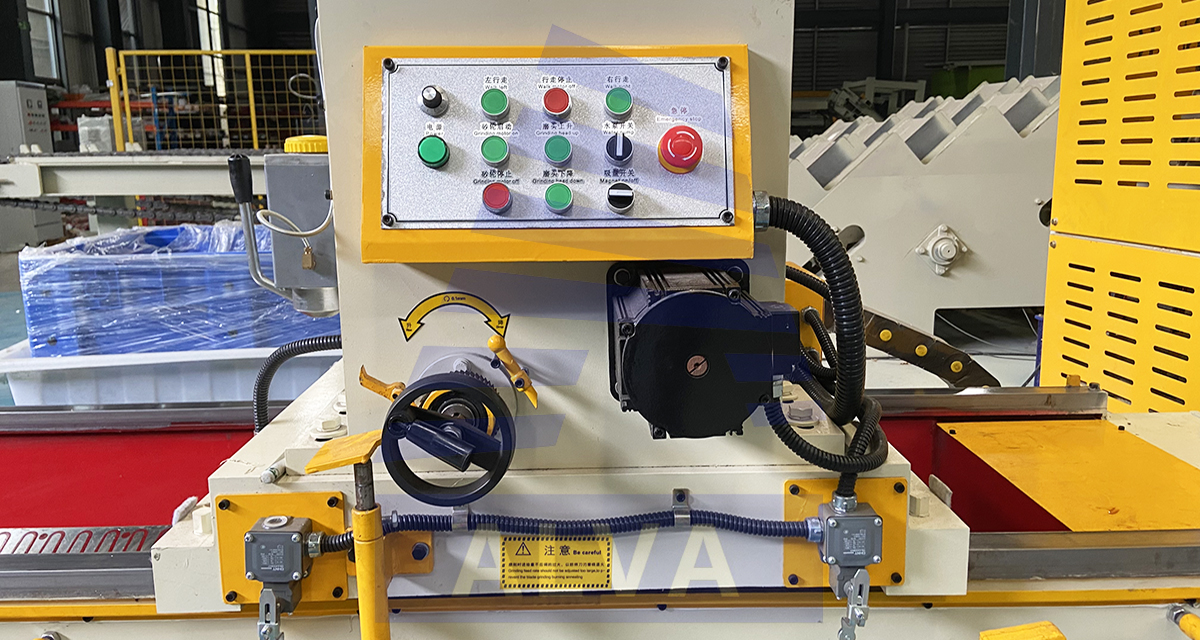
The machine adopts a long-bed configuration, with the working area arranged along the length of the knife. The grinding assembly is installed on a traveling mechanism and moves along the knife during the grinding process. The machine is equipped with a knife clamping structure, adjustment mechanism, operating handwheel, limit devices, control panel, emergency stop system, and other components.
The design focuses on stable knife positioning, controlled grinding movement, and convenient operation.
For wood-processing applications, the purpose of the ALVA 4.5-meter Knife Grinding Machine is not simply to make a knife sharp. Its main purpose is to provide a controlled and repeatable grinding process so that the knife edge can be maintained properly and the corresponding rounding or peeling machine can continue to operate under appropriate knife conditions.
1.Application of the 4.5-Meter Knife Grinding Machine
Wood-processing machines often use knives with relatively long working lengths. During continuous production, knife edges gradually wear due to contact with wood, knots, impurities, and repeated cutting.
Knife wear may occur across different sections of the cutting edge at different rates. Therefore, when a long knife is reground, the grinding process needs to cover the working length while maintaining a stable relationship between the grinding wheel and the knife.
Manual grinding of long knives can be affected by operator experience, grinding pressure, tool condition, and operating consistency. For long knives, maintaining a consistent grinding path can be difficult when using manual methods.
The ALVA 4.5-meter Knife Grinding Machine is designed specifically for this type of application.
The machine provides a long working platform for knife installation and support. After the knife is properly positioned and clamped, the grinding assembly travels along the knife and performs continuous grinding.
The machine can be used by woodworking companies, veneer production facilities, plywood manufacturers, log processing companies, and other users who require maintenance of long woodworking knives.
For users operating 4.5-meter log rounding machines, the grinder can be used as a supporting machine for knife maintenance.
For rotary peeling machine users, the machine can also be integrated into the knife maintenance process. Depending on the knife specification and machine configuration, users can select the appropriate grinding solution.
2. Why a 4.5-Meter Log Rounding Machine Needs a Supporting Knife Grinder
A log rounding machine uses knives to process the outer surface of logs. During operation, the knives continuously interact with the wood.
As operating time increases, the cutting edge gradually becomes worn. Continued use of a heavily worn knife may affect the cutting condition and increase the load on the machine.
For a 4.5-meter log rounding machine, the knife has a long working length. When different areas of the knife show different levels of wear, the entire cutting edge needs to be properly maintained during regrinding.
The ALVA 4.5-meter Knife Grinding Machine uses a long working platform to provide continuous support for long knives.
After the knife is installed, the clamping and positioning system keeps it in a stable position. The grinding head then travels along the working area and performs the grinding operation.
This operating method is suitable for the maintenance requirements of long knives.
The purpose of the grinding machine is not to change the processing method of the log rounding machine. Instead, it provides the machine with a dedicated knife maintenance solution.
Through a standardized process involving knife removal, cleaning, clamping, grinding, inspection, and reinstallation, knife maintenance can become part of the regular equipment management process.
For wood-processing companies, a standardized knife maintenance process can help reduce production variations caused by changes in knife condition.
3. Supporting Relationship Between the 4.5-Meter Grinder and Rotary Peeling Machines
Rotary peeling machines are important equipment in veneer production.
During rotary peeling, logs are continuously fed into the processing area while the knife maintains a cutting relationship with the rotating log. Knife installation, knife edge condition, and cutting angle all affect the peeling process.
During continuous production, rotary peeling knives eventually require maintenance and regrinding.
The ALVA 4.5-meter Knife Grinding Machine provides a dedicated platform for maintaining these knives.
After the knife is removed from the rotary peeling machine, it can be cleaned, inspected, and installed on the grinder. The clamping and positioning system keeps the knife in place during grinding.
The grinding head then travels along the knife length to perform continuous grinding.
This approach allows knife maintenance to become part of the overall production equipment management system rather than an occasional external service.
For companies engaged in continuous veneer production, the combination of rotary peeling equipment and a dedicated knife grinder can help establish a more complete production and maintenance workflow.
4. Overall Machine Structure
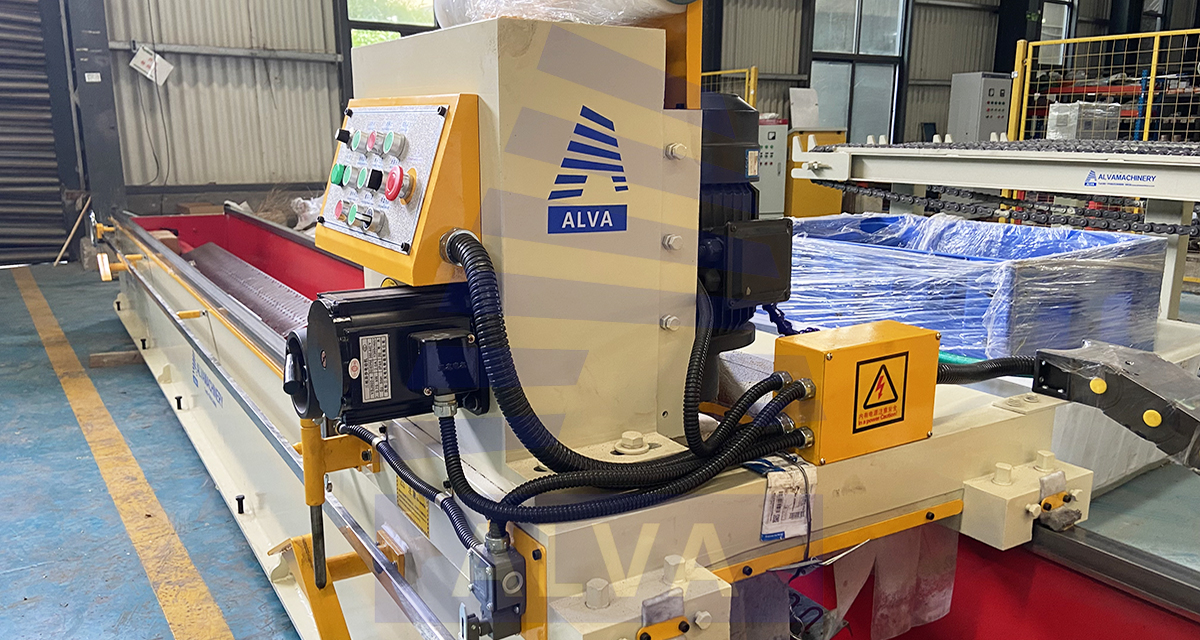
The ALVA 4.5-meter Knife Grinding Machine adopts a long-bed structure. The working platform extends along the length of the machine and provides a support surface for long knives.
The grinding assembly is positioned above the working area and travels along the machine through the traveling mechanism.
The main components include the machine bed, working platform, knife clamping system, grinding assembly, traveling mechanism, mechanical adjustment system, electrical control system, limit devices, and safety components.
The long machine bed provides a stable foundation for knife installation.
After the knife is placed on the working platform, the clamping system secures the knife in position. The working platform and supporting structures provide the necessary positioning and support.
The front section of the machine is equipped with operating components that allow the operator to make adjustments according to the actual knife condition.
The control panel is positioned at the front of the machine, allowing the operator to observe the equipment and operate the main functions from a centralized position.
The control panel includes operating buttons, switches, direction controls, emergency stop controls, and other operating components.
The machine also includes mechanical and electrical limit devices to control the operating range of the traveling mechanism.
5. Grinding Assembly
The grinding assembly is the main working component of the knife grinding machine.
The ALVA 4.5-meter Knife Grinding Machine uses a traveling grinding head. The grinding head is installed on the traveling mechanism, while the knife remains fixed on the working platform.
During operation, the grinding head travels along the knife and performs the grinding process.
Compared with manual grinding, a mechanical traveling structure can reduce the influence of manual movement on the grinding path.
For long knives, maintaining a continuous grinding process is important. If different sections of the knife receive significantly different grinding treatment, the final edge condition may vary along the knife.
The traveling mechanism therefore needs to maintain stable movement.
The machine uses a mechanical transmission system to control the movement of the grinding head and maintain the required grinding path.
During actual operation, the operator can adjust the grinding conditions according to the knife condition.
Different knife materials, wear conditions, and maintenance requirements may require different grinding methods. Therefore, actual grinding parameters should be selected according to the knife and production requirements.
6. Knife Clamping and Positioning
Knife clamping is one of the basic requirements of long-knife grinding.
If a long knife is not securely fixed, vibration or movement may occur during grinding. Any change in knife position can change the relative position between the grinding wheel and cutting edge and may affect the grinding result.
The ALVA 4.5-meter Knife Grinding Machine is equipped with a mechanical clamping system on the working platform.
Before installing a knife, the operator should clean the working platform and knife surface and remove wood chips, dust, and other foreign materials.
After the knife is installed, the operator should check the contact between the knife and working platform and confirm that the clamping system is properly secured.
The knife installation condition should be checked before starting the grinding operation.
Although this procedure is straightforward, it is important for long-knife grinding.
The machine provides the mechanical grinding conditions, but the final result is also affected by knife installation, knife condition, grinding method, and operating procedures.
Therefore, ALVA Machinery recommends that users establish standardized knife installation and inspection procedures before putting the machine into production.
7. Electrical Control System
The ALVA 4.5-meter Knife Grinding Machine uses a centralized electrical control system.
The control panel is installed at the front of the machine so that the operator can directly observe and control the equipment.
The control panel includes operating buttons, stop controls, direction controls, function switches, and an emergency stop button.
Different operating elements correspond to different machine functions.
Centralized control reduces unnecessary movement between different areas of the machine and allows the operator to monitor the grinding process more easily.
The emergency stop device allows the machine to be stopped quickly when an abnormal condition occurs.
Because woodworking machinery contains moving components, operators must maintain an appropriate safety distance during operation.
The operator should never touch the grinding head, knife, or other moving components while the machine is running.
The electrical control system is responsible for machine movement and operation control. Operators should always follow the machine operation manual and established safety procedures.
8. Mechanical Adjustment System
The machine is equipped with a handwheel and mechanical adjustment structure at the front.
The handwheel is used to adjust relevant mechanical positions according to the knife installation condition and grinding requirements.
The mechanical adjustment system allows the machine to accommodate different knife installation conditions.
Adjustments should be carried out according to the operating procedures. Unnecessary mechanical adjustments should not be performed while the machine is running.
For long-knife grinding, the adjustment mechanism must work together with the knife clamping system.
If the knife position has not been confirmed, grinding should not be started.
ALVA Machinery recommends checking the knife position after every knife change and completing the required adjustment procedure before grinding.
9. Application for 4.5-Meter Log Rounding Machine Knives
One of the main applications of the 4.5-meter Knife Grinding Machine is knife maintenance for 4.5-meter log rounding machines.
Log rounding machines perform outer-surface processing on logs. As the knives are used continuously, their cutting edges gradually change.
For companies engaged in continuous production, knife maintenance needs to be coordinated with the production schedule.
With a dedicated knife grinder, companies can carry out corresponding knife maintenance within their own production facility.
When a log rounding machine knife reaches the required maintenance condition, it can be removed and transferred to the grinder.
After cleaning, clamping, grinding, and inspection, the knife can be returned to service after confirming that its condition meets the operating requirements.
This process allows knife maintenance to become a regular part of log rounding machine management.
The relationship between the grinder and log rounding machine is therefore not simply that of two independent machines. The grinder serves as a supporting maintenance machine for the production equipment.
10. Application for Rotary Peeling Machine Knives
Rotary peeling knives are key working components in veneer production.
During rotary peeling, the knife continuously participates in the cutting process. Wood has natural variations in density, structure, knots, moisture condition, and other characteristics, which can affect knife wear.
After continuous use, the knife needs to be maintained according to its actual condition.
The ALVA 4.5-meter Knife Grinding Machine can be used as a dedicated maintenance machine for rotary peeling knives.
Production companies can establish a spare-knife management system.
When the production knife requires maintenance, it can be replaced with a prepared knife. The removed knife can then enter the grinding process.
After grinding and inspection, the knife can be placed back into the spare-knife system and prepared for future production.
This method helps separate knife maintenance from the main production process.
For veneer production companies, this equipment configuration can help organize knife maintenance as an independent supporting process.
11. Relationship Between Grinding Quality and Veneer Production
The condition of the rotary peeling knife affects the cutting process.
When the cutting edge is properly maintained, the knife can work according to the required operating conditions. When the knife condition changes, the cutting process may also change.
In veneer production, companies generally pay attention to veneer surface condition, thickness consistency, production continuity, and material utilization.
Knife condition is one of the factors that can influence these production results.
For this reason, veneer producers need to establish a systematic knife management process while maintaining the main rotary peeling machine.
The role of the knife grinding machine in this system is to provide a dedicated mechanical solution for knife maintenance.
Using a dedicated grinder can reduce reliance on entirely manual grinding and provide a fixed equipment platform for long-knife maintenance.
ALVA Machinery Group continues to provide rotary peeling equipment and related woodworking machinery solutions for veneer production, with equipment configurations developed around different wood-processing requirements.
12. Requirements for Stable Long-Knife Grinding
Long-knife grinding differs from grinding shorter knives.
As knife length increases, requirements for knife clamping, support, and grinding travel also increase.
During grinding, problems with machine rigidity, traveling mechanisms, or knife fixation can affect the final result.
A long-knife grinder therefore requires a stable working platform and traveling mechanism.
The ALVA 4.5-meter Knife Grinding Machine uses an integrated long-bed structure with a working platform and traveling grinding assembly designed around long-knife grinding.
During operation, the knife remains fixed while the grinding head travels along the knife.
This configuration creates a stable working relationship between the knife and grinding head.
For users who regularly maintain long woodworking knives, this structure is suitable for production-site use.
13. Grinding and Cooling Management
Grinding generates heat.
If grinding conditions are not properly controlled, localized temperature increases may affect the condition of the knife material.
Therefore, the grinding process should be controlled according to the knife material, grinding amount, and machine operating condition.
Knife grinding should not simply be carried out by continuously increasing the grinding amount.
A suitable grinding method should be selected according to the actual condition of the knife.
For knives undergoing routine maintenance, unnecessary material removal should be minimized.
For knives with significant wear or edge damage, the grinding process should be determined according to the actual condition.
Operators should observe the grinding process and make appropriate adjustments according to machine operation.
The grinding area should also be kept clean, and grinding residue should be removed regularly.
14. Reducing Production Variation Through Knife Maintenance
Wood-processing production lines are generally designed for continuous operation.
Unstable knife conditions may result in variations in processing performance. If knife problems are not addressed in time, they may also affect production planning.
Establishing a regular knife maintenance system is therefore important.
Companies can classify knives according to their production status.
Knives currently installed on machines are production knives.
Knives that have been ground and inspected can be managed as spare knives.
Knives requiring maintenance can enter the grinding process.
Through this type of management, knife maintenance can be coordinated with production.
The 4.5-meter Knife Grinding Machine provides a dedicated maintenance platform for long knives.
Companies can establish their own procedures for knife removal, grinding, inspection, storage, and reinstallation according to their production requirements.
This approach is suitable for wood-processing companies with continuous production needs.
15. Safety Design
Safety operation is an essential part of woodworking machinery.
The ALVA 4.5-meter Knife Grinding Machine is equipped with safety warning labels, an emergency stop device, and relevant limit structures.
Before operating the machine, personnel should understand the functions of all control elements.
Before starting the machine, the operator should inspect the electrical system, mechanical connections, knife clamping condition, grinding assembly, and working area.
The machine should only be started after confirming that all relevant conditions are normal.
During operation, operators must not place their hands inside moving areas or touch rotating grinding components.
After stopping the machine, the operator should confirm that all moving components have completely stopped before cleaning, adjustment, or knife replacement.
Safe operation depends not only on machine structure but also on compliance with operating procedures.
ALVA Machinery recommends providing appropriate operator training after installation and establishing standardized operating procedures for the equipment.
16. Electrical Control Cabinet
The electrical control cabinet of the machine contains components including a frequency inverter, contactors, circuit protection devices, relays, terminal blocks, and related wiring.
Different electrical components perform different control and protection functions.
The frequency inverter can be used for corresponding motor control according to the machine's operating requirements.
Contactors control relevant electrical circuits, while protection components provide electrical protection. Terminal blocks are used for field wiring connections and maintenance.
The electrical wiring is arranged according to functional requirements to facilitate inspection and maintenance.
The electrical system works together with the mechanical system to control machine operation.
For woodworking machinery, electrical stability is as important as mechanical structure.
After installation, electrical connections, commissioning, and inspection should be completed by qualified personnel.
During operation, if the control buttons, indicators, frequency inverter, or other electrical components show abnormal behavior, the machine should be stopped and inspected.
Electrical wiring and control parameters should not be changed without professional authorization.
17. Daily Maintenance
Daily maintenance of the knife grinding machine mainly includes mechanical components, electrical components, grinding components, and the working area.
For the mechanical system, operators should regularly inspect the traveling mechanism, fasteners, handwheel, limit devices, and related transmission components.
The grinding assembly should be kept clean, and the operator should inspect it for abnormal wear.
The working platform should remain clean and free from wood chips, metal particles, and other foreign materials that may affect knife installation.
The electrical system should be checked regularly, including the control cabinet, wiring, terminal connections, and protection components.
Maintenance should be carried out according to the equipment operation manual.
Mechanical components requiring lubrication should be lubricated according to the specified maintenance requirements.
If abnormal noise, vibration, unstable movement, or electrical alarms occur, the machine should be stopped and inspected.
Continuous operation with an unresolved fault is not recommended.
18. Coordination with Wood-Processing Production Lines
Modern wood-processing companies increasingly focus on coordination between different machines.
A rotary peeling machine solves the veneer peeling process, while a knife grinder provides the corresponding knife maintenance capability.
When these machines are properly integrated, companies can establish a more complete production and maintenance system.
In a typical veneer production process, logs undergo preliminary processing before entering the rotary peeling stage. The rotary peeling machine processes logs into veneer, which can then proceed to drying, sorting, stacking, or further processing according to the production requirements.
During this process, rotary peeling knives require regular maintenance.
The knife grinding machine is therefore a supporting machine within the veneer production system.
For companies using 4.5-meter rotary peeling machines or 4.5-meter log rounding machines, selecting a matching 4.5-meter knife grinder allows the knife maintenance capability to correspond to the main machine configuration.
ALVA Machinery Group can develop supporting equipment solutions based on the customer's machine model, knife specification, factory layout, and production requirements.
19. The 4.5-Meter Knife Grinder from a Manufacturing Perspective
Although a knife grinder is a supporting machine, its manufacturing involves mechanical structure, electrical control, assembly accuracy, and equipment stability.
Long-bed equipment requires a stable overall machine structure.
The working platform needs to provide appropriate support for knife installation.
The traveling mechanism needs to maintain stable movement.
The grinding assembly needs to maintain the required working relationship with the knife.
The control system needs to coordinate the different machine functions.
These components work together to determine the actual operating condition of the equipment.
ALVA Machinery Group focuses on the relationship between machine structure and practical production requirements.
For the 4.5-meter Knife Grinding Machine, the design is not simply based on adding a grinding motor and traveling mechanism. The complete knife maintenance process is considered, including knife installation, positioning, grinding, adjustment, operation, and maintenance.
20. Suitable Customers
The ALVA 4.5-meter Knife Grinding Machine is suitable for customers who need to maintain long woodworking knives.
Potential users include:
Wood-processing companies
Veneer production facilities
Plywood manufacturers
Rotary peeling machine users
Log rounding machine users
Woodworking machinery manufacturers
Wood-processing production lines
Companies using long woodworking knives
For companies already operating 4.5-meter log rounding machines, the 4.5-meter Knife Grinding Machine can be configured according to their knife maintenance requirements.
For rotary peeling machine users, the grinder can be selected according to the rotary peeling knife specification.
For users operating equipment from other manufacturers, the machine can also be considered if the knife dimensions and working requirements are compatible.
ALVA Machinery Group evaluates the machine selection according to the customer's actual equipment and knife requirements rather than relying only on the machine name.
21. What to Consider When Selecting a Knife Grinding Machine
The first consideration is knife length.
Different woodworking machines use different knife specifications, and the working length of the grinding machine needs to match the knife.
The knife width, thickness, material, and installation method should also be confirmed.
Different knife designs may require different clamping and grinding conditions.
The main machine type should also be confirmed.
Although knives used by log rounding machines and rotary peeling machines are both woodworking knives, their installation structures and operating conditions may differ.
Therefore, when selecting a knife grinding machine, customers should provide the equipment model, knife dimensions, knife photographs, and actual application conditions.
ALVA Machinery Group can evaluate the required configuration based on this information.
This approach helps avoid selecting equipment that does not match the customer's existing knife specifications.
22. ALVA Machinery Group Equipment Services
ALVA Machinery Group provides not only individual machines but also supporting equipment solutions for wood-processing production.
For wood-processing companies, equipment performance is related to installation, commissioning, operator training, maintenance, and technical support.
For a knife grinding project, the relevant configuration should be confirmed according to the customer's knife specification before delivery.
After the machine arrives at the customer's facility, installation and commissioning should be completed according to the equipment requirements.
Operators should understand the control system, knife installation method, grinding procedure, and daily maintenance requirements before production.
After commissioning, customers can establish daily maintenance procedures according to their production conditions.
If an operating problem occurs, inspection should be carried out according to the machine troubleshooting procedure.
ALVA Machinery Group provides technical support according to project requirements and works with customers to provide suitable equipment solutions for wood-processing applications.
23. Practical Value of the 4.5-Meter Knife Grinding Machine
For wood-processing companies, the primary value of a knife grinder is its knife maintenance capability.
When a company has its own long-knife grinding machine, it can perform knife maintenance according to its own production schedule and reduce dependence on external knife maintenance services.
For continuous production, knife maintenance is closely connected with production planning.
The knife grinding machine can therefore become an important part of the company's knife management system.
For companies operating 4.5-meter log rounding machines and rotary peeling machines, the long-knife maintenance equipment needs to correspond to the main machine configuration.
The ALVA 4.5-meter Knife Grinding Machine is designed around this requirement.
The machine integrates a long working platform, knife clamping structure, traveling grinding assembly, mechanical adjustment system, and centralized electrical control system to provide a dedicated solution for long woodworking knife maintenance.
24. From “Grinding Capability” to “Stable Knife Maintenance”
The basic function of a knife grinder is to grind a knife.
However, industrial production requires more than simply being able to grind.
Companies also need to consider whether the grinding process is stable, whether knife installation is convenient, whether operation is clear, whether maintenance is practical, and whether the grinder can work effectively with existing production equipment.
For this reason, ALVA Machinery Group considers machine structure, operating method, mechanical adjustment, electrical control, and safety management as an integrated system when designing the 4.5-meter Knife Grinding Machine.
The grinder is not an isolated machine.
It supports the knife maintenance requirements of log rounding machines, rotary peeling machines, and other wood-processing equipment.
From a production management perspective, the knife grinder supports stable knife conditions.
From an equipment management perspective, it supports continuous operation of the main processing equipment.
From a factory management perspective, it can help establish a more standardized knife maintenance process.
25. Why Choose Shandong ALVA Machinery Group
Shandong ALVA Machinery Group has long focused on the development and manufacture of woodworking machinery and supporting equipment for the wood-processing industry.
The company's product range covers log processing, rotary peeling, veneer production, wood crushing, knife grinding, and other related equipment.
For wood-processing companies, equipment procurement is not limited to purchasing individual machines. Compatibility between machines and the overall production process is also important.
ALVA Machinery Group can develop equipment configurations based on the customer's existing machinery and production requirements.
The 4.5-meter Knife Grinding Machine is designed as a supporting machine for the maintenance of long knives used by 4.5-meter log rounding machines and rotary peeling machines.
The machine adopts a long-bed structure, an independent grinding assembly, and a centralized control system to provide the corresponding conditions for long-knife maintenance.
ALVA Machinery Group also focuses on practical operating conditions and considers installation, operation, maintenance, and technical support during equipment development.
For customers planning a complete wood-processing production line, the knife grinding system can be incorporated into the overall equipment configuration according to production requirements.
26. Long-Term Equipment Support for the Wood-Processing Industry
Wood-processing machinery requires continuous maintenance during long-term operation.
Rotary peeling machines require maintenance.
Log rounding machines require maintenance.
Conveying equipment requires maintenance.
Knives also require maintenance.
Among these components, knives directly participate in the cutting process, so changes in knife condition can directly affect production.
Establishing a proper knife maintenance system is therefore an important part of equipment management for wood-processing companies.
The ALVA 4.5-meter Knife Grinding Machine is designed primarily for long woodworking knives and focuses on the maintenance requirements of knives used by 4.5-meter log rounding machines and rotary peeling machines.
The machine can be used independently or integrated into a wood-processing production line as a supporting machine.
For the customer, purchasing a knife grinding machine is not simply adding an auxiliary machine. It is also a step toward completing the overall production equipment system.
27. Conclusion
Knives are important working components of wood-processing equipment.
Log rounding machines require properly maintained knives for wood processing, while rotary peeling machines require properly maintained knives for veneer production.
As machines operate continuously, knife edges inevitably require maintenance.
For long knives, stable clamping, continuous grinding movement, and standardized operation are important foundations for effective maintenance.
The ALVA 4.5-meter Knife Grinding Machine is designed around the knife maintenance requirements of 4.5-meter log rounding machines and rotary peeling machines. Through its long working platform, knife clamping system, traveling grinding assembly, mechanical adjustment structure, and centralized electrical control system, the machine provides a dedicated solution for long-knife grinding.
The focus of the equipment is practical application.
From knife removal and cleaning to installation and clamping; from grinding adjustment to grinding completion; and from final inspection to reinstallation, the machine can be integrated into a standardized knife management process.
For companies using 4.5-meter log rounding machines, rotary peeling machines, and other woodworking equipment with long knives, a suitable knife grinding machine can help complete the production equipment system and improve the organization of knife maintenance.
Shandong ALVA Machinery Group will continue to develop and provide machinery and supporting solutions for the wood-processing industry, including rotary peeling machines, log rounding machines, knife grinding machines, veneer production equipment, and related woodworking machinery.
Our focus is not only on manufacturing individual machines, but also on the practical application of equipment after it enters the production environment.
The 4.5-meter Knife Grinding Machine is ALVA Machinery Group's dedicated equipment solution for long woodworking knife maintenance. It is designed to support the knife maintenance requirements of 4.5-meter log rounding machines and rotary peeling machines, providing wood-processing companies with a dedicated and organized approach to long-knife grinding.
For more information about machine configuration, knife compatibility, installation requirements, technical specifications, or complete production-line solutions, please contact Shandong ALVA Machinery Group. Our technical team can evaluate your existing machine and knife requirements and provide a suitable equipment solution for your wood-processing application.

 English
 العربية
 Français
 Русский
 Español
 Português
 Deutsch
 italiano
 日本語
日本語 한국어
한국어 Nederlands
 Tiếng Việt
 ไทย
ไทย Polski
 Türkçe
 አማርኛ
አማርኛ ພາສາລາວ
 ភាសាខ្មែរ
 Bahasa Melayu
 ဗမာစာ
ဗမာစာ தமிழ்
தமிழ் Filipino
 Bahasa Indonesia
 magyar
 Română
 Čeština
 Монгол
 қазақ
қазақ Српски
 हिन्दी
 فارسی
فارسی Kiswahili
 Slovenčina
 Slovenščina
 Norsk
Norsk Svenska
 українська
 Ελληνικά
 Suomi
Suomi Հայերեն
 עברית
עברית Latine
 Dansk
Dansk اردو
اردو Shqip
Shqip বাংলা
বাংলা Afrikaans
 Māori
Māori অসমীয়া
 Беларуская мова
 Català


