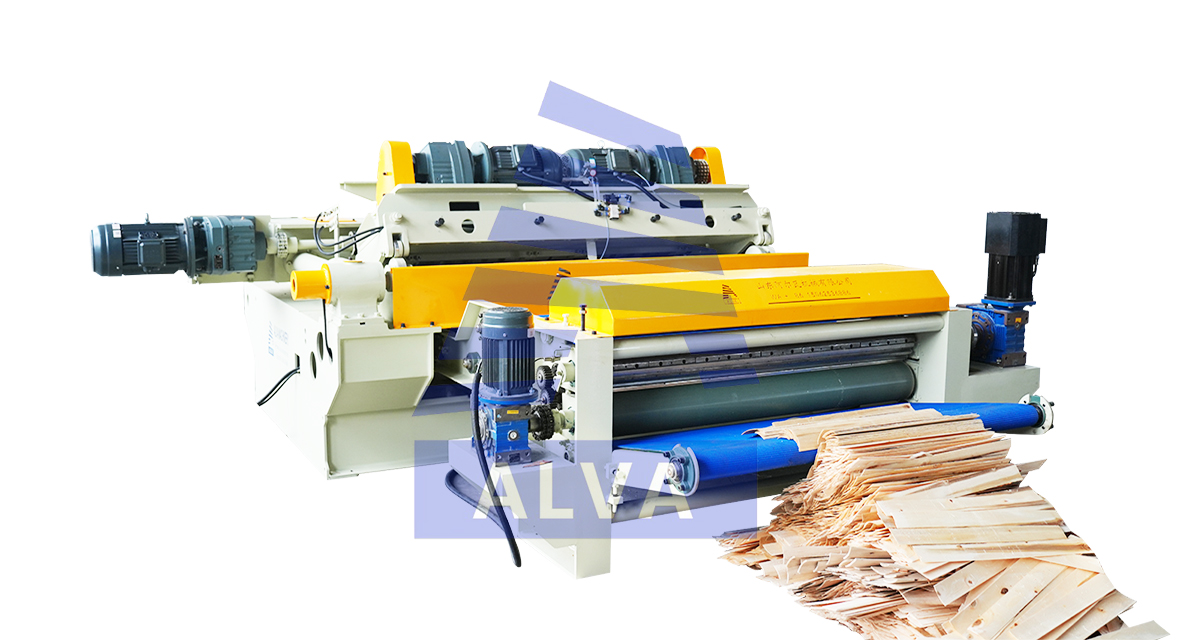
Against the backdrop of profound restructuring in the global wood-based panel industry, veneer—as the core substrate for plywood,
oriented strand board, and other products—has its peeling efficiency and quality directly determining the competitiveness of the
downstream industrial chain. With the increasing global focus on forest resource protection and the continuous evolution of raw
material supply structures, the traditional resource-intensive peeling model is facing severe challenges. As a technology-driven
enterprise with over two decades of experience in wood processing equipment, **ALVA** Machinery Co., Ltd. has always been comm-
itted to the mission of "maximizing the value of every inch of wood". Through technological innovations across the entire veneer
peeling process and the delivery of scenario-specific solutions, we provide the industry with a systematic answer that transforms from
"capacity improvement" to "value reconstruction".
I. Industry Challenges: The Dual Pressures of Efficiency and Quality in Veneer Peeling
The current veneer processing industry is in a period of transformation marked by overlapping contradictions. On one hand, down-
stream markets such as furniture, decoration, and packaging are demanding higher precision, stability, and environmental friendliness
from veneer. On the other, the raw material sector is facing mounting pressures: the supply of large-diameter high-quality logs is declin-
ing sharply, while the proportion of small-diameter logs and fast-growing timber is rising year by year. These materials typically exhibit
twisted grain, uneven stress, and fluctuating moisture content, posing significant challenges to stability control during peeling.
At the same time, the technical limitations of traditional peeling equipment are becoming increasingly apparent. Most small and
mediumsized manufacturers still rely on ordinary peeling machines that require manual adjustment of the relative position between
the knife bed and the mandrel. This not only leads to low efficiency but also frequent veneer thickness deviations due to human error.
"Knife chatter" caused by insufficient knife frame rigidity creates periodic waves on the veneer surface, severely compromising bonding
strength. Outdated log centering technology further keeps veneer yield at a low level, resulting in the waste of large amounts of high-
quality wood in offcuts. Against the backdrop of stricter environmental policies and rising labor costs, these issues have become core
bottlenecks restricting enterprise survival and development.
As an industry observer and problem-solver, ALVA Machinery has keenly recognized that mere hardware upgrades are no longer
sufficient to meet the deep-seated needs of industrial upgrading. Only by transforming from "equipment tools" to "systematic solutions"
and leveraging synergistic innovations in process optimization, intelligent control, and service enhancement can we truly help enterprises
break through the efficiency ceiling of the peeling process.
II. Technological Breakthroughs: The Underlying Logic of ALVA's Peeling Solutions
ALVA Machinery's veneer peeling technology system is built on a deep understanding of wood physical properties, peeling mechanics,
and industrial manufacturing scenarios. Our R&D team, in collaboration with university wood engineering laboratories, has conducted
extensive peeling tests on various tree species and log diameters, constructing a multi-dimensional database covering wood stress release,
cutting heat transfer, and knife roll dynamic response. This provides a solid foundation for the precise implementation of technical solutions.
(1) Intelligent Centering System: From Experience-Dependent to Data-Driven
Centering is the first step in peeling, and its accuracy directly determines veneer yield. Traditional manual or simple mechanical centering
often relies on operator experience, leading to significant errors in log eccentricity detection and widespread waste from "small logs with
large mandrels" during peeling. ALVA's intelligent centering system quickly captures log surface contours through visual scanning and
profile recognition, calculating the optimal centering point.
The system's built-in tree species adaptive algorithm dynamically adjusts centering strategies based on the density and grain characteristics
of different woods. For prone-to-cracking hardwoods, the system prioritizes preserving core integrity to reduce veneer breakage. For fast-
growing timber with twisted grain, it optimizes the peeling path through eccentricity compensation algorithms to ensure veneer surface
smoothness. In practical applications, this technology helps enterprises reduce wood waste and improve veneer yield.
(2) Dynamic Knife Bed Technology: From Passive Adaptation to Active Regulation
The knife bed is the core execution unit of the peeling machine, and its dynamic performance directly impacts cutting quality. ALVA's
adaptive dynamic knife bed features a high-rigidity cast iron monolithic structure paired with a precision drive system, enabling real-time
closed-loop control of the knife carriage feed rate. During peeling, vibration sensors mounted on the knife carriage continuously monitor
cutting force changes. When detecting wood grain variations or stress fluctuations, the system automatically adjusts the knife carriage
feed rate and knife roll angle to counteract cutting vibrations, preventing "wave marks" or "knife digging" defects on the veneer surface.
The knife bed system supports flexible thickness adjustment to meet rapid switching between multi-specification orders. Its integrated
automatic knife sharpening and wear compensation device performs online sharpening and real-time wear monitoring, automatically
compensating for knife bed position to maintain consistent cutting accuracy throughout the blade's service life. This design not only
reduces downtime from manual sharpening but also keeps veneer thickness tolerance within a stable range.
(3) Stress Relief and Flexible Clamping: From Rigid Cutting to Flexible Adaptation
Small-diameter logs and fast-growing timber have complex internal stress distributions, making them prone to veneer cracking due to
stress concentration during peeling. ALVA's log pre-treatment and flexible clamping system uniformly preheats logs before peeling
to homogenize internal moisture content, effectively releasing growth stress. Meanwhile, the mandrel uses a special elastic expansion
structure combined with multi-segment pressure rollers, adapting clamping force to the log's surface contour to avoid damage from
rigid clamping.
This system is particularly effective for processing difficult-to-cut wood. For example, fast-growing poplar—with its low density and
loose grain—typically exhibits high cracking rates with traditional peeling methods. With ALVA's flexible clamping technology,
cracking rates are significantly reduced, improving the utilization of low-quality wood. In practical production, this technology has
helped enterprises increase veneer yield rates, directly reducing raw material costs and defective product losses.
III. Scenario Implementation: ALVA Solutions Across Different Production Models
ALVA Machinery's peeling solutions are not one-size-fits-all standardized products but customized system integration services
tailored to each enterprise's production scale, raw material structure, and product positioning. From continuous production lines
in large wood-based panel groups to single-machine upgrades in small and medium-sized processing plants, ALVA's technical
solutions have been validated across various scenarios.
(1) Continuous Production Lines: The Ultimate Balance of Efficiency and Quality
For a leading domestic wood-based panel enterprise's plywood production line, ALVA Machinery delivered a full-process solution
including intelligent centering, high-speed peeling, veneer drying, and defect detection. The line features unmanned operation: logs
enter the centering station via an automatic feeding system, proceed to the peeling machine after scanning and recognition, and the
peeled veneer is conveyed to a dryer via a belt conveyor. An online defect detection system identifies knots, cracks, and other surface
defects, automatically marking and sorting veneers.
Through system integration and optimization, the line has achieved significant improvements in peeling speed and veneer yield,
leading to substantial annual value growth. More importantly, full-process digital management enables the enterprise to trace quality
from raw logs to finished veneer, with production data for each sheet accessible via the MES system—meeting the quality control
requirements of high-end downstream customers.
(2) Small and Medium-Sized Processing Plants: A Cost-Effective Path to Upgrading
Addressing the pain points of small and medium-sized processors, **ALVA** Machinery offers peeling machine retrofitting services,
breathing new life into traditional equipment by replacing intelligent centering systems and upgrading knife bed drive units. At a
small plywood factory in Linyi, Shandong, the original peeling equipment suffered from low centering accuracy, resulting in poor
veneer yield and thickness stability. After ALVA's retrofitting, the factory saw significant improvements in yield and veneer quality,
successfully entering the high-end furniture board supply chain and achieving higher order values.
Beyond hardware upgrades, ALVA Machinery provides process optimization training for small and medium-sized customers,
including practical courses on log pre-treatment, blade maintenance, and fault diagnosis. Through technical empowerment, we help
customers transition from "using equipment" to "maximizing equipment value". This "hardware + software + service" model has
become an effective path for small and medium-sized processing plants to achieve cost-effective upgrades.
(3) Custom Scenarios: Efficient Utilization of Specialized Wood
Amidst growing wood resource constraints, using low-quality wood such as branches and small-diameter logs to produce high-value
veneer has become an important industry trend. ALVA Machinery has developed a specialized peeling system for small-diameter
logs, featuring dual mandrel linkage technology to stably grip thin logs. Combined with optimized knife roll angles, it enables efficient
peeling of small-diameter wood.
At a bamboo processing enterprise in Fujian, ALVA's technical team customized a bamboo veneer peeling solution to address
bamboo's high hardness and tendency to crack. By adjusting the knife carriage feed rate and pressure roller force, they achieved
continuous peeling of bamboo, producing veneer with uniform thickness and smooth surfaces that is widely used in bamboo furniture
and decorative materials. This breakthrough not only expands the enterprise's raw material sources but also increases product added
value, providing valuable experience for the industry to explore the utilization of non-wood resources.
IV. Ecological Collaboration: Building a Sustainable Wood Processing Industry Ecosystem
ALVA Machinery recognizes that industrial upgrading cannot be achieved by a single enterprise alone but requires collaborative
innovation across the entire value chain. To this end, we actively promote ecological cooperation among "equipment manufacturers,
wood suppliers, panel producers, and downstream users", building a sustainable wood processing industry ecosystem through
technology sharing and resource integration.
At the upstream, ALVA collaborates with forestry research institutions to conduct research on fast-growing wood modification and
efficient utilization, improving wood physical properties through superior species selection and optimized planting techniques to
enhance the quality of peeling raw materials from the source. In the midstream, we partner with wood-based panel enterprises to
establish a peeling process database, sharing process parameters for different tree species and equipment to help the industry
accumulate technical experience. Downstream, ALVA works with furniture enterprises to drive collaborative optimization of veneer
performance and furniture design, reducing secondary processing in furniture production by improving veneer stability and surface
quality, thereby lowering energy consumption and emissions across the entire industrial chain.
In addition, ALVA Machinery actively responds to China's "Dual Carbon" goals by integrating energy-saving concepts into equipment
design. Our peeling machines adopt high-efficiency drives and energy recovery designs, significantly reducing energy consumption
compared to traditional equipment. Meanwhile, optimizing veneer yield to reduce wood waste contributes to the industry's green
transformation.
V. Future Outlook: From "Made in China" to "China Solution"
With the in-depth penetration of industrial internet, artificial intelligence, and other technologies, the veneer peeling industry is
ushering in a new wave of transformation. **ALVA** Machinery has launched the development of its next-generation intelligent
peeling system, which will integrate digital twin, edge computing, and other technologies to enable real-time equipment condition
monitoring and predictive maintenance, further improving efficiency and quality through algorithm-optimized peeling paths. In the
future, ALVA aims not only to become a global leader in wood processing equipment but also to set industry technical standards
and drive industrial upgrading.
Against the backdrop of global industrial chain restructuring, Chinese wood processing equipment enterprises are transitioning from
"followers" to "leaders". With technological innovation at its core, scenario-based implementation as its foundation, and ecological
collaboration as its link, ALVA Machinery is providing a "China Solution" to the global veneer processing industry. From tropical
wood-producing regions in Southeast Asia to fast-growing timber bases in Africa, **ALVA**'s equipment has been exported to multiple
countries and regions, helping local enterprises improve production efficiency and optimize resource utilization.
The improvement of veneer peeling is not only a technological advancement but also an upgrade of industrial philosophy. Under the
"Dual Circulation" development paradigm, ALVA Machinery will continue to deepen its expertise in the wood processing sector,
adhering to its original mission of "maximizing the value of every inch of wood". Working hand in hand with industry partners, we
will jointly drive the sustainable development of the global wood processing industry and contribute to building a modern society
where humans and nature coexist in harmony.

 English
 العربية
 Français
 Русский
 Español
 Português
 Deutsch
 italiano
 日本語
日本語 한국어
한국어 Nederlands
 Tiếng Việt
 ไทย
ไทย Polski
 Türkçe
 አማርኛ
አማርኛ ພາສາລາວ
 ភាសាខ្មែរ
 Bahasa Melayu
 ဗမာစာ
ဗမာစာ தமிழ்
தமிழ் Filipino
 Bahasa Indonesia
 magyar
 Română
 Čeština
 Монгол
 қазақ
қазақ Српски
 हिन्दी
 فارسی
فارسی Kiswahili
 Slovenčina
 Slovenščina
 Norsk
Norsk Svenska
 українська
 Ελληνικά
 Suomi
Suomi Հայերեն
 עברית
עברית Latine
 Dansk
Dansk اردو
اردو Shqip
Shqip বাংলা
বাংলা Afrikaans
 Māori
Māori অসমীয়া
 Беларуская мова
 Català


