1. Overview of the Commissioning
Recently, Alva Woodworking Machinery Co., Ltd. has completed the commissioning of its Single-head Small Wood Strip Veneer Peeling Production Line. This commissioning marks a key milestone in the equipment R&D cycle, confirming that the production line has passed full-process verification from design to implementation and has the basic conditions for market application. Custom-built for a Chilean client, the equipment will be shipped to the customer’s site in Chile upon completion of commissioning, to support large-scale production in the local wood processing industry.
In the wood processing sector, small wood strips serve as a foundational raw material, whose processing efficiency and finished product stability directly impact the production rhythm of downstream industries. In response to the actual needs of wood processing in Chile, Alva launched the R&D project for the Single-head Small Wood Strip Veneer Peeling Production Line. Building on existing peeling technology, the project team integrated feeding, slitting, and collection units to form an integrated solution. The commissioning aimed to verify the equipment’s adaptability and reliability under continuous operation, covering processing scenarios of common local wood raw materials in Chile, and providing technical support for the equipment’s overseas deployment.
The commissioning was jointly executed by Alva’s R&D Center, Production Department, Quality Control Department, and Foreign Trade Department, following standardized testing procedures throughout. Testing items included no-load operation, material-loaded operation, continuous operation, fault simulation and recovery, and transport adaptability verification. After multi-stage verification, all units of the equipment operated in stable coordination, and the finished product specifications met preset requirements. The commissioning was completed as planned, laying the groundwork for shipment to the Chilean customer’s site.
2. Project Background and R&D Process
Currently, the global wood processing industry is in a phase of technological iteration. Downstream sectors such as furniture, packaging, and construction continue to increase demand for small wood strips, while imposing higher requirements on the consistency of raw material specifications and production continuity. Traditional single-machine processing models suffer from fragmented workflows and poor connectivity, failing to meet large-scale production needs. As a region rich in wood resources, Chile’s local processing enterprises face challenges such as insufficient equipment adaptability and low production efficiency. Based on this, Alva entered into cooperation with the Chilean client and launched the R&D project for the Single-head Small Wood Strip Veneer Peeling Production Line.
Following project approval, the R&D Center first conducted domestic and international market research to identify the Chilean client’s processing scenarios and pain points. Research showed that the client primarily processes local hardwood raw materials, facing issues such as fluctuating log diameters, low manual slitting efficiency, and insufficient finished product regularity. Addressing these challenges, the project team established the R&D direction of “integration, continuity, standardization, and overseas adaptability,” specifying that the production line must integrate full-process functions including log feeding, peeling and slitting, and finished product collection, while adapting to Chile’s local voltage standards, raw material characteristics, and site layout.
The R&D process was divided into four phases:
Phase 1: Scheme Design – Completed the overall layout of the production line and technical selection of core units, confirming the one-to-one configuration (a single peeling host matched with one set of feeding and collection systems), and adjusting the equipment layout to fit the Chilean client’s site dimensions.
Phase 2: Component Prototyping and Assembly – The Production Department processed and assembled each unit according to design drawings, while the R&D Center simultaneously programmed and debugged the electrical control system to adapt to local voltage standards.
Phase 3: In-plant Testing – Conducted no-load debugging and partial material-loaded testing to optimize the coordination logic and operating parameters of each unit, and performed modular disassembly and assembly testing to verify transport adaptability.
Phase 4: Customer Requirement Verification – Invited the Chilean client’s representatives to participate remotely in the commissioning process, confirming that equipment functions and finished product specifications met expectations.
During the R&D cycle, the project team organized multiple cross-departmental reviews to iteratively optimize issues related to equipment stability, material adaptability, and overseas transportation. For example, the material and operating parameters of the peeling knife roller were adjusted to suit the hardness of local Chilean hardwoods; the equipment’s modular design was optimized to facilitate disassembly and container loading for long-distance overseas transport; and the dust collection structure was improved to meet local environmental requirements. After multiple rounds of adjustments, the equipment gradually met the preset technical indicators and customer needs.
3. Core Composition and Technical Features of the Production Line
The Single-head Small Wood Strip Veneer Peeling Production Line consists of a feeding unit, peeling host, slitting unit, conveying unit, collection unit, and electrical control system. All units are linked via mechanical structures and electrical signals, with adaptive design tailored to the Chilean client’s requirements.
Feeding Unit – Responsible for automatic log conveying and positioning, using a roller conveyor structure to enable continuous log feeding. The positioning module adjusts conveying speed by identifying log positions via sensors, ensuring logs enter the peeling host’s processing area accurately. To accommodate fluctuating log diameters in Chile, the feeding unit was equipped with an adaptive adjustment function compatible with raw materials of varying diameters.
Peeling Host – The core unit of the production line, adopting a knife roller structure to achieve log peeling through roller rotation. The host is equipped with an automatic centering system that adjusts the knife roller position based on log diameter, ensuring stable peeling. Veneer produced by peeling is conveyed to the slitting unit via a guide structure. The knife roller uses wear-resistant materials to extend equipment service life, addressing the characteristics of local hardwoods.
Slitting Unit – Utilizes a multi-knife shaft structure to slit peeled veneer into small wood strips of preset width. The distance between knife shafts can be adjusted mechanically to adapt to different finished product specifications. Slit small wood strips are conveyed to the collection unit via the conveying unit. To meet the client’s requirements for finished product regularity, a positioning guide structure was added to ensure width deviation of small wood strips stays within preset ranges.
Conveying Unit – Adopts a belt conveyor structure, with speed regulation synchronized with the peeling host and slitting unit to prevent material accumulation or disconnection.
Collection Unit – Features a leveling mechanism to stack small wood strips in layers for subsequent packaging and transportation. Both the conveying and collection units use modular design for quick disassembly, reducing container space occupancy for overseas transport.
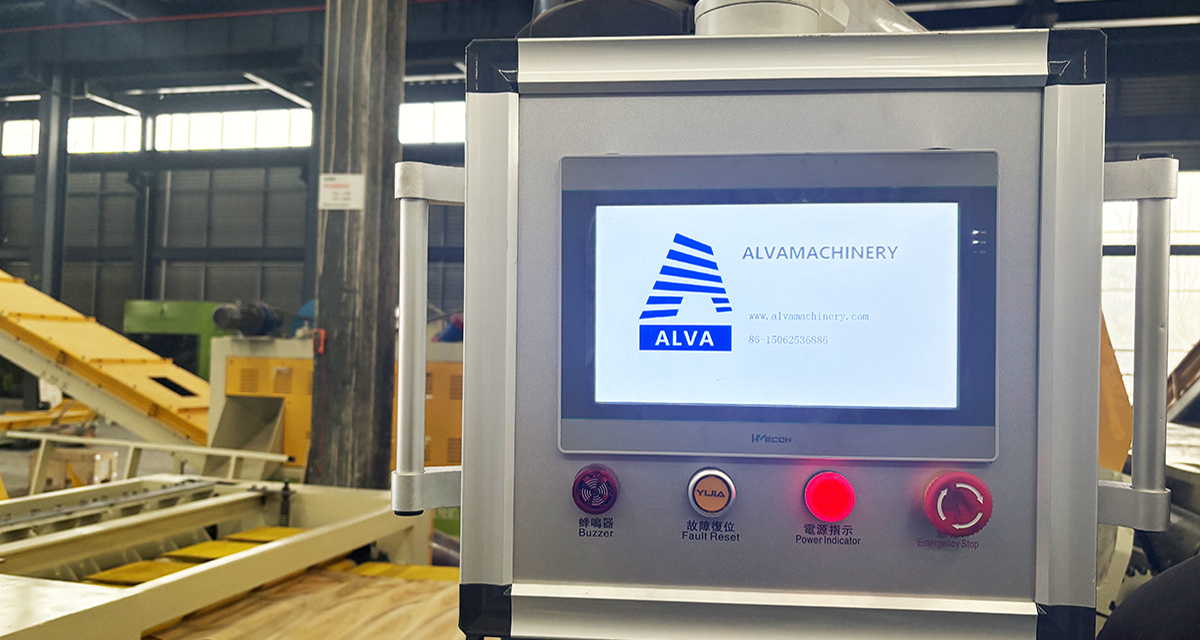
Electrical Control System – Based on a PLC control architecture with an integrated human-machine interface, enabling parameter setting, operation status monitoring, and fault alarm. The system includes data recording functionality to store equipment operating parameters and finished product data for future optimization. To adapt to Chile’s local voltage standards, the electrical system is equipped with an adaptive transformer and a lightning protection module to suit the local power environment.
4. Commissioning Verification Process and Results
The commissioning was conducted in four phases, including special verification for overseas transportation and customer requirements:
(1) No-load Operation Verification
The no-load phase tested the independent operation and linkage response of each unit, including adjustment of feeding unit conveying speed, peeling host knife roller rotation speed, slitting unit knife shaft positioning accuracy, and conveying unit speed matching. Testing confirmed that all unit operating parameters met design requirements, linkage response delays were within preset ranges, and no abnormalities such as jamming or abnormal noise occurred. Additionally, modular disassembly and assembly verification was performed, demonstrating smooth disassembly and assembly processes that meet packaging requirements for overseas transport.
(2) Material-loaded Operation Verification
The material-loaded phase tested common local Chilean hardwood raw materials, covering logs of varying hardness and diameters. During continuous operation, equipment status and finished product specifications were recorded. Results showed that the peeling host stably adapted to different raw material hardness levels, slitting unit knife shaft positioning accuracy met finished product width requirements, and the conveying and collection units connected smoothly without material blockage or scattering. The client’s representatives remotely observed the material-loaded testing and confirmed that finished product specifications aligned with their production needs.
(3) Continuous Operation and Fault Simulation Verification
During continuous operation, the equipment maintained material-loaded status to test long-term stability. No overheating or abnormal wear occurred in any unit, and finished product specification consistency remained stable. In the fault simulation phase, test personnel artificially triggered sensor faults and conveying jams; the electrical control system promptly identified faults, issued alarms, and activated emergency shutdown mechanisms to prevent fault escalation. After fault resolution, the equipment resumed operation quickly, verifying system reliability.
(4) Overseas Adaptability Special Verification
To meet the requirements of shipment to the Chilean customer’s site, special overseas adaptability verification was added during commissioning, including testing of anti-rust treatment effectiveness, container loading simulation, and voltage adaptability. Testing confirmed that the equipment’s anti-rust coating met protective requirements for maritime transport, the modular structure was compatible with standard container dimensions, and the electrical system operated stably under local voltage, providing assurance for overseas transportation and installation.
After commissioning, the Quality Control Department sampled finished products for testing. Results showed that thickness and width deviations of small wood strips were within preset ranges, with no significant surface damage, meeting the Chilean client’s raw material standards. The Foreign Trade Department simultaneously initiated logistics preparation, including container booking, customs declaration, and overseas insurance, to ensure timely shipment.
5. Team Collaboration and Support System
The success of the commissioning and preparation for shipment to the Chilean customer’s site relied on Alva’s cross-departmental collaboration support system, covering R&D, production, quality control, foreign trade, logistics, and other functions.
R&D Center – Responsible for technical scheme design and iteration, with a project team composed of professionals in mechanical design, electrical control, process optimization, and overseas adaptability, following the equipment’s R&D and debugging throughout.
Production Department – Handled equipment processing and assembly, strictly adhering to design drawings and quality standards to ensure component processing accuracy, while optimizing packaging structures for overseas transport.
Quality Control Department – Developed detailed testing plans, monitored the commissioning process, recorded data, and issued verification reports, while conducting special inspections on anti-rust treatment and packaging.
Foreign Trade Department – Coordinated communication with the Chilean client, synchronized customer requirements, facilitated remote participation in commissioning, and handled export procedures including customs declaration, commodity inspection, and certificate of origin.
Logistics Department – Managed equipment packaging and transport preparation, selected logistics providers with international heavy cargo transport qualifications, and designed container loading schemes to ensure safe transport.
Additionally, Alva’s supply chain system supported the project:
The Procurement Department locked in core component suppliers in advance to ensure timely material supply and quality stability.
The Operation and Maintenance Team provided equipment maintenance support during commissioning to ensure continuous testing.
The After-sales Department pre-developed overseas installation and debugging plans, arranging technical personnel to conduct on-site installation and training at the Chilean customer’s site.
Cross-departmental collaboration mechanisms were implemented throughout the project, with weekly project meetings to synchronize progress and resolve issues. For detailed problems identified during commissioning, departments responded rapidly, forming a closed-loop management process of “problem identification – root cause analysis – optimization adjustment – effect verification” to ensure project progress and full preparation for shipment to the Chilean customer’s site.
6. Industry Value and Future Layout
The successful commissioning of the Single-head Small Wood Strip Veneer Peeling Production Line and its upcoming shipment to Chile deliver multiple values to Alva and the global wood processing industry.
First, the production line enables continuous processing of small wood strips, reducing manual intervention and improving the Chilean client’s production efficiency. Second, the standardized processing model enhances finished product specification consistency, reducing raw material waste in downstream industries. Third, the integrated layout reduces the client’s site occupancy and equipment investment costs, optimizing production workflows. For Alva, this equipment export represents a key step in its overseas market expansion, accumulating experience for further penetration into the South American wood processing equipment market.
Looking forward, Alva will build on the project’s achievements to optimize and promote the equipment:
On one hand, iterative upgrades will address detailed issues identified during commissioning to further enhance equipment stability and adaptability.
On the other hand, global market promotion will be launched through industry exhibitions, customer visits, and overseas agent cooperation to showcase equipment functions and advantages, driving market adoption.
Alva will also continue to monitor technological demands in the wood processing industry, conducting subsequent R&D focused on intelligence and green development. For example, exploring the integration of IoT technology into equipment management to enable remote monitoring and predictive maintenance; optimizing equipment energy consumption structures to reduce production energy use, supporting industry green upgrading. For overseas markets, Alva will establish localized service systems, setting up service outlets in key regions to provide timely installation, debugging, and maintenance services, improving customer satisfaction.
7. Conclusion
The successful commissioning of the Single-head Small Wood Strip Veneer Peeling Production Line reflects Alva’s technical accumulation in woodworking machinery and its response to overseas customer demands, driving technological iteration. The equipment’s upcoming shipment to Chile marks Alva’s official entry into the South American market, supporting the upgrading of local wood processing industries.
Here, we thank all R&D, production, quality control, foreign trade, and logistics personnel involved in the project, as well as the Chilean client for their trust and support. Alva will take this commissioning as a new starting point, continuously enhancing its technical strength and service capabilities to contribute to the development of the global wood processing industry.
Alva Woodworking Machinery Co., Ltd.

 English
 العربية
 Français
 Русский
 Español
 Português
 Deutsch
 italiano
 日本語
日本語 한국어
한국어 Nederlands
 Tiếng Việt
 ไทย
ไทย Polski
 Türkçe
 አማርኛ
አማርኛ ພາສາລາວ
 ភាសាខ្មែរ
 Bahasa Melayu
 ဗမာစာ
ဗမာစာ தமிழ்
தமிழ் Filipino
 Bahasa Indonesia
 magyar
 Română
 Čeština
 Монгол
 қазақ
қазақ Српски
 हिन्दी
 فارسی
فارسی Kiswahili
 Slovenčina
 Slovenščina
 Norsk
Norsk Svenska
 українська
 Ελληνικά
 Suomi
Suomi Հայերեն
 עברית
עברית Latine
 Dansk
Dansk اردو
اردو Shqip
Shqip বাংলা
বাংলা Afrikaans
 Māori
Māori অসমীয়া
 Беларуская мова
 Català


