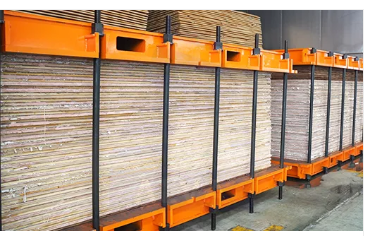
Wood deformation directly attacks your bottom line. Cupped boards, bowed panels, and twisted frames destroy material yield. They trigger costly rework and ultimately damage your brand reputation. Many manufacturers rely on pre-kiln-dried lumber or passive air drying. They hope environmental conditions remain stable. However, these methods leave moisture levels completely unpredictable. This unpredictability prompts many business owners to consider bringing moisture control in-house.
A dedicated Furniture Drying Room is not a magical cure-all. It is, instead, a highly controlled technical environment. When you pair it with standard operational protocols, you gain a massive advantage. It represents the most reliable method to hit your target Equilibrium Moisture Content (EMC). You will minimize warping risks and stabilize your daily production. Read on to discover how this technology works and how it integrates into your lumber management strategy.

Key Takeaways
Controlled Moisture Stabilization: A furniture drying room safely lowers wood moisture below the 30% Fiber Saturation Point to the optimal 6-8% EMC for indoor furniture, preventing uneven shrinkage.
Risk Mitigation: It significantly reduces the physical stresses that cause cupping and bowing, but cannot override poor initial lumber selection or improper milling techniques.
Operational Dependencies: Equipment alone isn't enough; preventing deformation still requires correct stacking (spacers), end-grain sealing, and acclimation protocols.
Avoid Over-Drying: Professional drying rooms prevent irreversible cell damage and brittleness caused by uncontrolled heat sources.
The Business Cost of Deformation: Why Wood Warps
Before exploring solutions, we must understand the physical realities of lumber. Wood moves. It breathes. When moisture leaves the cellular structure, the physical dimensions change. This movement rarely happens evenly across a single board.
The Mechanics of Shrinkage
Deformation is driven by a concept called the "shrinkage differential." Wood shrinks anisotropically. This means it changes size differently depending on the grain direction. Tangential shrinkage occurs along the growth rings. Radial shrinkage occurs perpendicular to the growth rings. Longitudinal shrinkage happens along the length of the board. Tangential shrinkage is roughly twice radial shrinkage. This exact mathematical imbalance forces flat-sawn boards to cup as they dry.
Grain Direction | Shrinkage Rate | Impact on Furniture |
Tangential (Across Rings) | Highest (Approx. 6-10%) | Causes severe cupping and width reduction in plain-sawn lumber. |
Radial (Perpendicular to Rings) | Moderate (Approx. 3-5%) | Maintains reasonable stability; makes quarter-sawn wood highly desirable. |
Longitudinal (Lengthwise) | Negligible (Approx. 0.1-0.2%) | Rarely causes length issues, but uneven longitudinal tension causes bowing. |
The Fiber Saturation Point (FSP)
You cannot effectively dry wood without understanding the Fiber Saturation Point. Freshly cut lumber contains two types of water. "Free water" lives inside the cell cavities. "Bound water" is trapped inside the actual cell walls. Wood only begins to shrink after free water is completely gone. Bound water then leaves the cell walls. This transition typically happens just below 30% moisture content. If you fail to manage the drying speed below this 30% threshold, the wood will tear itself apart.
Environmental Volatility
Passive air drying leaves lumber entirely vulnerable to seasonal humidity spikes. Summer moisture swells the boards. Winter heating dries them rapidly. Predicting the final EMC becomes nearly impossible. This constant cycling increases your scrap rate during final machining. Your operators will waste hours trying to flatten boards twisted by uncontrolled weather variations.
How a Furniture Drying Room Addresses Warping
Bringing this process indoors changes the entire equation. You stop relying on weather forecasts. You begin relying on data, sensors, and programmed climates.
Precision EMC Targeting
A Furniture Drying Room utilizes automated temperature and humidity controls. Sensors monitor the exact moisture levels inside sample boards. The system then gradually steps down the ambient moisture. It lands precisely at the 6-8% EMC required for interior environments. This precise targeting ensures the core and the shell of the board reach the same moisture level simultaneously. You eliminate the guesswork entirely.
Stress Relief
Drying wood too fast creates disastrous internal tensions. The outer shell hardens while the core remains soaking wet. This condition is called case hardening. Controlled drying cycles prevent this phenomenon. Modern systems rotate through heating, venting, and conditioning phases. During the conditioning phase, the system introduces humidity back into the room. This brief burst of moisture relaxes the hardened outer shell. It relieves internal drying stresses safely. The board emerges flat, stable, and ready for the jointer.
Mitigating Biological Risks
Moisture control also provides biological protection. Air-dried wood often harbors unseen threats. Mold spores flourish in damp stacks. Brown rot and white rot silently compromise structural integrity inside the boards. The sustained heat used during a professional drying cycle eradicates these biological threats entirely. You guarantee a sanitary, structurally sound material for your clients.
Evaluating the Investment: Limits and Operational Realities
New technology excites production managers. However, you must separate marketing hype from physical reality. Equipment alone cannot guarantee perfect lumber. You must enforce strict handling rules.
Mythbusting: The Double-Sided Seal
A drying room does not replace proper handling. You will often hear an industry myth stating you must "seal both sides of a board" to prevent warping. This is fundamentally incorrect. Finishing both sides only slows moisture exchange. It does not stop it. If the internal core remains wet, internal shrinkage mechanics will eventually overpower any surface finish. The finish will crack. The board will warp. You must dry the wood properly first.
Mandatory Pre-Drying SOPs
To maximize your equipment, you must implement strict Standard Operating Procedures (SOPs) before closing the chamber doors.
Stacking & Circulation: Wood must be elevated off the ground. You must stack layers using uniformly placed stickers (spacers). These stickers must align perfectly vertically. This alignment transfers weight evenly and allows even airflow across every board face.
End Sealing: End grain loses moisture up to 20 times faster than flat surfaces. This rapid localized drying causes severe end checking and splitting. You must apply a wax emulsion end-sealer immediately after cross-cutting. Do this before loading the room.
The Risk of Over-Drying
Uncontrolled heat destroys wood. Pushing the moisture content too low is equally dangerous as leaving it wet. A high-quality furniture drying room prevents dropping moisture below 6%. Going below this critical threshold causes irreversible cell collapse. The wood becomes extremely brittle. Your router bits will cause massive tear-out. Screws will split the grain instantly. Good equipment uses sophisticated limiters to prevent this over-drying scenario.
Furniture Design & Acclimatization Post-Drying
Your responsibility does not end when the drying cycle finishes. How you handle the wood immediately afterward dictates your final success.
The Transition Phase
Never move wood directly from a hot drying chamber into a saw. You must highlight the necessity of an acclimatization phase. Let the kiln-dried wood rest in your specific workshop environment. It needs several days to adjust to ambient shop temperatures and humidity before you begin cutting. Rushing this transition invites immediate bowing.
Timing of Assembly
Milling wood exposes fresh, unoxidized cells to the air. These newly exposed surfaces will rapidly absorb or release moisture. Therefore, you must manage your assembly schedule tightly. Once you mill your boards flat, assembly should happen within days. Do not mill parts on a Friday and leave them unstacked over the weekend. You will return Monday to find twisted components. Mill, assemble, and apply base sealers in a continuous workflow.
Engineering for Movement
Even perfectly dried wood expands and contracts seasonally. You cannot defeat nature using extra glue or larger screws. Instead, you must engineer furniture to accommodate movement. Follow the "2% rule." Assume the wood will change dimensionally by up to 2% across its width over the year. You must design furniture with sliding slots, z-clips, or floating panels. Rigidly screwing a solid wood tabletop to a rigid metal base guarantees a catastrophic crack by February.
Shortlisting Logic: Is an In-House Drying Room Right for You?
Making the decision requires a hard look at your supply chain and your daily operational frustrations.
Material Availability vs. In-House Control
Consider your current purchasing strategy. You likely pay a massive premium purchasing specialized quarter-sawn or properly kiln-dried lumber from third-party yards. You also suffer delays when they run out of stock. Compare this ongoing premium against the upfront capital expenditure of installing your own equipment. Taking control of the drying process allows you to purchase cheaper green lumber. You capture the value-add yourself. More importantly, you control the final quality standard.
Feature Checklist for Buyers
If you decide to evaluate equipment, avoid basic heated boxes. Demand specific engineering features.
Essential Feature | Why It Matters |
Programmable Moisture Stepping | Allows gradual reduction rather than aggressive continuous heating, protecting cell walls. |
Uniform Airflow Baffles | Ensures air velocity is identical at the top and bottom of the stack. Eliminates wet pockets. |
Active Condensation Management | Evacuates evaporated water efficiently so boards do not re-absorb ambient humidity during cooling phases. |
Integrated Conditioning Cycle | Re-introduces steam at the end of the run to relieve case hardening and balance core/shell metrics. |
Next Steps
Do not guess at your current losses. Conduct a rigorous material audit this month. Measure your current scrap rate caused directly by warping, checking, and twisting. Define your target defect rate. Armed with real data, contact equipment manufacturers. Request trial drying cycles using your specific species of wood. See the physical results before committing.
Conclusion
A professionally managed drying chamber transforms a volatile organic material into a predictable engineering asset. It safely navigates the critical danger zones below the Fiber Saturation Point. It relieves internal stresses and targets exact moisture requirements. However, technology requires discipline. You must pair the hardware with rigorous stacking protocols, end-sealing habits, and intelligent joinery design.
Evaluate your production bottlenecks honestly. If unpredictable lumber constantly stalls your assembly lines, passive methods are failing you. Taking control of your drying environment elevates your product quality and protects your profit margins. Commit to mastering moisture control, and your furniture will stand the test of time.
FAQ
Q: Can warped or over-dried wood be restored in a drying room?
A: No. While minor cupping can sometimes be corrected with surface moisture and physical weight, severe deformation and over-drying cause irreversible cellular damage. You cannot "re-hydrate" collapsed cells back to structural health.
Q: What is the ideal moisture content a furniture drying room should achieve?
A: For indoor furniture, the target Equilibrium Moisture Content (EMC) is typically 6-8%. For outdoor applications, 10-18% is standard depending on the region.
Q: Does the type of cut affect how the wood behaves in the drying room?
A: Yes. Quarter-sawn lumber is inherently more stable and less prone to cupping than plain-sawn lumber. This stability makes the drying room cycle more predictable and yields higher usable material rates.

 English
 العربية
 Français
 Русский
 Español
 Português
 Deutsch
 italiano
 日本語
日本語 한국어
한국어 Nederlands
 Tiếng Việt
 ไทย
ไทย Polski
 Türkçe
 አማርኛ
አማርኛ ພາສາລາວ
 ភាសាខ្មែរ
 Bahasa Melayu
 ဗမာစာ
ဗမာစာ தமிழ்
தமிழ் Filipino
 Bahasa Indonesia
 magyar
 Română
 Čeština
 Монгол
 қазақ
қазақ Српски
 हिन्दी
 فارسی
فارسی Kiswahili
 Slovenčina
 Slovenščina
 Norsk
Norsk Svenska
 українська
 Ελληνικά
 Suomi
Suomi Հայերեն
 עברית
עברית Latine
 Dansk
Dansk اردو
اردو Shqip
Shqip বাংলা
বাংলা Afrikaans
 Māori
Māori অসমীয়া
 Беларуская мова
 Català


