In the wood processing industrial chain, rotary-cut veneer serves as a vital intermediate material linking log resources and wood-based panel products, and constitutes the fundamental component of the plywood production system. With continuous adjustments to the utilization modes of global wood resources and sustained growth of downstream industries including construction, furniture, interior decoration, packaging and transportation, rotary-cut veneer and plywood have witnessed expanding application scope in the international timber product trade.
The entire production process — from logs to veneers, then to plywood and other wooden panels — covers multiple stages: log preprocessing, bolt processing, rotary cutting, veneer drying, sorting, gluing, panel assembling, hot pressing and post-treatment. Equipment stability, process connection and raw material adaptability directly determine the operational efficiency of production lines and the quality of end products.
Shandong Alva Machinery Group has long focused on the wood processing sector, supplying mechanical equipment and production line solutions for log rotary cutting, veneer manufacturing and plywood production projects. This article systematically introduces the rotary-cut veneer and plywood market from the perspectives of international market landscape, product applications, production processes, equipment demands and industry development directions, and further elaborates on Alva Machinery’s technical and service concepts for relevant equipment.
I. Position of Rotary-Cut Veneer and Plywood in the Global Wood Processing Industry
Rotary-cut veneer is generally produced by rotary cutting of logs. After preprocessing procedures including sawing, rounding, debarking, centering and clamping, logs are continuously machined into thin wooden sheets of specified thickness by rotary cutting equipment. Subsequent trimming, drying and conditioning yield veneers suitable for further processing.
Plywood is a wood-based panel product manufactured by further processing veneers. Veneers arranged in different grain directions are assembled, glued and pressed to form panels with structural stability. Therefore, plywood production forms an important industrial chain extending from log processing and veneer fabrication to deep processing.
Within the international timber product statistical framework, veneers, plywood and other wood-based panels are key segments of global forest product trade. The Food and Agriculture Organization of the United Nations (FAO) continuously collects and releases statistics on the production, trade and consumption of global forest products, covering logs, sawn timber, veneers, wood-based panels and other categories.
The International Tropical Timber Organization (ITTO) also keeps track of global timber production and trade over the long term, incorporating veneers and plywood into its primary timber product statistics. This indicates that rotary-cut veneer and plywood are not regional wood processing goods, but industrial products supported by relatively complete international supply chains.
For wood processing enterprises, logs are merely the starting point of the production system. Converting logs of diverse species, diameters, moisture contents and forms into veneers and panels meeting downstream processing requirements is a core task throughout production.
II. Basic Characteristics of the International Rotary-Cut Veneer Market
1. Veneer as an Essential Base Material for Plywood and Other Wood Products
Rotary-cut veneer features continuous processing, high material utilization rate, and convenience for subsequent drying and panel assembly, making it widely adopted in plywood manufacturing.
Depending on end use, veneers can be used for standard plywood, film-faced panels, furniture substrates, decorative panels, packaging boards and other wood composite products. Some veneers act as surface layers and are combined with various core materials to satisfy requirements for appearance, strength, dimensional stability and processability.
In the global market, veneer trade serves not only traditional plywood factories. Many furniture manufacturers, decorative material enterprises and wood product processors also purchase veneers of different species and specifications for further fabrication.
Hence, the market for rotary-cut veneer equipment is not limited to the plywood industry, but covers multiple wood processing sectors.
2. Gradually Diversified Raw Material Sources
Log species and sources adopted by the international wood processing industry show obvious regional differences.
In different countries and regions, enterprises may use eucalyptus, pine, poplar, willow, mixed hardwood, and other plantation or natural forest timbers. Wood species differ in density, grain, moisture content, fiber characteristics and machinability. For this reason, rotary cutting production lines cannot be designed only for a single timber condition.
In recent years, plantation timber has gained growing attention in segments of the wood processing industry. ITTO notes that the core layers of some tropical plywood now adopt plantation species such as eucalyptus, acacia and poplar, paired with other timbers for surface veneers. Such shifts in raw material structure require plywood and veneer processing equipment to adapt to more diversified log conditions.
For equipment manufacturers, this means rotary cutting machines must not only complete basic bolt rotary cutting, but also accommodate variations of different timbers in feeding, centering, clamping, rotary cutting, veneer thickness control and subsequent conveying.
3. Growing Emphasis on Continuous Veneer Production
Traditional veneer processing can be accomplished with relatively decentralized equipment, while modern wood processors pay greater attention to inter-process connection.
Starting from log entry into the workshop, log storage, feeding, sawing, rounding, rotary cutting, veneer trimming, drying and stacking need proper coordination.
Mismatch between upstream log processing speed and rotary cutting capacity leads to waiting time; inconsistency between rotary cutting speed and downstream veneer conveying and drying capacity also disrupts overall production scheduling.
Accordingly, global market demand for rotary-cut veneer equipment is gradually shifting from standalone machinery to complete production line solutions.
III. Application Sectors of the International Plywood Market
Plywood is a typical engineered wood panel with broad applications worldwide.
Construction Sector
Plywood is used for construction formwork, walls, floors, roofs and some structural applications. Depending on service environments and technical requirements, plywood of different grades can select appropriate wood species, adhesives and surface treatments.
For construction projects, panels must feature dimensional stability, easy machinability and certain load-bearing and durability. Therefore, veneer quality, assembly method, bonding quality and pressing process are critical during production.
Furniture Manufacturing Sector
The furniture industry constitutes one major application field for plywood.
Plywood can serve as structural components of furniture, and can be further processed via veneer overlay, facing and finishing. Compared with solid wood, plywood has distinct advantages in dimensional specifications and processing modes, catering to diverse production demands of modern furniture manufacturing.
Interior Decoration Sector
With the development of interior design and wooden decorative materials, plywood and related wood-based panels are applied for wall cladding, ceilings, partitions, cabinets and other interior structures.
Rotary-cut veneers of different wood species create varied grain patterns, laying the foundation for subsequent decorative processing.
Packaging and Industrial Sector
Plywood is also made into wooden packing cases, pallets and other industrial packaging products.
For the packaging industry, panels must be easy to cut, join and assemble, and withstand transport conditions. Stable panel production processes are therefore a key concern for industrial packaging manufacturers.
IV. Increasingly Distinct Regional Features of the Global Plywood Market
The global plywood industry consists of multiple production and consumption regions rather than a single unified market.
Asia boasts a solid wood processing industrial base and stands as a major producer of plywood and other wood-based panels. Europe, North America and other territories also have mature wood processing and panel consumption markets.
The latest FAO statistics on forest products show that wood-based panels have formed a large-scale international production and trading system, among which plywood and LVL are important components.
Meanwhile, market demands vary across regions.
Some markets prioritize construction formwork and engineering applications; some focus on furniture and interior decoration; others concentrate on packaging, industrial manufacturing and other specialized uses.
When building production lines, plywood manufacturers need to define raw materials, veneer specifications, adhesive systems, panel structures and post-processing methods according to target markets.
This brings new requirements for woodworking machinery manufacturers: equipment shall not merely realize production, but match processes according to raw material conditions and product orientation of individual projects.
V. New Requirements for Wood Processing Equipment from the Global Market
With the development of the global wood processing industrial chain, plywood manufacturers’ concerns over equipment are evolving.
Previously, enterprises selected machines mainly based on whether standalone units could finish a single working procedure.
Now, more and more clients evaluate the entire production system, including:
How logs enter the production line
Log centering and rounding operations
Methods to improve stability during rotary cutting
Continuous conveying of veneers
Veneer drying solutions
Sorting and conditioning of dried veneers
Assembly of different veneers
Coordination between gluing and panel assembly
Hot pressing process control
Handling of finished panels for subsequent processing
These elements together form a complete plywood production project.
Therefore, the value of modern woodworking machinery suppliers lies not only in supplying individual machines, but also in understanding the whole production workflow and configuring equipment according to project conditions of clients.
VI. Alva Rotary-Cut Veneer Equipment: Starting from Log Feeding into Production Lines
Centered on wood processing workflows, Shandong Alva Machinery Group provides equipment and production line solutions for log handling, rotary-cut veneer production and related plywood manufacturing stages.
The first step of rotary-cut veneer production is not rotary cutting itself, but log preparation.
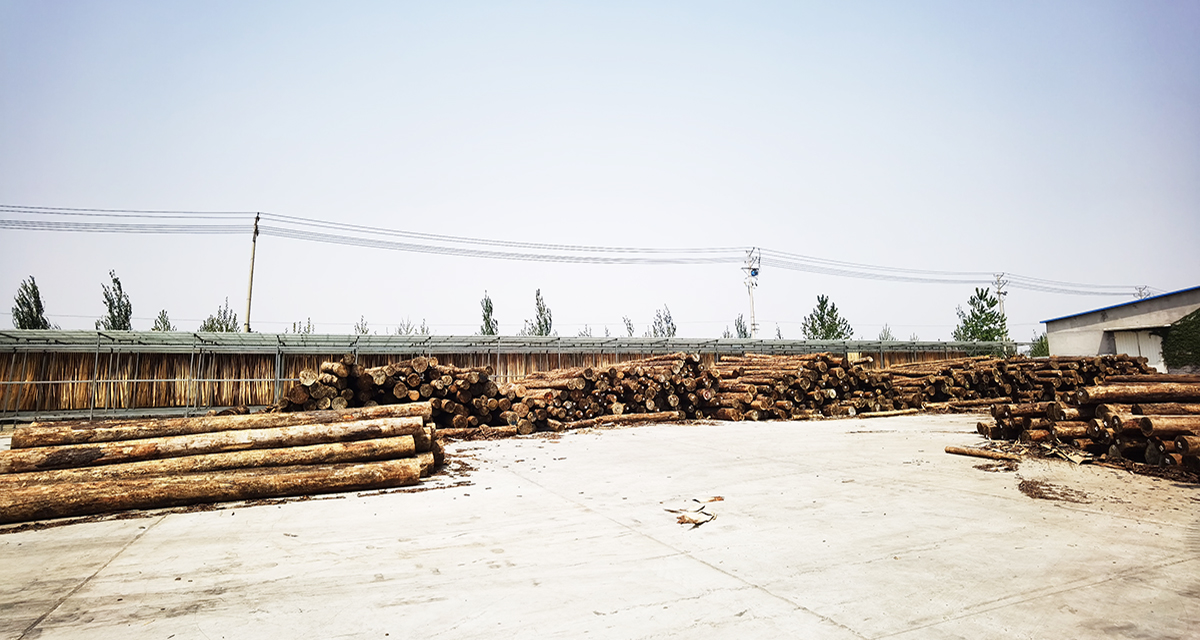
After entering the production area, logs are stored, conveyed and sorted as required. For continuous production, stable log feeding forms the foundation for subsequent procedures.
Alva Machinery can configure production lines covering log storage, feeding, sawing, rounding and conveying to feed logs into rotary cutting machines following process flow.
During log processing, log size, shape and wood condition directly affect rotary cutting results. Hence, front-end equipment undertakes not only transportation, but also the critical task of preparing suitable bolts for rotary cutting.
VII. Process Coordination between Log Rounding and Rotary Cutting Equipment
After sawing, log shapes may not be directly suitable for rotary cutting.
Rounding machines process log outer surfaces to form bolt profiles more favorable for subsequent rotary cutting.
For plywood manufacturing, bolt geometry has a direct bearing on rotary cutting. Proper bolt treatment helps rotary cutters maintain stable feeding and cutting performance and facilitates later veneer conditioning.
For rotary cutting line design, Alva Machinery considers the full front-end bolt processing instead of only focusing on rotary lathes.
From log storage platforms, saw mills and feeding machines to rounding equipment, rotary cutters and downstream veneer processing machines, all procedures shall be rationally connected according to actual production requirements.
VIII. Alva Rotary-Cut Veneer Equipment: Focus on the Veneer Production Process
Rotary cutting is the core stage of veneer manufacturing.
Through relative movement between cutting knives and wood bolts, rotary cutting equipment continuously processes timber into veneers. Knife condition, bolt clamping, feeding stability and machine structure all affect continuous veneer production during rotary cutting.
In designing rotary cutting machines and related production lines, Alva Machinery prioritizes process matching between different devices.
For wood of various species, diverse log conditions and different product requirements, corresponding log treatment and rotary cutting solutions can be configured based on project realities.
For manufacturers, rotary cutting machines do not operate in isolation. Freshly cut veneers require timely conveying, conditioning and drying, so continuous connection between equipment is also a key part of production line design.
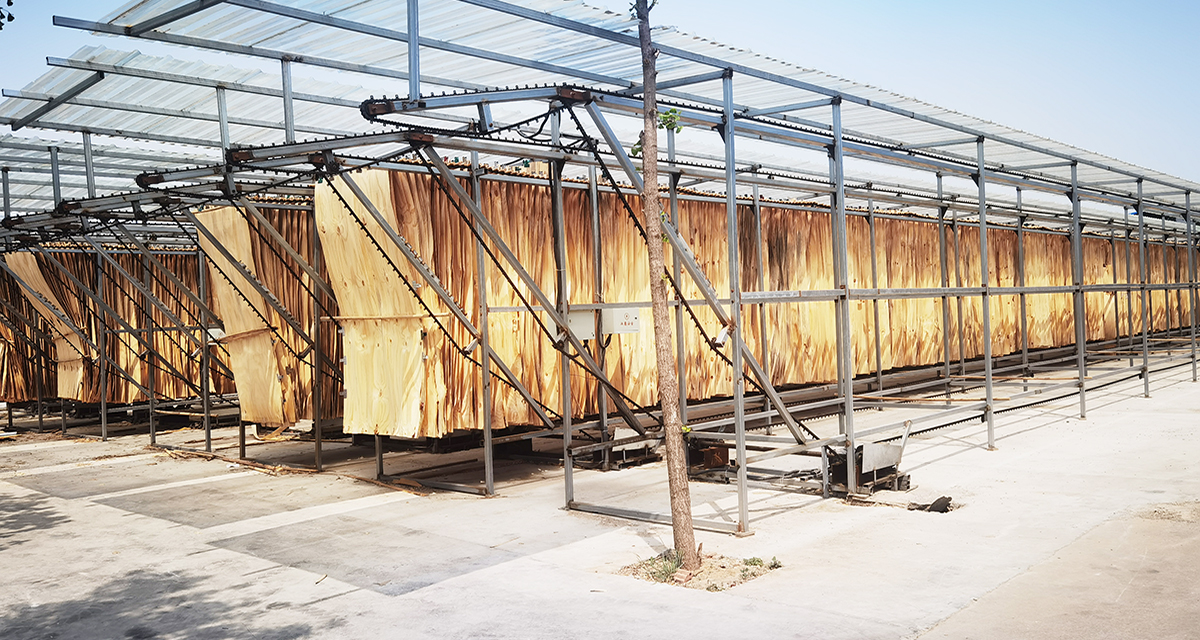
IX. Veneer Drying: A Critical Post-Procedure of Rotary Cutting
Newly produced veneers generally undergo drying treatment according to end usage.
The purpose of veneer drying is not merely moisture reduction, but to achieve proper material status for subsequent plywood assembly and hot pressing.
Drying needs to control veneer transportation, heat exposure, moisture content and uniformity across different zones. Improper drying control may cause veneer warping, cracking or other quality defects and impair later bonding.
Therefore, rotary-cut veneer production lines must maintain a reasonable production rhythm between dryers and rotary cutters.
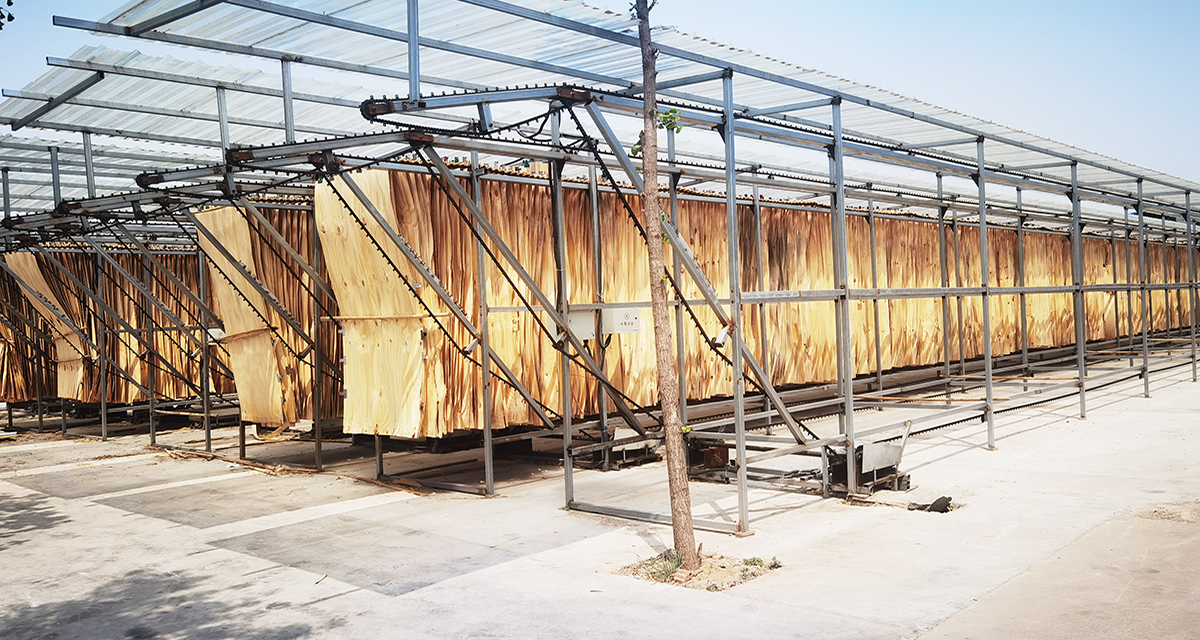
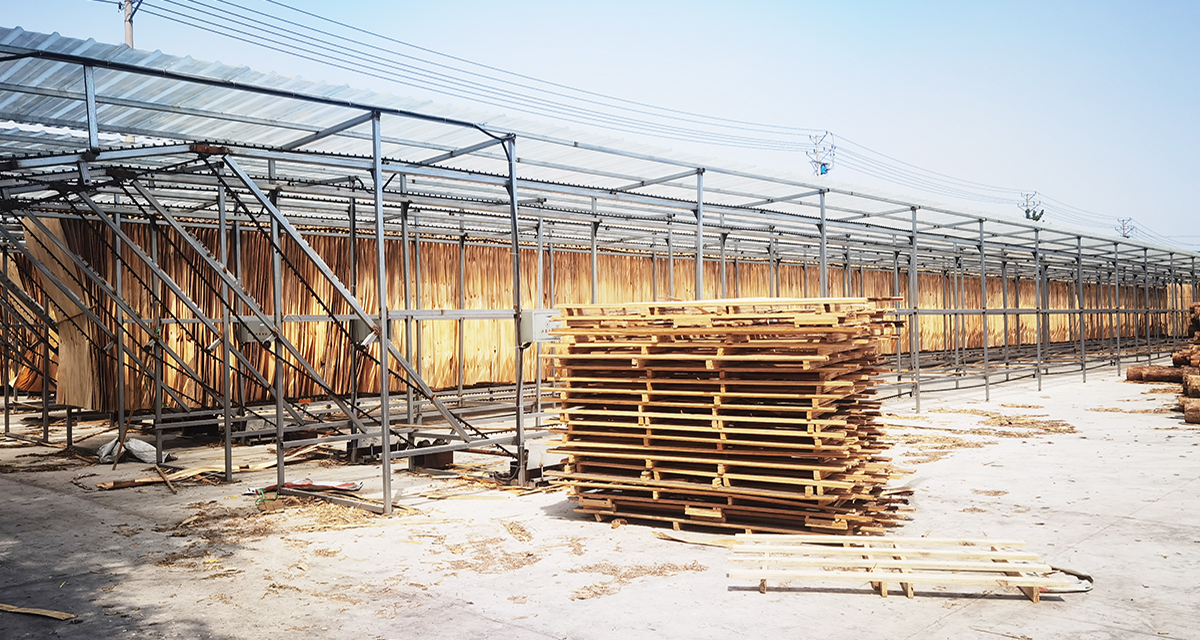
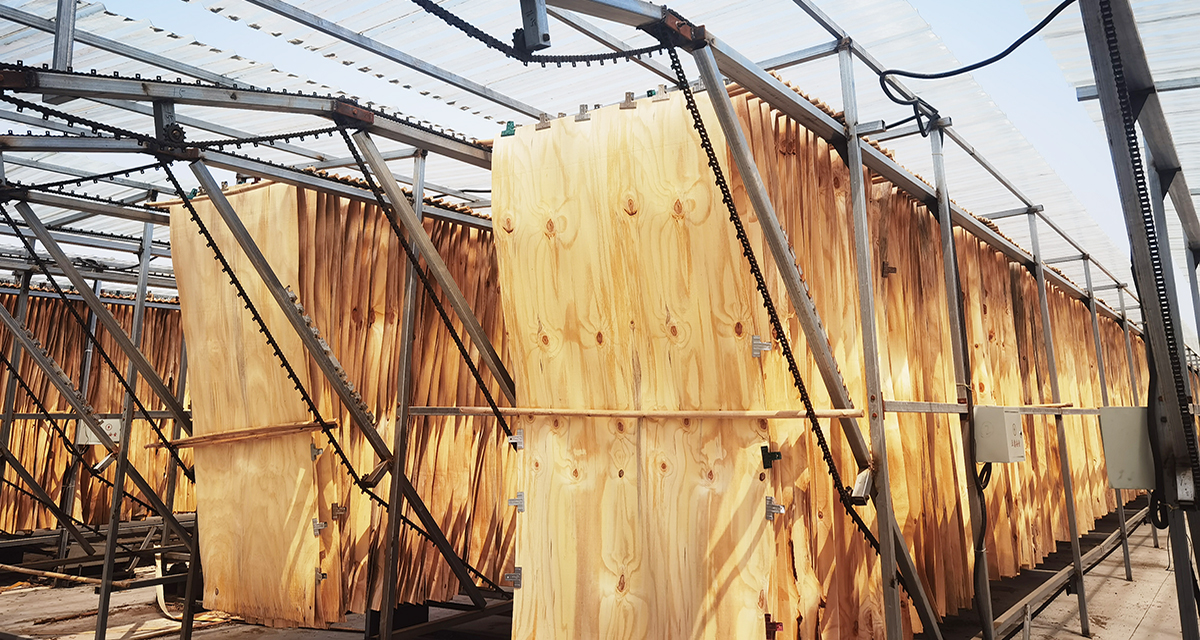
On-site photos provided by users show actual production status of veneers in continuous conveying and drying sections. After rotary cutting, veneers are arranged and processed following workflows to form continuous veneer processing operations. Such production scenarios reflect the transition of veneer manufacturing from standalone machining to continuous production systems.
X. Transition from Rotary-Cut Veneer to Plywood Production
After drying and conditioning, rotary-cut veneers enter the key phase of plywood manufacturing.
The core principle of plywood production is to stack multi-layer veneers in specified grain directions, then form stable interlayer bonding via adhesives and pressure.
This workflow includes gluing, panel assembling, pre-pressing, hot pressing and post-processing.
Different products impose distinct requirements for panel structures, so plywood equipment shall be configured according to product applications.
For instance, products for construction use differ from those for furniture and interior decoration in veneer selection, adhesive types, assembly structures and subsequent surface treatment.
Plywood production lines cannot be simply regarded as a collection of separate machines; they require systematic design based on product specifications.
XI. Alva Machinery’s Plywood Equipment Solutions
For plywood production, Alva Machinery focuses on process connection once veneers enter plywood fabrication.
Based on project demands, equipment can be configured for veneer conditioning, gluing, panel assembling, pre-pressing, hot pressing and subsequent panel processing.
Among these stages, hot pressing is a vital procedure in plywood production. Properly assembled multi-layer veneers need pressing under suitable process parameters to form panels with stable structures.
When designing relevant equipment, Alva Machinery pays attention to machine structure, operation modes, production workflows and inter-equipment connection, and communicates solutions according to clients’ product requirements.
Clients from different countries and regions may differ in raw materials, workshop conditions, energy supply, panel specifications and automation demands. Equipment solutions must therefore be adjusted to match actual project conditions.
XII. From Standalone Machinery to Complete Production Lines
The development of the global wood processing market has gradually changed clients’ procurement patterns for woodworking machinery.
In the past, clients might purchase only rotary lathes, knife grinders, hot presses or other single machines.
For factories building new plywood lines or upgrading production capacity, greater importance is attached to matching performance across the whole production line.
Alva Machinery can combine equipment starting from log handling according to clients’ production workflows.
A typical production sequence is summarized as:
Log storage → Log conveying → Sawing → Feeding → Rounding → Rotary cutting → Veneer trimming → Veneer conveying → Veneer drying → Veneer conditioning → Gluing → Panel assembling → Pressing → Plywood post-treatment
Equipment configuration for individual projects will be adjusted according to log conditions, panel structures, workshop layout and automation requirements.
This production-line-oriented mindset helps clients shift from purchasing separate machines to overall process planning and establishes clearer production links among equipment.
XIII. Impacts of Shifts in International Timber Trade on Equipment Manufacturers
Current global timber trade is affected by multiple factors including raw material supply, logistics, real estate, construction activities, environmental regulations and regional policies.
ITTO continuously releases timber market information and states that trade in tropical timber and plywood is influenced by raw material supply, production costs, end-user demand and international trade environments.
Therefore, wood processing enterprises investing in equipment increasingly value the adaptability of machines to changes in raw material supply and production structures.
For example, shifts in log supply composition may require enterprises to process logs of new species; changes in target markets may demand adjustments to plywood product structures; rising labor costs and production reorganization may push factories to upgrade automation levels.
Equipment suppliers need to deliver adaptable production solutions responding to these changes, instead of merely selling standard machines.
XIV. Growing Attention to Resource Utilization and Wood Processing Efficiency
The global timber industry is attaching rising importance to rational utilization of wood resources.
The whole process from logs to veneers and then plywood essentially realizes graded utilization and value upgrading of timber.
Rotary cutting converts logs into continuous veneers, which are then processed by drying, conditioning, assembling and pressing into plywood products.
During this workflow, stable machine operation, knife maintenance, log utilization, veneer conveying and production organization all affect final material utilization efficiency.
For wood processors, improving equipment stability and optimizing process connection is critical to reduce production losses.
For equipment manufacturers, continuous optimization is required in mechanical structure, automatic control, production line layout and maintenance strategies.
XV. Service Requirements for Wood Processing Equipment in the Global Market
As Chinese woodworking machinery enters more overseas markets, equipment exports are no longer limited to machinery supply alone.
International clients usually also require equipment installation, commissioning, operator training, maintenance guidance, spare parts support and technical communication on production processes.
Especially for complete plywood production lines, strong process links exist between different machines.
Thus, equipment suppliers need to understand clients’ raw materials, products, workshops and production plans and participate in solution consultation at the early project stage.
When serving overseas clients, Alva Machinery prioritizes equipment configuration based on project requirements and conducts technical communication adapted to local production environments, product orientations and workshop conditions of client countries.
Forming a full project service workflow covering equipment manufacturing, production line installation and after-sales technical support constitutes Alva Machinery’s key strategy to compete in the global woodworking machinery market.
XVI. Continuous Layout of Alva Machinery in Rotary-Cut Veneer and Plywood Equipment
Shandong Alva Machinery Group supplies mechanical equipment and production line solutions for the wood processing industry.
For rotary-cut veneer production, Alva Machinery configures equipment covering log storage, conveying, sawing, feeding, rounding, rotary cutting, veneer drying and stacking.
For plywood manufacturing, solution design covers gluing, panel assembly, pressing and related post-procedures after veneers enter plywood production.
Alva Machinery focuses not on isolated operation of individual machines, but on the function of each device within the whole wood processing workflow.
For clients, stable operation of a production line depends on reasonable coordination between all working procedures. Therefore, systematic consideration is required for every stage from log arrival at the factory to finished plywood output.
XVII. Delivering Production Line Solutions for Markets in Different Countries
Countries vary greatly in wood resources, production conditions and end markets.
For instance, some regions are rich in plantation resources, suitable for processing eucalyptus, pine and poplar logs; others rely mainly on hardwood resources, imposing different requirements for machine structures and cutting tools.
Some clients manufacture construction-grade plywood; some target furniture and interior decoration markets; others produce multiple types of wood-based panels simultaneously.
During project consultation, Alva Machinery matches equipment based on clients’ raw materials, product orientation, production workflows, workshop layout and automation requirements.
This approach enables equipment to better fit actual production, rather than applying identical equipment packages to all projects.
XVIII. Future Development Directions of the Rotary-Cut Veneer and Plywood Market
Judging from the development of the global wood product industry, rotary-cut veneer and plywood remain vital products within the wood processing industrial chain.
FAO continuously builds and updates its global forest product production and trade database, demonstrating that international trade of timber products remains an important part of global forest industry statistics and industrial research.
Meanwhile, ITTO has strengthened research on trade data of tropical veneers and plywood in recent years, analyzing statistical differences caused by wood species, density, moisture content and production methods. This reflects constant evolution of product structures of global veneers and plywood.
The development of wood processing equipment will likely continue along several directions in the future:
Production line continuity: Automatic conveying and connection between different procedures will grow more important.
Automation: Automatic feeding, conveying, process control and stacking machines will be adopted in more production projects.
Raw material adaptability: Equipment needs to handle more wood species and varied log conditions.
Production management: Machine operating status, process parameters and maintenance management will gradually form more systematic production management modes.
Resource utilization: Enterprises will pay more attention to log utilization, veneer quality and material management during production.
XIX. Alva Machinery’s Understanding of the Global Woodworking Machinery Market
For wood processing enterprises, mechanical equipment is part of the production system.
A qualified production line must address not only “whether processing can be realized”, but also questions including “how to realize continuous processing”, “how to connect different machines”, “how raw materials are fed”, “how finished products are discharged” and “how to maintain equipment over long-term operation”.
Therefore, in the field of rotary-cut veneer and plywood equipment, Alva Machinery adheres to equipment configuration based on production processes.
Every stage — from log entry into the line, rotary cutting into veneers, veneer drying and conditioning, gluing, panel assembling to pressing — shall be planned according to clients’ actual conditions.
Clients with existing partial equipment can add supplementary machines based on their current production setup; for new projects, overall production workflows can be discussed for solution design.
XX. Conclusion
Rotary-cut veneer is a key link for logs entering plywood and other wood-based product processing systems, while plywood stands as one of the core products in the wood deep-processing industry. Together, they connect log resources, wood processors and multiple end markets including construction, furniture, decoration and packaging.
The global forest product trade system keeps evolving, while the international timber market is affected by raw material supply, regional demand, production costs, trade environment and resource utilization requirements. FAO and ITTO continuously compile and research statistics on global timber, veneer, plywood and other wood-based products, providing fundamental data for industry participants to understand international markets.
Against this industrial backdrop, woodworking machinery enterprises must attach greater importance to production technology, equipment connection and project services.
Shandong Alva Machinery Group will continue to serve the wood processing industry, supplying log handling equipment, rotary-cut veneer machines, plywood-related equipment and production line solutions for clients at home and abroad. Through systematic mastery of log processing, rotary cutting, veneer drying, veneer conditioning and plywood manufacturing processes, we provide tailored machinery configurations for markets with diverse raw materials and product requirements.
From a single log, to one veneer sheet, and finally to a plywood panel, wood processing is a process of continuous material value transformation. Based on wood processing technology, centered on equipment manufacturing and oriented by project demands, Shandong Alva Machinery Group will provide more systematic mechanical support for global wood processors, and promote the development of rotary-cut veneer and plywood production toward continuity, automation and systematization.
Shandong Alva Machinery Group — Specialized in wood processing machinery and production line solutions, providing global clients with equipment support covering log processing, veneer and plywood manufacturing.

 English
 العربية
 Français
 Русский
 Español
 Português
 Deutsch
 italiano
 日本語
日本語 한국어
한국어 Nederlands
 Tiếng Việt
 ไทย
ไทย Polski
 Türkçe
 አማርኛ
አማርኛ ພາສາລາວ
 ភាសាខ្មែរ
 Bahasa Melayu
 ဗမာစာ
ဗမာစာ தமிழ்
தமிழ் Filipino
 Bahasa Indonesia
 magyar
 Română
 Čeština
 Монгол
 қазақ
қазақ Српски
 हिन्दी
 فارسی
فارسی Kiswahili
 Slovenčina
 Slovenščina
 Norsk
Norsk Svenska
 українська
 Ελληνικά
 Suomi
Suomi Հայերեն
 עברית
עברית Latine
 Dansk
Dansk اردو
اردو Shqip
Shqip বাংলা
বাংলা Afrikaans
 Māori
Māori অসমীয়া
 Беларуская мова
 Català


