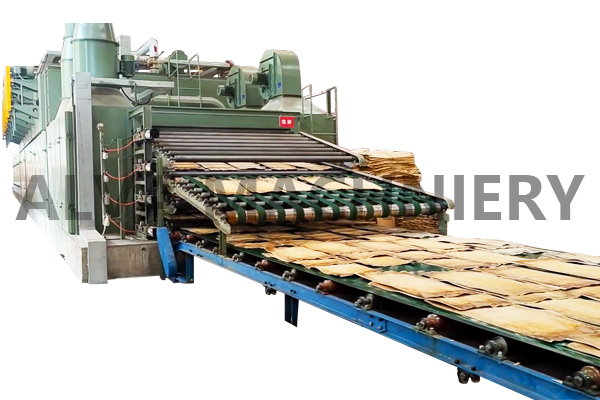
1. Introduction
Why do some plywood lines fail early? Often the drying step causes it. Wet veneers warp or crack fast. A Veneer Dryer solves this problem. It removes moisture with heat and airflow. In this article, you will learn how efficient veneer dryers improve quality and boost woodworking production efficiency.
2. Why Efficient Veneer Drying Is Critical in the Woodworking Industry
The Role of Moisture Control in Veneer Production
Wood naturally absorbs and releases moisture depending on the surrounding environment, which directly affects its dimensional stability and mechanical strength. When veneers are freshly cut from logs, they contain a large amount of water trapped inside the wood fibers. If this moisture is not carefully controlled, the veneer may change shape during storage or processing.
An industrial Veneer Dryer gradually reduces the moisture level in veneers to the ideal range required for manufacturing. Controlled drying ensures that veneer sheets remain flat and structurally stable while also improving the performance of adhesives used in plywood production.
Proper moisture control helps manufacturers achieve several key benefits, including improved veneer flatness, stronger adhesive bonding, better surface quality, and higher overall product durability.
Common Problems Caused by Improper Veneer Drying
If veneers are dried improperly, several defects can occur that negatively impact product quality and production efficiency. Uneven drying conditions often cause internal stresses in the wood, which may lead to deformation or surface damage.
The following table summarizes common veneer drying problems and their causes:
Drying Problem | Main Cause | Impact on Production |
Warping | Uneven moisture removal | Veneer becomes curved |
Surface checking | Excessive heat | Small cracks appear |
Cracking | Rapid moisture loss | Veneer splits easily |
Delamination | High moisture during gluing | Weak bonding |
These defects can significantly increase production waste because damaged veneer sheets often cannot be used in plywood manufacturing or decorative panel production. Efficient drying equipment therefore becomes essential for maintaining stable production quality.
Ideal Moisture Content for Veneer Processing
In most industrial veneer applications, the ideal moisture content ranges from approximately 6% to 12%. Veneers that are too wet may shrink or distort after pressing, while veneers that are too dry can become brittle and difficult to handle.
The drying process becomes more energy-intensive once the moisture level falls below the fiber saturation point, which generally occurs between 25% and 30%. At this stage, the remaining water is bound within the wood fibers and requires higher energy input for removal. Therefore, modern drying systems use automated monitoring technologies to maintain precise moisture control throughout the drying cycle.
Impact of Proper Drying on Finished Wood Products
The drying quality of veneers has a direct influence on the final quality of plywood, laminated panels, and furniture components. Evenly dried veneers maintain their flatness during pressing, which helps create smooth and stable finished panels.
Proper veneer drying also improves adhesive bonding and reduces the risk of delamination in plywood products. Manufacturers who maintain consistent drying conditions often experience fewer defects, improved product durability, and greater production efficiency.
3. How a Veneer Dryer Works: The Drying Process Explained
Feeding and Transport Systems in a Veneer Dryer
The drying process begins when veneer sheets enter the dryer through automated feeding systems. These systems typically use conveyor belts or roller transport structures to move the veneer sheets smoothly through the drying chamber while maintaining their flat shape.
Continuous feeding systems are particularly important for large plywood factories because they allow veneers to move through the dryer without interruption, which helps maintain stable production flow and improves manufacturing efficiency.
Heat Application and Moisture Evaporation Mechanism
Inside the drying chamber, heat energy is applied to the veneer sheets using steam heating systems, hot air circulation, or thermal oil heating. As the temperature of the wood fibers increases, the moisture inside the veneer begins to evaporate and move toward the surface.
Once the moisture reaches the surface, airflow systems remove the vapor from the chamber, allowing additional moisture to migrate outward from the interior of the veneer.
Air Circulation and Ventilation for Uniform Drying
Airflow plays a critical role in veneer drying because it distributes heat evenly across the veneer sheets and carries away evaporated moisture. Industrial veneer dryers typically use powerful circulation fans and well-designed air ducts to maintain consistent airflow throughout the drying chamber.
Efficient drying relies on three key elements—dry air, heat energy, and proper air movement—which work together to remove moisture from wood materials. :contentReference[oaicite:0]{index=0}
Without balanced airflow, moisture may accumulate in certain areas, leading to uneven drying and product defects.
Moisture Monitoring and Automated Control Systems
Modern veneer dryers are equipped with advanced monitoring systems that track temperature, humidity, and moisture levels in real time. Sensors installed inside the dryer provide continuous feedback to automated control systems, which adjust the drying parameters to maintain optimal conditions.
This automation helps prevent problems such as overdrying or overheating and ensures that veneer sheets reach the target moisture content before leaving the dryer.
Cooling and Stabilization After Drying
After the drying stage is completed, veneers pass through a cooling zone where the temperature gradually decreases. Controlled cooling is important because sudden temperature changes may create internal stresses in the wood, which could cause cracking or deformation.
By stabilizing the veneer before it exits the dryer, manufacturers can ensure that the material is ready for stacking, gluing, and pressing processes.
4. Types of Veneer Dryer Systems Used in Modern Woodworking
Several types of veneer dryers are used in industrial wood processing, each designed to meet specific production requirements.
Dryer Type | Features | Suitable Application |
Roller Veneer Dryer | Continuous drying with rollers | High-volume plywood production |
Conveyor Veneer Dryer | Gentle drying with belt transport | Thick or delicate veneers |
Vacuum Veneer Dryer | Low-temperature drying under vacuum | Premium hardwood veneers |
Roller dryers are the most common choice for plywood factories because they combine high production capacity with consistent drying performance.
A practical example of modern drying technology is the Rotary Drum Roller Veneer Dryer produced by Alva Machinery Co., Ltd. This equipment is designed specifically for plywood production lines and serves as a key connection between the veneer peeling process and the gluing stage.
The machine is suitable for veneers with thicknesses ranging from 0.2 mm to 5 mm, and it uses a composite drying method that combines roller conductive heating with hot air convection. This integrated design ensures that moisture is removed precisely while maintaining the structural integrity of the veneer sheets.
One of the core advantages of this system is its roller-based structure, which has been precisely processed and temperature calibrated. The rollers apply gentle pressure and uniform heat to the veneer surface, which produces a natural smoothing effect while eliminating small warping that may occur during the peeling process.
During operation, the veneer sheets move between sets of rotating rollers that allow slight transverse movement. This design allows the veneer to shrink naturally as moisture evaporates, which effectively reduces internal stress within the wood and prevents defects such as cracking or splitting.
Another advantage of this dryer is its ability to combine drying and shaping functions in one process. The veneer emerges from the dryer with a smooth surface and consistent moisture content, which provides an ideal base material for the gluing and pressing stages of plywood production.
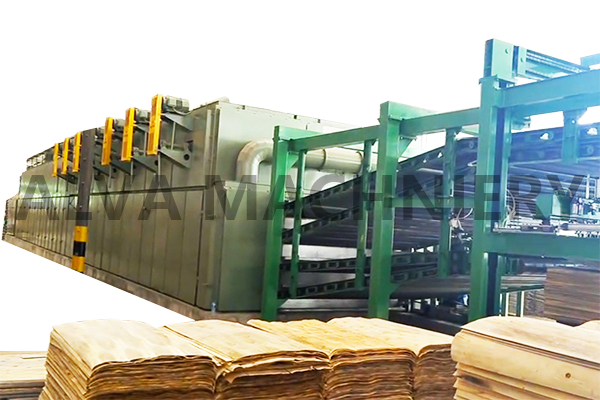
Key Technical Specifications
Parameter | Value |
Working width | 2800 mm |
Veneer thickness | 1.5–4.5 mm |
Initial moisture content | 65% |
Final moisture content | 10% ±2 |
Drying temperature | 130–160°C |
Veneer speed | 1.5–15 m/min |
Drying capacity | Up to 5.5 m³/h |
These technical parameters demonstrate that the machine can support large-scale continuous production while maintaining precise moisture control.
Major Advantages of the Alva Roller Veneer Dryer
1. High Production Efficiency
The machine is designed to match common plywood sizes such as 4×8 ft and 3×6 ft veneer sheets. A single drying cycle typically takes 30–40 minutes, which allows factories to achieve high hourly processing volumes.
2. Uniform Drying Quality
The equipment uses a scientifically designed hot-air circulation system with upper and lower air nozzles that distribute heat evenly across the veneer surface. This ensures uniform drying while preventing defects such as carbonization, warping, or cracking.
3. Intelligent Control System
The dryer uses modular drying chambers and high-precision temperature sensors combined with variable-frequency control systems. These technologies allow operators to adjust drying parameters according to veneer moisture content and production requirements.
4. Flexible Adaptability
The system can process veneers made from different wood species such as eucalyptus and pine, and operators can adjust feeding speed, temperature, and airflow parameters to match various production needs.
6. Benefits of Using an Efficient Veneer Dryer in Woodworking Production
Using a high-performance Veneer Dryer provides several advantages for woodworking manufacturers. Faster drying cycles allow factories to process more veneer sheets within shorter time periods, which increases overall production capacity.
Controlled drying conditions also improve veneer quality by preventing defects such as warping or uneven moisture distribution. This stability ensures stronger bonding during plywood pressing and improves the durability of the finished product.
Efficient drying systems also reduce material waste because fewer veneer sheets are damaged during processing. As a result, manufacturers can reduce raw material costs and improve sustainability in wood production.
7. Factors to Consider When Choosing the Right Veneer Dryer
Selecting the appropriate veneer drying equipment requires careful evaluation of several factors, including veneer thickness, wood species, production capacity, and energy consumption. Hardwoods generally require slower drying schedules than softwoods, while thicker veneers require longer drying cycles.
Manufacturers should also consider how well the drying system integrates with existing production lines, including peeling machines, stacking equipment, and plywood presses. Proper integration ensures smooth material flow and prevents bottlenecks in the manufacturing process.
8. Maintenance and Operational Tips for Maximizing Veneer Dryer Efficiency
Proper maintenance is essential for ensuring stable operation and long equipment life. Regular inspections should be performed on rollers, conveyors, and circulation fans to ensure smooth mechanical operation. Operators should also calibrate moisture sensors and control systems periodically to maintain accurate monitoring.
Preventive maintenance tasks such as cleaning air ducts, checking insulation materials, and lubricating moving parts can significantly extend equipment lifespan and reduce unexpected downtime.
9. Conclusion
Efficient veneer drying is a crucial step in modern woodworking manufacturing because it directly affects both production efficiency and product quality. A reliable Veneer Dryer ensures precise moisture control, which helps veneers maintain their structural stability and prepares them for gluing and pressing processes.
Advanced drying equipment such as the Alva Roller Veneer Dryer developed by Alva Machinery Co., Ltd. demonstrates how modern technology can combine high production capacity, intelligent control systems, and energy-efficient operation to support large-scale plywood manufacturing. By investing in high-performance drying systems from Alva Machinery Co., Ltd., woodworking companies can improve product consistency, reduce material waste, and strengthen their competitive position in the global wood processing industry.
FAQ
Q: What does a Veneer Dryer do in plywood production?
A: A Veneer Dryer removes moisture from thin veneers and prepares them for gluing and pressing in plywood manufacturing.
Q: Why is an efficient Veneer Dryer important for woodworking factories?
A: An efficient Veneer Dryer ensures uniform drying, reduces defects, and improves productivity in industrial veneer drying equipment.
Q: How does a roller veneer dryer improve drying quality?
A: A roller Veneer Dryer combines conductive heating and hot air convection to dry veneers evenly while preventing warping or cracking.
Q: What moisture level should veneers reach after drying?
A: Most veneer drying machines reduce moisture from about 60–65% to around 10% for stable plywood bonding.
Q: How long does veneer drying usually take?
A: With a modern Veneer Dryer, a drying cycle typically takes 30–40 minutes in continuous plywood production lines.
Q: What factors affect Veneer Dryer performance?
A: Key factors include veneer thickness, drying temperature, airflow design, and feeding speed in the veneer drying process.

 English
 العربية
 Français
 Русский
 Español
 Português
 Deutsch
 italiano
 日本語
日本語 한국어
한국어 Nederlands
 Tiếng Việt
 ไทย
ไทย Polski
 Türkçe
 አማርኛ
አማርኛ ພາສາລາວ
 ភាសាខ្មែរ
 Bahasa Melayu
 ဗမာစာ
ဗမာစာ தமிழ்
தமிழ் Filipino
 Bahasa Indonesia
 magyar
 Română
 Čeština
 Монгол
 қазақ
қазақ Српски
 हिन्दी
 فارسی
فارسی Kiswahili
 Slovenčina
 Slovenščina
 Norsk
Norsk Svenska
 українська
 Ελληνικά
 Suomi
Suomi Հայերեն
 עברית
עברית Latine
 Dansk
Dansk اردو
اردو Shqip
Shqip বাংলা
বাংলা Afrikaans
 Māori
Māori অসমীয়া
 Беларуская мова
 Català


