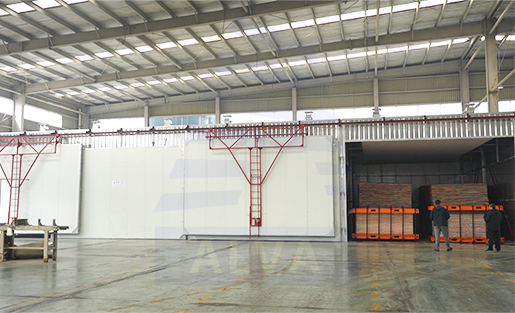
Wood absorbs and releases moisture constantly. This can cause warping, cracking, or weak boards. A drying kiln controls temperature, humidity, and airflow. It helps wood reach optimal moisture safely. In this article, you will learn how it works.
Fundamentals of a Drying Kiln
What Is a Drying Kiln?
A drying kiln is a chamber specifically engineered to accelerate wood drying by creating controlled environmental conditions, including precise temperature, airflow, and humidity regulation. Unlike natural air-drying, which may take months or even years, a drying kiln can achieve consistent results in days or weeks. The controlled environment ensures uniform drying, prevents cracking and warping, and allows manufacturers to maintain consistent wood properties for downstream machining, assembly, or finishing processes.
Why Kiln Drying Is Important
Kiln drying is essential to prevent wood defects and improve its usability, as excessive moisture or uneven drying can compromise structural integrity and surface quality. By maintaining target moisture levels, a drying kiln improves dimensional stability, reduces weight, enhances strength, and prevents issues caused by fungi or insects. Moreover, kiln-dried wood supports precise machining, better adhesive performance, and longer service life, which is crucial for commercial manufacturing and large-scale production.
Types of Drying Kilns
There are several types of wood drying kilns, each optimized for different applications:
Kiln Type | Method of Heating | Advantages | Disadvantages |
Conventional Steam Kiln | Steam pipes radiate heat | Simple, widely used | Slower, high energy use |
Dehumidification Kiln | Heat recycled, moisture condensed | Energy-efficient, environmentally friendly | Higher electricity cost |
Vacuum Kiln | Reduced pressure, faster drying | Rapid drying, preserves color and quality | Expensive, limited capacity |
Solar Kiln | Sunlight + airflow | Low operational cost, eco-friendly | Weather-dependent, slower |
Modern industrial kilns, such as the Alva wood drying kiln, feature touch-screen control systems, precise temperature and humidity management, and adjustable airflow to meet production demands efficiently. These kilns can handle softwood and hardwood species such as pine, fir, and eucalyptus while providing stable, high-quality drying results.
Core Principles
Drying kilns operate on heat transfer and moisture evaporation. Hot air heats the wood surface and penetrates through conduction to the core, causing moisture to migrate outward as vapor. Fans and vents remove this moisture continuously, allowing wood to achieve equilibrium moisture content without developing internal stress, surface cracks, or structural weakening.
Energy and Environmental Considerations
Modern kilns incorporate energy-saving technologies, such as heat recycling in dehumidification systems, and can utilize biomass, electricity, gas, or hybrid energy sources. Efficient kilns minimize energy consumption and reduce environmental impact while maintaining consistent drying outcomes. Some models, including the Alva series, employ low-temperature drying methods to protect wood adhesives and prevent resin degradation, ensuring both high-quality output and sustainability.
Consider dehumidification kilns for high efficiency and environmental compliance in commercial operations.
The Drying Process Step by Step
Loading and Stacking Lumber
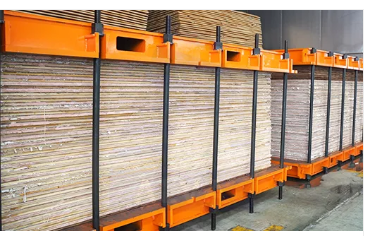
Before drying, lumber is sorted by species, thickness, and grade. Boards are stacked with stickers to promote airflow, which prevents uneven moisture removal and surface deformation. Proper stacking also reduces mechanical stress, especially in dense hardwoods, ensuring the final product maintains shape and stability.
● Pre-Conditioning Stage
Pre-conditioning gradually warms the wood to a target temperature while controlling humidity to prevent surface checks and internal stress. Slow, controlled heating prepares the wood for more rapid moisture removal while preserving the fiber structure and surface quality.
● Active Drying (Fanning)
Industrial fans circulate hot air, promoting uniform moisture evaporation from both the surface and the core of the wood. Relative humidity and airflow are continuously adjusted, taking board thickness and species into account, to avoid internal stress and uneven drying.
● Conditioning Stage
During conditioning, moisture is slightly increased to relieve internal tension. This step balances the moisture gradient between the core and surface, preventing casehardening and cupping, and stabilizes the wood for safe removal from the kiln.
● Cooling Stage
Gradual cooling allows the wood to reach ambient temperature without causing shrinkage or cracks. Rapid cooling can reintroduce stress and lead to deformation, so the cooling phase is critical for dimensional stability and surface quality.
Use sensors or sample boards during each stage to monitor moisture levels and prevent potential defects before the wood exits the kiln.
Understanding Drying Stresses and Defects
Stage 1: Stress-Free Initial Drying
At the beginning, moisture is evenly distributed, and wood is stress-free. Outer fibers reach fiber saturation point (FSP) first, and careful environmental control ensures no tension or compression develops prematurely.
Stage 2: Tension and Compression Development
As moisture migrates from the surface to the air, outer fibers shrink faster than the core, creating surface tension and internal compression. Improper management can cause surface checks or internal buckling, which can compromise wood strength and appearance.
Stage 3: Casehardening
When surface layers shrink excessively compared to the core, residual stress, known as casehardening, may develop, causing cupping or warping. Controlled conditioning or steam injection is required to relieve stress and restore equilibrium between surface and core moisture levels.
Monitoring Moisture and Stress
Sample boards and moisture probes are used to track moisture content and stress development. This monitoring allows timely adjustment of kiln parameters, ensuring uniform drying and reducing defects.
Daily checks and precise monitoring of wood moisture levels improve kiln efficiency and final product quality.
Impact of Kiln Drying on Wood Properties
Surface Characteristics
Proper kiln drying enhances grain patterns, smoothness, and surface hardness, while avoiding premature hardening or resin-related defects. Low-temperature kilns, such as those used in plywood drying, prevent surface cracking and maintain smooth, clean panels, optimizing appearance and post-processing efficiency.
Strength and Durability
Controlled drying maintains wood strength, as higher moisture content can reduce structural integrity while over-drying can cause brittleness. Kiln-dried wood provides reliable performance for high-stress applications, including flooring, furniture, and structural components.
Dimensional Stability
Kiln drying minimizes shrinkage, warping, and internal stress, ensuring consistent dimensions for precision manufacturing. Wood processed in advanced kilns like the Alva system demonstrates improved stability even under varying environmental conditions.
Property | Effect of Kiln Drying | Risk of Improper Drying |
Moisture Content | Achieves target levels | Warping, cracking, casehardening |
Surface Hardness | Enhanced, smooth surfaces | Over-hardening, rough finish |
Dimensional Stability | High, precise machining ready | Shrinkage, cupping, distortion |
Strength | Maintained or improved | Weak structure, brittleness |
Kiln-dried wood is essential for projects requiring precision, consistency, and durability.
Kiln Drying vs Air Drying
● Time Efficiency
Kiln drying reduces drying time from months to days, greatly accelerating production cycles and improving inventory turnover, while air-drying is limited by climate and seasonal factors.
● Quality Control
Kilns provide uniform moisture content and fewer defects. Air-drying is less predictable and may result in inconsistent quality, surface checking, or internal cracks.
● Cost-Benefit Analysis
Though kilns require significant capital, they reduce waste, improve material utilization, and lower long-term costs due to fewer defects and higher efficiency.
● Environmental and Safety Considerations
Kiln-dried wood eliminates pests, fungi, and mold, while low-temperature methods protect adhesives in plywood and reduce particulate emissions, enhancing safety and environmental compliance.
Practical Considerations for Using a Drying Kiln
● Choosing the Right Kiln Type
The choice depends on wood species, volume, desired speed, and operational budget. Dehumidification and low-temperature kilns are ideal for sensitive woods and high-value plywood products.
● Controlling Temperature, Humidity, and Airflow
Precise control prevents uneven drying, internal stress, and surface defects. Advanced models offer touch-screen controls and programmable settings for flexibility and consistency.
● Preventing Shrinkage and Cracks
Adjust drying benchmarks, perform intermediate steam treatments, and stack lumber properly with aligned stickers to minimize defects and maintain wood integrity.
● Post-Kiln Storage and Maintenance
Store dried wood in dry, ventilated environments to prevent reabsorption of moisture. Regular monitoring ensures long-term stability, essential for large-scale B2B operations.
Implement proper storage protocols to preserve kiln-dried wood quality for distribution and production.
Investment and Industry Relevance
● Cost and ROI
Kilns have a high upfront cost but improve product quality, reduce material losses, and increase throughput, providing measurable long-term financial benefits for industrial-scale wood processors.
● Technological Advancements
Modern kilns feature automation, modular designs, and energy-efficient systems, reducing labor, energy use, and operational risk while improving drying accuracy.
● Market Demand
Kiln-dried lumber is critical for flooring, furniture, cabinetry, and high-precision woodworking. Demand for reliable, defect-free wood supports continued investment in advanced kilns.
● Environmental Impact
Energy-efficient kilns and low-temperature systems reduce carbon emissions and minimize the environmental footprint while preserving wood properties and adhesive performance in plywood production.
Investing in advanced kiln technology strengthens competitiveness in quality-focused wood industries.
Conclusion
A drying kiln efficiently manages temperature, humidity, and airflow to remove moisture from wood, ensuring uniform drying and minimizing defects such as warping, cracking, and casehardening. Advanced kilns, like the Alva wood drying kiln from Shandong Alva Machinery Group Co., Ltd., established in 2001, or low-temperature plywood kilns, enhance surface quality, maintain structural strength, and improve dimensional stability, making them indispensable for high-quality manufacturing, large-scale production, and B2B supply chains. Using kiln-dried wood ensures consistent performance, reduces material losses, and maximizes long-term operational efficiency.
FAQ
Q: What is a wood drying kiln?
A: A drying kiln is a controlled chamber that removes moisture from wood to prevent warping and cracking.
Q: How does a drying kiln work?
A: It manages temperature, humidity, and airflow to dry wood evenly while maintaining strength and stability.
Q: Why should I use a drying kiln for lumber?
A: Kiln drying reduces defects, improves dimensional stability, and ensures consistent wood quality for manufacturing.
Q: How long does wood take to dry in a kiln?
A: Drying time varies by species and thickness, typically from a few days to several weeks.
Q: What are the benefits of kiln-dried wood?
A: It prevents shrinkage, improves strength, enhances surface quality, and extends the wood’s service life.

 English
 العربية
 Français
 Русский
 Español
 Português
 Deutsch
 italiano
 日本語
日本語 한국어
한국어 Nederlands
 Tiếng Việt
 ไทย
ไทย Polski
 Türkçe
 አማርኛ
አማርኛ ພາສາລາວ
 ភាសាខ្មែរ
 Bahasa Melayu
 ဗမာစာ
ဗမာစာ தமிழ்
தமிழ் Filipino
 Bahasa Indonesia
 magyar
 Română
 Čeština
 Монгол
 қазақ
қазақ Српски
 हिन्दी
 فارسی
فارسی Kiswahili
 Slovenčina
 Slovenščina
 Norsk
Norsk Svenska
 українська
 Ελληνικά
 Suomi
Suomi Հայերեն
 עברית
עברית Latine
 Dansk
Dansk اردو
اردو Shqip
Shqip বাংলা
বাংলা Afrikaans
 Māori
Māori অসমীয়া
 Беларуская мова
 Català


