I. Introduction
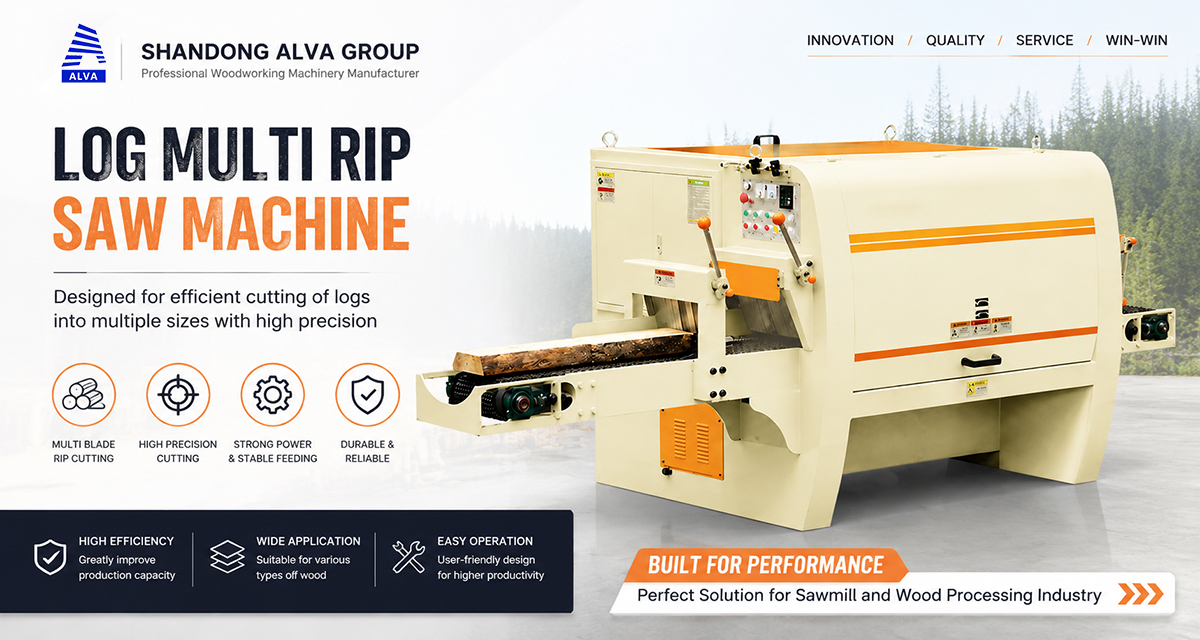
The log multi‑blade sawing machine is a piece of wood processing equipment used for the longitudinal cutting of logs. The machine was independently developed by Shandong Alva Machinery Group and represents an important achievement in the field of wood sawing technology. Its core function is to process logs into multiple boards of preset specifications in a single pass, playing a critical role in the pre‑processing stages of blockboard, finger‑jointed board, and other panel production.
In terms of equipment types, log multi‑blade saws are mainly divided into horizontal and vertical categories. The horizontal multi‑blade saw features vertically oriented saw blades that cut logs in the vertical direction, making it suitable for center‑squaring operations. The vertical multi‑blade saw has horizontally oriented saw blades, suitable for full‑slicing of logs. Each type has its specific applications, and users can choose based on their actual processing requirements.
Shandong Alva Machinery Group has been active in the log multi‑blade saw field for many years, with its products exported to more than thirty countries and regions worldwide, earning broad recognition from domestic and international customers. As a modern woodworking machinery enterprise that integrates independent R&D, precision manufacturing, global sales, and full‑process after‑sales service, Alva has accumulated extensive experience in this sector.
II. Working Principle and Equipment Structure
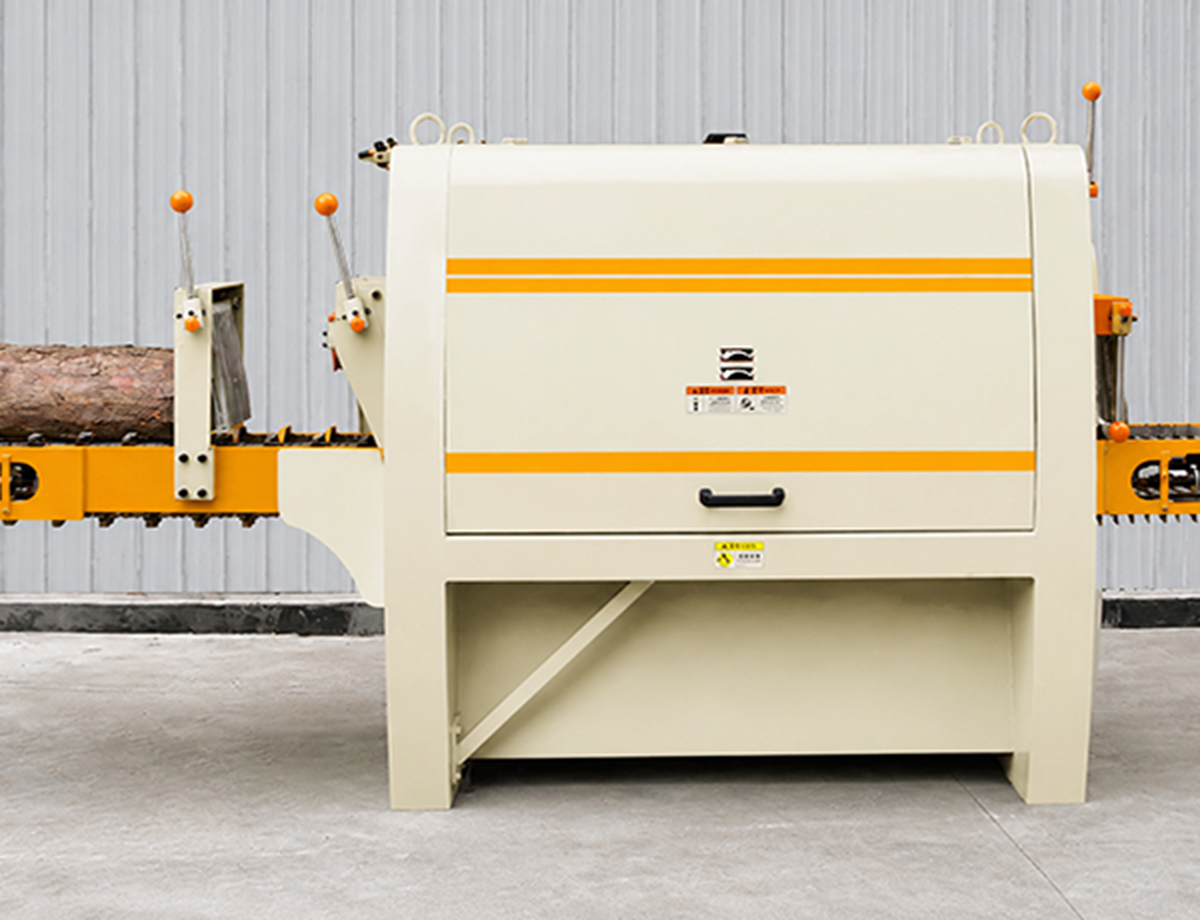
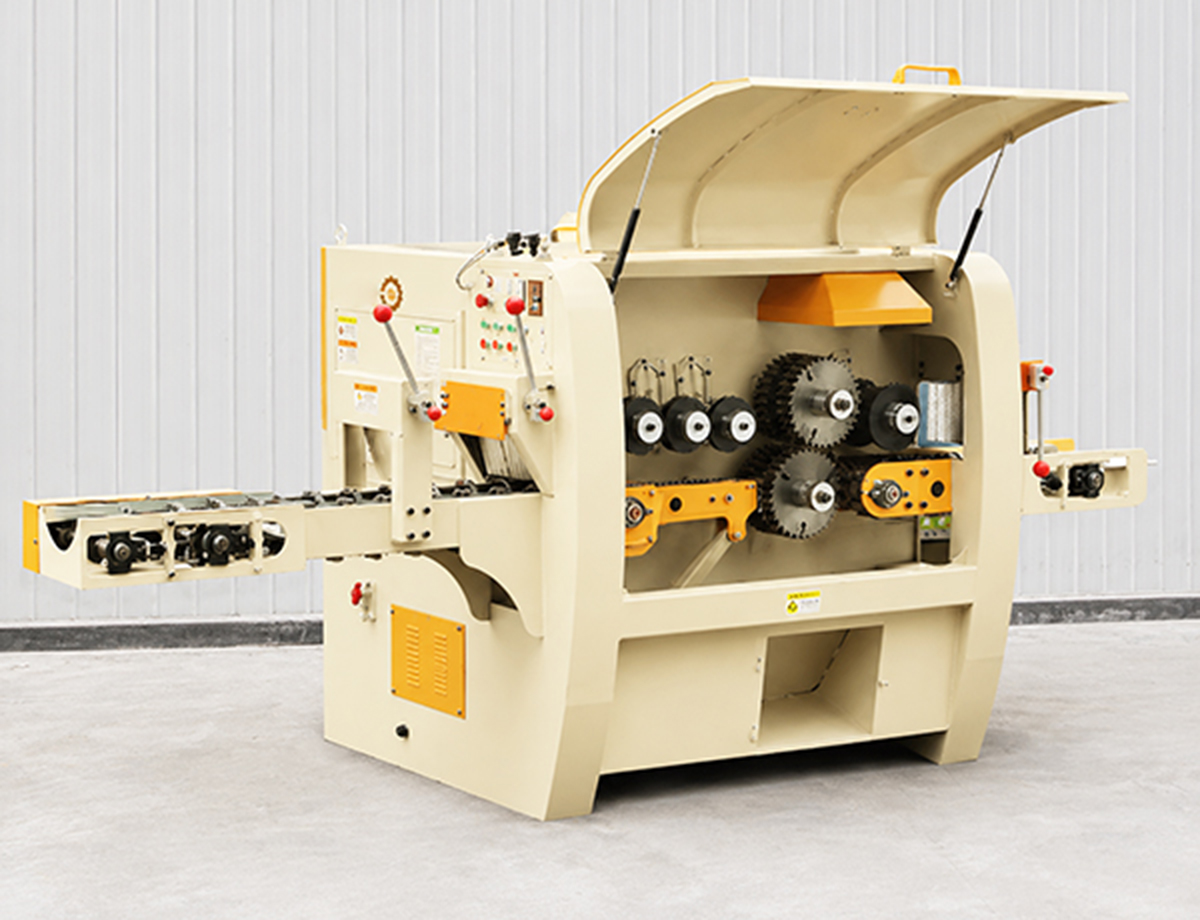
The basic structure of a log multi‑blade sawing machine consists of two main parts: the machine body assembly and the feeding mechanism. The machine body is equipped with an upper saw blade shaft and a lower saw blade shaft, each carrying multiple saw blades installed coaxially. The corresponding blades on the upper and lower shafts are positioned in the same vertical plane, but the vertical centerline of the upper shaft does not align with that of the lower shaft. This staggered blade arrangement allows the cutting load to be distributed across multiple blades during sawing, helping to reduce the cutting load on each individual blade.
The feeding mechanism typically comprises a transmission chain, guide plates, a V‑shaped trough, and supporting components. During operation, the operator selects the feed speed according to the log diameter. The chain moves continuously along the guide plate trough, feeding the log placed in the V‑shaped trough into the cutting zone. Some models employ a double‑row sharp‑tooth chain feeding structure, which offers advantages in feeding stability.
On the cutting spindle, users can adjust board thickness by adding or removing circular saw blades. The blades are equipped with heat dissipation holes and noise reduction slots—the former to reduce the risk of deformation caused by heat generated under high‑speed rotation, and the latter to reduce operational noise.
Alva's log multi‑blade saws place particular emphasis on structural stability and durability. The equipment adopts a welded steel frame structure that undergoes stress‑relief annealing treatment to ensure that the structure does not deform over prolonged use. Core cutting components (saw blades, spindles, and bearings) are manufactured from high‑wear‑resistant, high‑strength materials. The internal structural design facilitates easy disassembly and replacement, effectively controlling maintenance costs and downtime.
III. Main Functions and Processing Characteristics
The main functions of the log multi‑blade sawing machine are as follows.
Longitudinal sawing. The machine is primarily used for longitudinal cutting of logs, i.e., cutting along the grain direction. In a single feed pass, it produces multiple boards according to preset dimensions, eliminating the need for repeated passes. For blockboard and finger‑jointed board manufacturers, this represents a key processing step in the pre‑production stage.
Center squaring. On horizontal multi‑blade saws, users can perform center‑squaring operations. Specifically, they can take one square from the center, two squares from the center, or simultaneously square the center while slicing the outer edges. This processing method is suitable for applications where squared timber needs to be obtained from logs.
Full slicing. Vertical multi‑blade saws can fully slice logs, cutting them into boards of natural width. Horizontal multi‑blade saws also support full‑slicing functionality. This application is used in board production, where one log can be split into multiple boards of specified thickness in a single pass.
Wet and dry processing. The log multi‑blade saw can process both dry and wet timber. Whether the material is air‑dried wood or freshly harvested logs with relatively high moisture content, the machine can operate normally without requiring frequent parameter adjustments due to differences in moisture content.
Adaptation to long and short logs. The equipment can process logs of varying lengths, accommodating both long and short material. The specific processing range varies by model, with certain models capable of handling logs up to several meters in length.
Alva's log multi‑blade saws demonstrate notable performance in processing accuracy. Through an optimized sawing structure and drive system, the equipment achieves a balance between cutting efficiency and precision. During sawing, precise feed control and blade positioning ensure consistency in board thickness and width, reducing processing errors and improving timber utilization.
IV. Comparison with Traditional Band Saws
Compared with traditional band saws, the log multi‑blade sawing machine exhibits differences in several aspects.
Processing efficiency. The multi‑blade saw employs simultaneous cutting with multiple blades, completing the sawing of multiple boards in a single pass. In contrast, a band saw can only cut one board at a time and is more suitable for small‑batch production. From a capacity perspective, multi‑blade saws can achieve higher daily output, offering advantages in batch production scenarios.
Processing accuracy. The sawing process of multi‑blade saws is relatively stable, producing boards with good thickness accuracy and surface finish. The cut surfaces are smooth and flat, and in some cases, one semi‑finishing step may be eliminated.
Operational skill requirements. The multi‑blade saw is relatively simple and convenient to operate, with no high skill requirements for operators. Ordinary workers can operate the machine after a brief training, without the need for specialized band‑saw technicians. This helps enterprises reduce labor costs to some extent.
Safety. The power transmission devices and saw blades of band saws are typically exposed, posing certain safety risks during operation. Multi‑blade saws, however, feature more comprehensive safety protection, with the power transmission system and blades enclosed within the machine housing.
Alva's log multi‑blade saws demonstrate distinct characteristics in each of these comparison dimensions. The equipment employs high‑performance drive systems and optimally designed blade assemblies, enabling high‑speed, stable blade operation with rapid cutting response and clean edges. In terms of material utilization, kerf loss is well controlled, contributing to improved timber yield.
V. Application Fields
The log multi‑blade sawing machine is widely used in the wood processing industry.
In panel production, the equipment is primarily used in the pre‑processing stages of blockboard and finger‑jointed board manufacturing. The blockboard multi‑blade saw is suitable for processing fir, pine, eucalyptus, poplar, and other wood species, serving as equipment for producing finger‑jointed boards, blockboards, construction panels, and furniture squares.
In furniture manufacturing, the machine is used for processing timber for solid wood flooring, wooden pallets, solid wood furniture, and other products. The furniture industry has specific requirements for board dimensions and surface quality, and the accuracy performance of multi‑blade saws enables them to meet these requirements.
In building materials, the equipment can be used for processing construction formwork, studs, joists, and other structural timber. The construction industry consumes large quantities of timber and places high demands on processing efficiency, making the high‑capacity feature of multi‑blade saws valuable in such applications.
In terms of wood species, the machine can process pine, fir, mixed hardwood, rubberwood, acacia, poplar, and many other types, covering both softwood and hardwood categories. When faced with variations in hardness among different wood species, the equipment can adjust feed speed and cutting parameters accordingly to prevent chipping and splitting, thereby improving finished product quality. For logs of different dimensions and materials, the machine can flexibly adjust cutting logic, supporting both longitudinal cutting and cross‑cutting as required.
Alva's products have been widely applied in various industries, including wood processing, furniture manufacturing, and construction materials. Whether as a stand‑alone unit for flexible cutting in small‑scale workshops or integrated into automated production lines with upstream feeding conveyors and downstream sorting equipment, the machines can be effectively adapted.
VI. Equipment Selection Considerations
Users should consider the following factors when selecting a model.
Processing objectives. If the primary requirement is center squaring, a horizontal log multi‑blade saw should be chosen. The horizontal saw cuts logs vertically, allowing center‑extraction from logs of different diameters. If the primary requirement is full slicing, a vertical multi‑blade saw may be selected.
Raw material specifications. Different models are suitable for different log diameter and length ranges. Users should choose equipment that matches the actual specifications of their raw materials.
Automation level. Some models use variable‑frequency drive feed systems, allowing feed speed to be adjusted according to processing needs. Some advanced models incorporate CNC technology with measuring systems for width calibration. Users can choose configurations based on their budget and production requirements.
Alva has developed multiple product series in the log multi‑blade saw field, covering different processing lengths and processing methods. Through modular design and structural optimization, the equipment can handle logs of various diameters and lengths, as well as secondary processing of squared timber and semi‑finished boards, without requiring core component changes when switching between tasks. The equipment can also be customized and manufactured according to customer specifications.
VII. Operation and Maintenance
Proper operation and maintenance are essential for long‑term stable performance of the equipment.
Operational precautions. Before use, check whether the saw blades conform to design specifications, and inspect for damage, deformation, broken teeth, and sharpness. Ensure that safety guards are in place and never remove them during operation. When replacing blades, first disconnect power, use a dedicated wrench to loosen the nut on the spindle in the direction of blade rotation, and remove or install blades one by one. Ensure that blades are installed in the correct direction and that no debris remains between blades and spacers.
Routine maintenance. Regularly inspect and adjust the feed chain, feed motor chain, and guide motor. Periodically check the tension of the main motor belt. Lubricate the housing oil cups at scheduled intervals and verify that oil lines are properly aligned. Spacers, blades, and guide plates should be cleaned regularly with diesel fuel, dried with clean cloths, and reinstalled without any residual debris. The spindle box traverse rails and feed rails are lubricated via a manual lubrication pump, and operators should add lubricating oil at regular intervals to extend rail service life.
Blade management. Saw blades are consumable items in machine operation. Poor heat dissipation, excessive teeth count causing increased resistance, and inadequate chip evacuation leading to localized overheating can all result in blade burning. Selecting appropriate blades, ensuring proper cooling system operation, and maintaining clear chip evacuation routes help extend blade service life.
Alva's log multi‑blade saws are designed with maintenance convenience in mind. The equipment generates relatively low levels of dust during operation. It is equipped with comprehensive safety protection devices, including mechanical guards, electrical interlocks, and emergency stop systems. The low maintenance frequency and straightforward servicing procedures help minimize machine downtime.
VIII. Conclusion
The log multi‑blade sawing machine, as a longitudinal log cutting device, plays an important role in the wood processing stages of blockboard, finger‑jointed board, furniture manufacturing, and building materials production. By utilizing simultaneous cutting with multiple saw blades, the machine processes logs into multiple boards of preset specifications in a single pass, offering distinct characteristics in processing efficiency and accuracy compared with traditional band saws. The equipment is available in horizontal and vertical types, catering respectively to center squaring and full slicing requirements.
Shandong Alva Machinery Group continues to invest in technological research and product development in the log multi‑blade saw field. Leveraging its independent R&D capabilities, standardized production systems, and full‑process quality inspection mechanisms, Alva has established a comprehensive equipment system covering the entire workflow from log pretreatment, rotary cutting, and sawing to finished product stacking. The group's woodworking machinery production base expansion project has taken shape, with the addition of CNC machining centers, laser cutting machines, welding robots, and precision assembly lines, further enhancing production capacity and delivery capability. With reliable product quality, a well‑established service system, and competitive pricing, Alva's log multi‑blade saws provide suitable equipment solutions for various wood processing enterprises.For more information, please visit this link:https://www.alvamachinery.com/Solid-Wood-Furniture-Processing-Equipment-pl48393486.html

 English
 العربية
 Français
 Русский
 Español
 Português
 Deutsch
 italiano
 日本語
日本語 한국어
한국어 Nederlands
 Tiếng Việt
 ไทย
ไทย Polski
 Türkçe
 አማርኛ
አማርኛ ພາສາລາວ
 ភាសាខ្មែរ
 Bahasa Melayu
 ဗမာစာ
ဗမာစာ தமிழ்
தமிழ் Filipino
 Bahasa Indonesia
 magyar
 Română
 Čeština
 Монгол
 қазақ
қазақ Српски
 हिन्दी
 فارسی
فارسی Kiswahili
 Slovenčina
 Slovenščina
 Norsk
Norsk Svenska
 українська
 Ελληνικά
 Suomi
Suomi Հայերեն
 עברית
עברית Latine
 Dansk
Dansk اردو
اردو Shqip
Shqip বাংলা
বাংলা Afrikaans
 Māori
Māori অসমীয়া
 Беларуская мова
 Català


