
In wood veneer production, the rotary veneer peeling machine performs the important task of converting processed logs into continuous veneer sheets. The rotary veneer peeling blade is one of the key cutting components used in this process. Its material properties, machining accuracy, cutting-edge condition, heat treatment, and installation directly affect the peeling process and veneer quality.
For plywood, veneer, LVL, film-faced plywood, and other wood-based panel products, veneer quality provides an important foundation for subsequent production processes. If the blade lacks sharpness, wears rapidly, has insufficient stability, or contains dimensional deviations, the surface quality, thickness consistency, and continuity of the veneer may be affected.
Therefore, a qualified rotary veneer peeling blade is not simply a piece of steel that has been cut and sharpened. It is manufactured through a series of processes including material selection, cutting, forming, heat treatment, straightening, precision grinding, edge processing, inspection, and packaging.
Shandong ALVA Machinery Group has been engaged in the field of woodworking machinery and wood processing equipment. In the development and application of rotary veneer peeling machines, veneer production lines, and related components, the company pays close attention to the requirements of veneer peeling blades. The purpose of blade manufacturing is not simply to achieve sharpness, but to establish a suitable balance between hardness, strength, toughness, wear resistance, and dimensional stability, allowing the blade to maintain stable cutting performance during continuous wood processing.
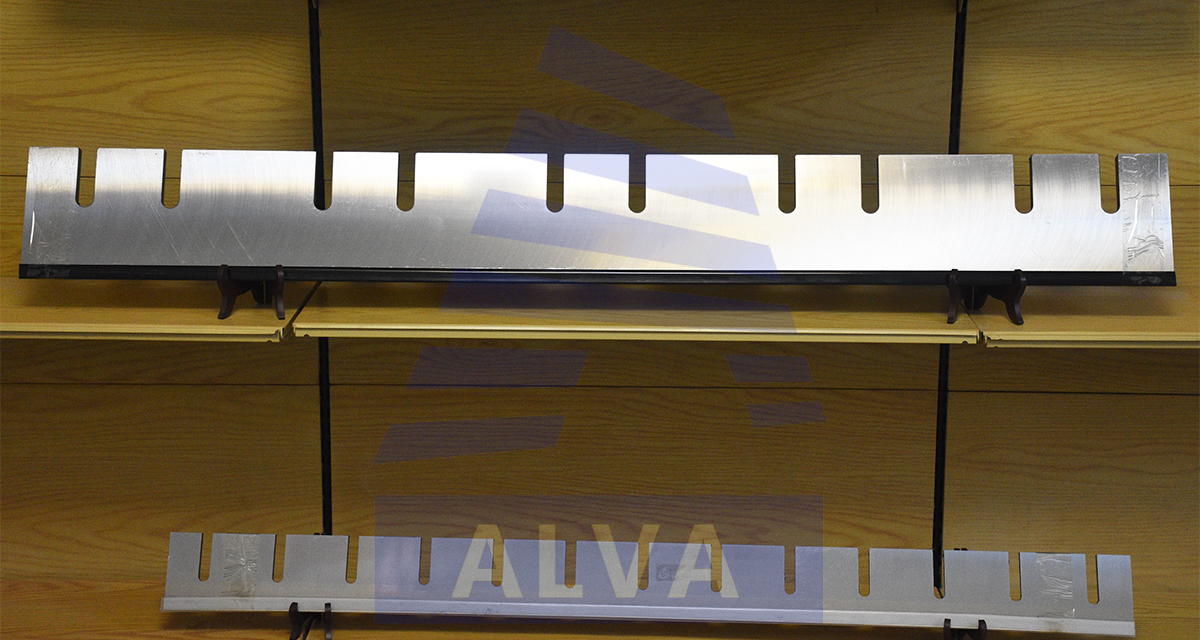
1. The Role of Rotary Veneer Peeling Blades in Wood Processing
A rotary veneer peeling machine rotates a log around a defined center while the knife assembly moves toward the log and continuously cuts the wood. Through this process, the log is converted into continuous veneer. Rotary veneer peeling machines are widely used to produce veneer for plywood, LVL, and other wood-based panel products.
During this process, the blade is not an ordinary cutting tool. The cutting edge must continuously withstand the cutting resistance generated by wood fibers while also dealing with variations caused by wood species, grain structure, moisture condition, knots, and other characteristics of natural timber.
Logs are not completely uniform materials. Different wood species have different structural characteristics, and hardness can vary between different areas of the same log. Knots, bark residues, and other hard materials may also be present.
These factors create different loads on the cutting blade.
Therefore, a rotary veneer peeling blade needs to maintain stable cutting performance. Under normal operating conditions, the cutting edge should continuously cut the wood fibers according to the required processing conditions, allowing the veneer to be produced in a continuous form.
The condition of the blade also affects subsequent processing. When the cutting edge is maintained properly, the peeling process can remain relatively stable and the veneer surface can maintain consistent quality. As the cutting edge wears, cutting resistance may increase, and the veneer may develop rough surfaces, fibers, cracks, or variations in thickness.
For this reason, the rotary veneer peeling blade is directly related not only to the cutting process but also to the quality of the veneer produced.
2. Material Selection Is the Starting Point of Blade Manufacturing
The foundation of blade manufacturing is material selection.
Rotary veneer peeling blades operate under continuous cutting conditions. Therefore, the blade material needs to provide an appropriate combination of hardness, strength, toughness, and wear resistance.
If the hardness is insufficient, the cutting edge may wear quickly. If the material is excessively hard without sufficient toughness, the cutting edge may become more susceptible to damage when exposed to impact.
Material selection should therefore be based on the actual application, including wood species, processing method, machine structure, and operating conditions.
Relevant standards for rotary veneer peeling blades cover aspects such as blade structure, technical requirements, inspection methods, acceptance procedures, and manufacturing requirements. This reflects the fact that veneer peeling blades are specialized woodworking tools with specific manufacturing and quality requirements.
Before entering production, raw materials need to be inspected. Material condition, structural consistency, and related properties can all influence subsequent processing.
Proper material selection provides a stable foundation for subsequent manufacturing.
For professional cutting tools, higher hardness alone does not necessarily mean better performance. Material characteristics need to be matched with the heat treatment process and actual working conditions. Only through the coordinated control of material, heat treatment, and machining can a blade achieve balanced performance.
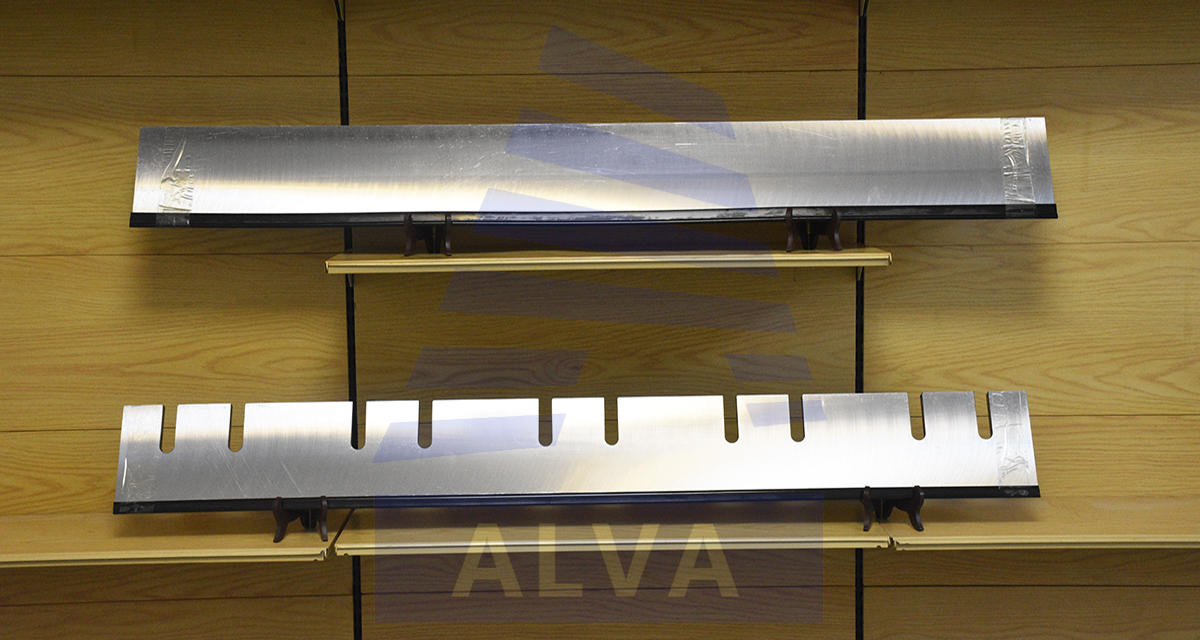
3. Raw Material Cutting: Establishing the Foundation for Further Processing
After the material has been selected, the blade enters the initial processing stage.
The raw material is cut according to the required blade structure and application requirements, producing a blank that is close to the required dimensions.
Although this process appears straightforward, it can affect subsequent machining and dimensional stability. Improper cutting may introduce deformation or internal stress, increasing the difficulty of later straightening and precision machining.
Therefore, each manufacturing process is connected to the next. The quality of one process directly influences the results of subsequent processes.
From the moment the material enters production, its processing condition needs to be controlled.
After the blade blank has been prepared, further forming is carried out to bring the blade body closer to its designed structure. The flatness, edge condition, and overall dimensions of the blade need to be controlled throughout the process.
For long woodworking blades, straightness and dimensional stability are particularly important. During operation, the blade needs to maintain proper contact and alignment with the knife holder. If the blade body has significant deformation, installation conditions may be affected, which can influence cutting performance.
Therefore, blade manufacturing does not begin simply with sharpening the cutting edge. It begins by establishing a stable blade body.
4. Heat Treatment: An Important Manufacturing Process
Heat treatment is one of the important processes affecting the performance of rotary veneer peeling blades.
Through an appropriate heat treatment process, the internal structure and mechanical properties of the blade material can be adjusted to meet the requirements of actual operation.
During rotary veneer peeling, the blade continuously contacts the wood and experiences cutting forces. If the material condition is not appropriate, the blade may experience excessive wear, deformation of the cutting edge, or localized damage.
The purpose of heat treatment is to establish a suitable balance between the different properties of the material.
Blade performance does not depend solely on hardness. During veneer peeling, the blade experiences continuous cutting and may also encounter intermittent impacts. Therefore, the blade needs sufficient hardness to resist wear while maintaining adequate toughness to reduce the risk of chipping or damage under abnormal loads.
Professional blade manufacturing requires heat treatment parameters to be matched with the material type, blade structure, and application requirements.
After heat treatment, the blade must be inspected. If deformation occurs, the blade proceeds to the straightening process.
5. Straightening Ensures Blade Stability
Rotary veneer peeling blades generally have a relatively long working edge, making blade straightness and stability important.
After heat treatment, changes in the internal structure of the material may cause deformation. The blade therefore needs to be straightened according to its actual condition.
Straightening is not simply a matter of pressing the blade flat. It requires controlled adjustment based on the actual deformation of the blade.
If the blade body is bent or twisted, the cutting relationship between the blade and the log may change after installation. During operation, the blade may also experience uneven loading, which can affect the stability of veneer production.
Therefore, the straightening process is used to restore the required geometric condition of the blade body.
After straightening, the blade is further inspected for flatness, straightness, and overall condition before entering precision grinding and edge processing.
This reflects an important principle of professional blade manufacturing: a blade must not only be sharp but also maintain overall dimensional stability.
6. Precision Grinding Determines Cutting-Edge Quality
After material preparation, heat treatment, and straightening, the blade enters the precision grinding process.
Grinding is one of the key processes through which the cutting edge and cutting surfaces are formed.
The cutting edge is not simply ground to a sharp point. It needs to form an appropriate cutting geometry according to the requirements of veneer peeling. Cutting-edge geometry, straightness, and surface condition can all influence cutting performance.
During veneer peeling, the blade continuously enters the wood. If the cutting edge is inconsistent, the cutting action on the wood fibers may also vary.
Professional manufacturers of veneer and rotary peeling knives emphasize that raw material selection, internal heat treatment, and cutting-edge geometry selected according to the processed material all influence veneer quality and blade service life.
Therefore, precision grinding needs to control more than cutting-edge sharpness. It must also maintain consistency along the working edge.
For long blades, the cutting edge needs to remain stable from one end to the other.
This is one of the important differences between professional woodworking blades and ordinary cutting components.
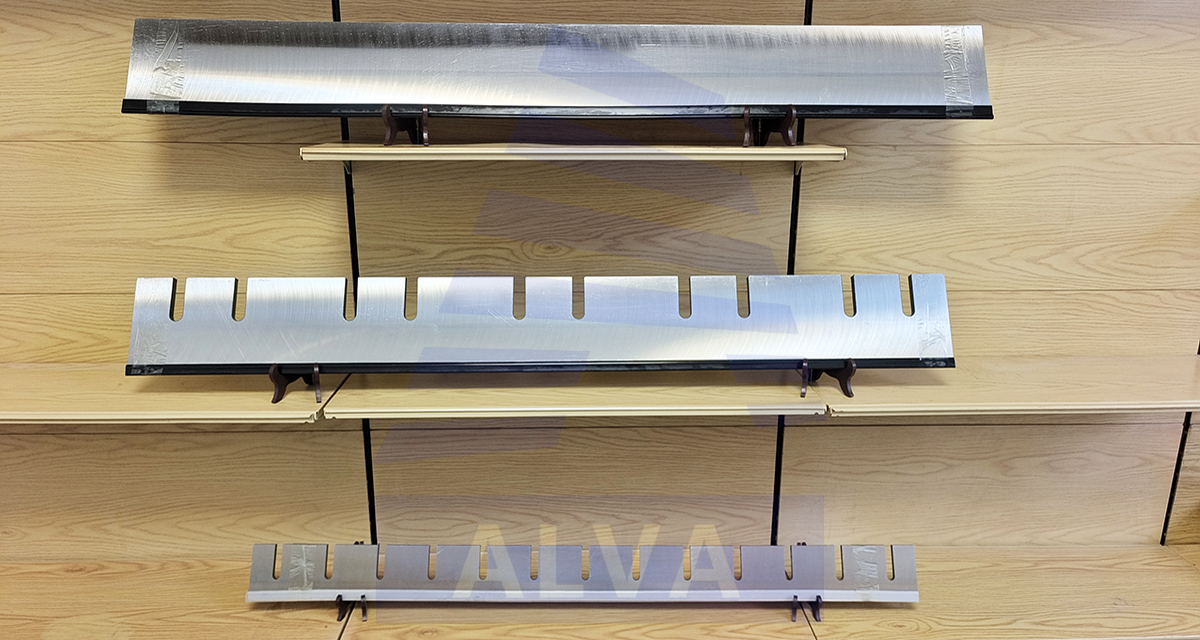
7. Cutting-Edge Processing: Establishing the Working Condition of the Blade
After precision grinding, additional cutting-edge processing is required.
The cutting edge is the working area that directly contacts the wood and is one of the most important functional parts of the blade.
A stable cutting edge needs to maintain a suitable balance between sharpness and edge strength.
An excessively sharp edge without sufficient support may be more susceptible to damage when cutting harder wood or encountering localized impact. A blunt edge, on the other hand, may increase cutting resistance and place additional load on the machine.
Therefore, cutting-edge processing must be carried out according to the actual application requirements.
The design of a veneer peeling blade must also consider the relative movement between the blade and the log during rotary peeling. Modern veneer peeling machines use the knife holder, pressure devices, feeding mechanisms, and other systems together to maintain stable cutting conditions.
The blade therefore needs to match the structure and operating requirements of the machine.
Only when blade manufacturing quality is coordinated with machine structure, installation, and processing conditions can the blade perform as intended.
8. Controlling Cutting-Edge Consistency
Rotary veneer peeling blades need to maintain continuous cutting along the working width.
If different sections of the cutting edge have significant variations, the cutting condition may change during operation.
Therefore, the cutting edge must be inspected after manufacturing.
Inspection may include the straightness of the cutting edge, edge integrity, blade-body flatness, and surface machining condition.
Through inspection, manufacturing defects can be identified and corrected before the product leaves the factory.
For woodworking tools, inspection is not simply the final step of production. It is an important part of ensuring that the blade enters actual service in an appropriate condition.
The relevant technical standards for rotary veneer peeling blades also include inspection methods and acceptance procedures, demonstrating the importance of quality control throughout the manufacturing process.
9. Why Rotary Veneer Peeling Blades Need Both Hardness and Toughness
During actual veneer peeling, the blade is continuously exposed to mechanical forces.
Wood fibers have a directional structure, and different species have different internal characteristics. During cutting, the blade experiences normal cutting resistance and may also encounter knots or other harder areas of the log.
Therefore, a rotary veneer peeling blade needs an appropriate combination of hardness and toughness.
Hardness is mainly related to the blade's resistance to wear.
During continuous cutting, the cutting edge gradually wears. When wear reaches a certain condition, cutting performance changes and the blade needs to be sharpened or replaced.
Toughness is related to the blade's ability to withstand impact and complex loading conditions.
If the material lacks sufficient toughness, abnormal impacts may cause cutting-edge damage.
Therefore, a blade designed for wood veneer peeling should not simply pursue one individual property. Material selection, heat treatment, and machining processes need to work together to establish an appropriate balance between hardness, strength, and toughness.
10. Wear Resistance Is an Important Blade Performance
Rotary veneer peeling is a continuous processing operation.
During production, the blade remains in contact with the wood for extended periods. Therefore, wear resistance is an important consideration when evaluating blade performance.
The cutting edge gradually wears during operation. The rate of wear is influenced by factors such as wood species, wood condition, processing method, machine condition, installation accuracy, and operating practices.
A blade with appropriate wear resistance can maintain a stable cutting condition for an extended period under normal operating and maintenance conditions, reducing the need for frequent sharpening and replacement.
Wear resistance is closely related to blade material and heat treatment.
Through appropriate material selection and process control, the blade's resistance to wear can be improved, allowing the cutting edge to maintain a suitable working condition during continuous processing.
However, all cutting blades are consumable components, and their actual service life cannot be defined by a single fixed value. Actual operating time depends on wood species, processing conditions, machine adjustment, operating practices, and maintenance.
Therefore, proper operation and timely sharpening are also important factors in maintaining blade durability.
11. Proper Blade Condition Helps Maintain Veneer Quality
The ultimate purpose of a rotary veneer peeling blade is to support veneer production.
Veneer is an important raw material for plywood and other wood-based panel products. Its surface condition and thickness consistency can affect subsequent gluing, lay-up, pressing, and finishing processes.
When the cutting edge is maintained in good condition, the wood cutting process can remain relatively stable.
As the blade becomes dull, cutting resistance increases and the interaction between the blade and wood fibers changes. Continued use of a significantly worn blade may result in rough surfaces, fibers, tearing, or other veneer defects.
Therefore, the rotary veneer peeling blade should not be considered an independent component. It forms part of an integrated production process together with the peeling machine, log preparation system, feeding equipment, and subsequent veneer handling equipment.
A stable blade condition helps maintain continuity in the veneer peeling process.
12. Blade Durability Comes from Both Material and Manufacturing Process
When selecting a rotary veneer peeling blade, users often focus first on the material.
In practice, material is only the foundation of blade performance.
Even when the same material is used, differences in heat treatment, grinding, and cutting-edge processing can result in different performance characteristics.
Therefore, blade durability is the result of multiple manufacturing processes working together.
Material provides the basic mechanical properties.
Heat treatment determines the internal material condition.
Straightening establishes blade-body stability.
Precision grinding determines the quality of the cutting surfaces.
Cutting-edge processing establishes the actual cutting condition.
Final inspection confirms the condition of the finished product before use.
These processes are interconnected and together determine the final working performance of the blade.
This is why Shandong ALVA Machinery Group places importance on process control in the manufacturing and application of woodworking machinery and related components.
13. Blade Installation Also Affects Actual Performance
In addition to blade quality, installation condition can influence veneer peeling performance.
During installation, the blade needs to be adjusted according to the structure and operating requirements of the peeling machine so that the blade maintains an appropriate relationship with the knife holder and the log.
If the installation height, angle, or fastening condition is not appropriate, even a well-manufactured blade may not perform as intended.
Therefore, blade installation requires attention to the machine structure and operating conditions.
The three key factors can be summarized as:
First, blade manufacturing quality.
Second, blade installation accuracy.
Third, machine operating and maintenance condition.
These factors work together to determine the actual performance of the blade.
14. Proper Use Helps Extend the Effective Service Period
A rotary veneer peeling blade is a consumable cutting tool. Proper use can help reduce unnecessary wear.
Before installation, the blade should be inspected to ensure that the cutting edge has no obvious damage and that the contact surfaces between the blade and knife holder are clean.
The blade should then be installed and adjusted according to the requirements of the peeling machine to avoid abnormal loading.
During production, operators should monitor the condition of the veneer. If the veneer quality changes, the blade should be inspected in time rather than continuing to operate until severe wear occurs.
Blade sharpening also requires appropriate processing methods.
Improper sharpening may affect cutting-edge geometry and blade condition. Therefore, sharpening should be carried out according to the blade material and actual processing requirements.
Through proper operation, regular inspection, and appropriate maintenance, the effective utilization of the blade can be improved.
15. Rotary Veneer Peeling Blade Manufacturing Is a Systematic Process
From a piece of steel to a finished blade ready for veneer peeling, the manufacturing process involves multiple stages.
Material selection provides the foundation.
Cutting begins the manufacturing process.
Forming establishes the blade-body structure.
Heat treatment adjusts material properties.
Straightening ensures blade-body stability.
Precision grinding forms the cutting surfaces.
Cutting-edge processing establishes cutting performance.
Inspection verifies product quality.
Packaging and storage help maintain the product condition before transportation and use.
No single process should be considered independently.
The manufacturing quality of the blade is ultimately reflected in the veneer peeling process.
For wood processing companies, a stable rotary veneer peeling blade can work together with the peeling machine to maintain continuous cutting and reduce veneer quality problems caused by blade condition.
Although the blade is a relatively small component of a woodworking machine, its role in the production process is significant.
16. Selecting Blades According to Different Wood Processing Requirements
Different wood species and veneer peeling processes have different requirements for cutting blades.
Softwood and hardwood have different cutting resistance characteristics.
Different species have different fiber structures.
Log diameter, moisture condition, preparation method, and final veneer requirements can also affect blade performance.
Therefore, rotary veneer peeling blades should be selected according to the actual machine and processing material.
For companies engaged in long-term veneer production, it is also useful to establish a blade management system covering blade use, sharpening, inspection, and replacement.
By recording blade operating conditions, sharpening history, and changes in veneer quality, manufacturers can better understand the actual working cycle of the blade.
This management approach can help reduce unexpected cutting-edge damage and maintain production stability.
17. Blade Quality Reflects the Manufacturing Approach of Woodworking Machinery
Woodworking machinery is not simply a combination of individual machines.
Rotary veneer peeling machines, log rounding machines, automatic log feeding systems, veneer drying equipment, stacking machines, and other equipment form an integrated wood processing system.
The rotary veneer peeling blade occupies an important position between log preparation and veneer production.
Every stage from log preparation to veneer formation can influence the final product.
Shandong ALVA Machinery Group focuses on the application requirements of wood processing equipment and considers machine stability, production efficiency, and processing quality during product development and manufacturing.
Although the rotary veneer peeling blade is a relatively small component, it directly participates in the wood cutting process. Its manufacturing therefore requires a professional and systematic approach.
18. Application Value of Rotary Veneer Peeling Blades from Shandong ALVA Machinery Group
As a supplier of woodworking machinery and wood processing equipment, Shandong ALVA Machinery Group focuses on the coordinated application of rotary veneer peeling machines and their related components.
The value of a rotary veneer peeling blade is not simply its sharpness. Its purpose is to provide a stable cutting foundation through appropriate material properties, cutting-edge geometry, machining accuracy, and dimensional stability.
Under normal working conditions, the blade continuously performs wood cutting and can be sharpened and maintained according to actual production requirements.
For wood processing companies, a stable blade condition can help reduce production fluctuations caused by cutting-tool problems and support consistent veneer quality.
For plywood manufacturers, stable veneer provides an important foundation for subsequent lay-up, gluing, and pressing processes.
Therefore, selecting an appropriate rotary veneer peeling blade is not simply a matter of selecting a cutting tool. It is also part of configuring the complete veneer peeling process.
19. Manufacturing Details Support Long-Term Blade Performance
Rotary veneer peeling blades operate under continuous mechanical loading.
Therefore, every manufacturing process needs to be connected with the final application.
From material selection and heat treatment to precision grinding and cutting-edge processing, each step needs to maintain consistent quality.
Blade durability is not achieved through a single manufacturing process. It is determined by the combined effects of material properties, heat treatment, machining accuracy, cutting-edge geometry, and actual operating conditions.
For users, evaluating whether a rotary veneer peeling blade is suitable for long-term use should not rely solely on its appearance. Actual veneer peeling performance should also be considered.
Stable veneer surfaces, consistent cutting behavior, appropriate edge retention, and reasonable sharpening intervals are all useful references for evaluating actual blade performance.
20. Conclusion
Although the rotary veneer peeling blade is a relatively small component within a woodworking production system, it directly performs the wood cutting operation.
From raw material selection to cutting and forming, from heat treatment to straightening, from precision grinding to cutting-edge processing, and finally to finished-product inspection, each stage affects the final performance of the blade.
A rotary veneer peeling blade designed for wood processing needs to establish an appropriate balance between hardness, toughness, strength, wear resistance, and machining accuracy. At the same time, it needs to work properly with the structure and operating conditions of the veneer peeling machine.
For companies engaged in long-term veneer peeling and veneer production, blade condition affects not only the cutting process but also veneer quality, machine operation, and subsequent production stages.
Shandong ALVA Machinery Group focuses on actual wood processing requirements and pays attention to the manufacturing and application of rotary veneer peeling machines and related products. Through controlled production processes and quality management, the company provides woodworking machinery and related solutions for wood processing applications.
The manufacturing of a rotary veneer peeling blade may appear to be a process of turning steel into a cutting edge, but it is actually the result of coordinated material selection, manufacturing technology, machine requirements, and application experience.
The value of a blade is not determined only by how sharp it is, but also by whether it can maintain stable cutting performance throughout its working process.
Controlling every manufacturing process and paying attention to every production detail provides the foundation for stable performance and durability of rotary veneer peeling blades, and remains an important part of Shandong ALVA Machinery Group's approach to woodworking machinery manufacturing.

 English
 العربية
 Français
 Русский
 Español
 Português
 Deutsch
 italiano
 日本語
日本語 한국어
한국어 Nederlands
 Tiếng Việt
 ไทย
ไทย Polski
 Türkçe
 አማርኛ
አማርኛ ພາສາລາວ
 ភាសាខ្មែរ
 Bahasa Melayu
 ဗမာစာ
ဗမာစာ தமிழ்
தமிழ் Filipino
 Bahasa Indonesia
 magyar
 Română
 Čeština
 Монгол
 қазақ
қазақ Српски
 हिन्दी
 فارسی
فارسی Kiswahili
 Slovenčina
 Slovenščina
 Norsk
Norsk Svenska
 українська
 Ελληνικά
 Suomi
Suomi Հայերեն
 עברית
עברית Latine
 Dansk
Dansk اردو
اردو Shqip
Shqip বাংলা
বাংলা Afrikaans
 Māori
Māori অসমীয়া
 Беларуская мова
 Català


