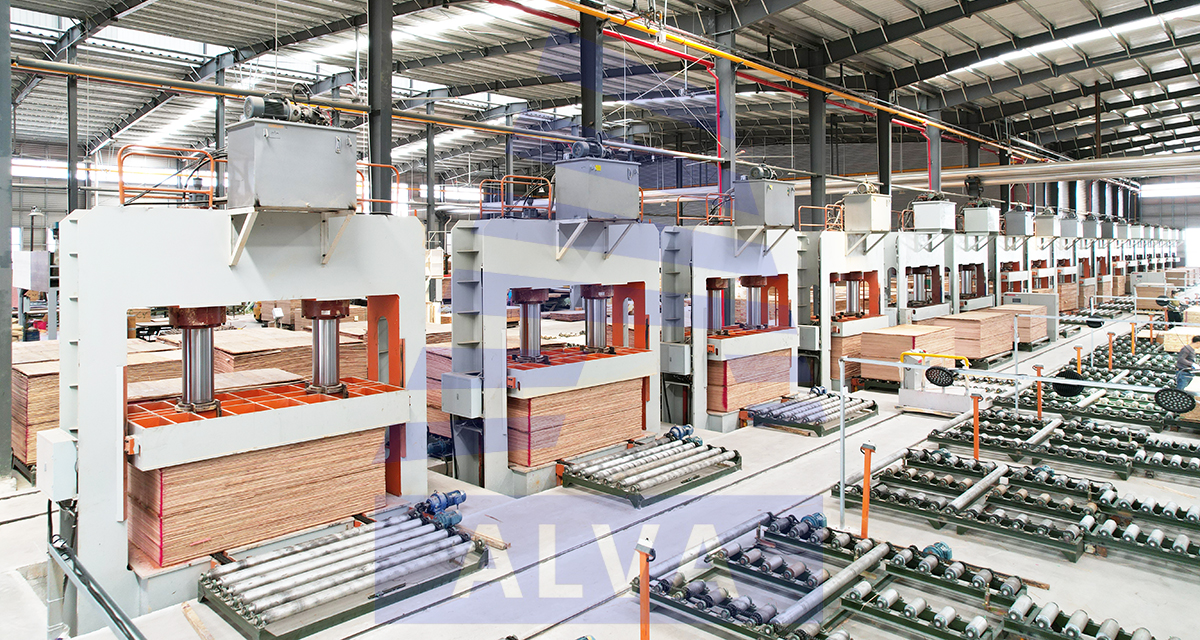
Hot pressing is one of the critical processes that determine the forming quality of panels in the production of plywood, film-faced panels, construction formwork, furniture substrates and other wood-based panels. Veneers processed through preceding procedures such as rotary cutting, drying, gluing, panel assembling and pre-pressing need to undergo lamination via hot press equipment, so that veneer layers can form panels with a stable structure. Therefore, the hot press not only performs heating and pressurization tasks, but also forms a complete production workflow together with upstream veneer processing, gluing, panel assembling and downstream trimming, sanding and other processes.
Shandong Alva Machinery Group has long focused on the R&D, manufacturing and supporting services of woodworking machinery and plywood production equipment. Its product range covers multiple production stages including log sawing, rounding, rotary cutting, veneer drying, gluing, panel assembling, pre-pressing, hot pressing, trimming, sanding and automatic stacking. As vital equipment for plywood production lines, hot presses also constitute one of the core products within Alva’s woodworking machinery portfolio. According to different production modes and automation requirements, Alva supplies hot presses with manual panel loading, semi-automatic hot presses, fully automatic hot presses and industrial hydraulic plywood hot presses, offering equipment options for plywood manufacturers of various types.
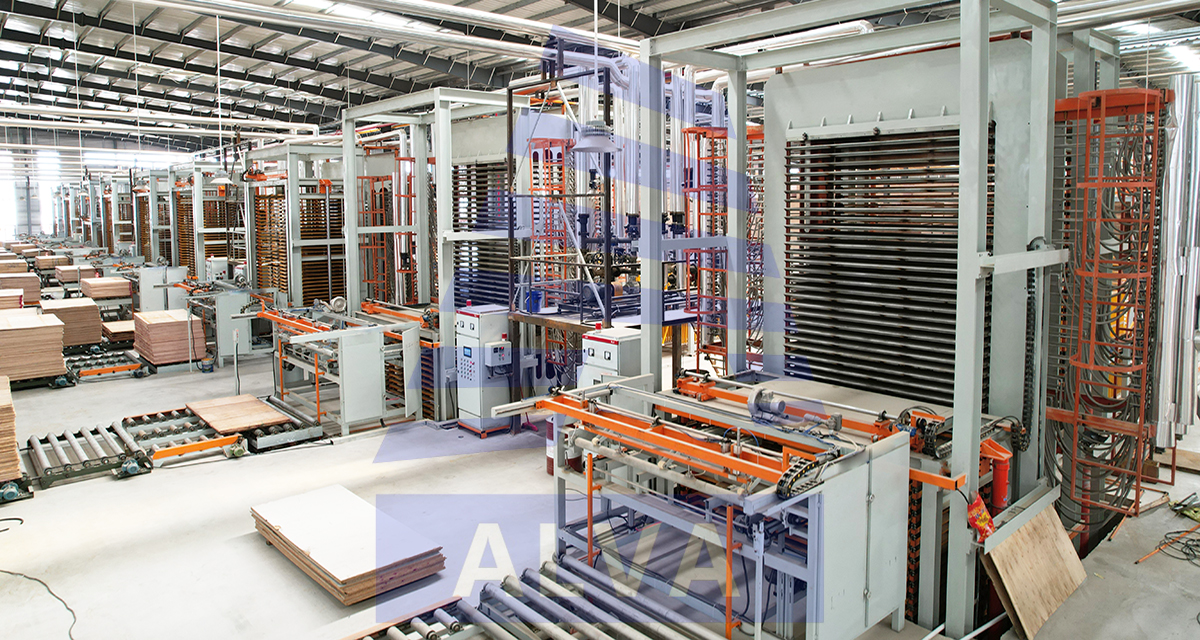
This article systematically introduces Shandong Alva Machinery’s hot press from the perspectives of hot pressing technology, equipment structure, working principle, hydraulic system, heating system, control system, panel quality, production line matching, equipment selection and daily maintenance.
I. Function of Hot Press in Plywood Production
Plywood production is not simply stacking multiple veneer layers. Instead, proper panel assembling methods and gluing processes are required to form a stable panel structure with veneers arranged in different grain directions.
Veneers produced by rotary lathes first need drying to reach the required condition for subsequent gluing and bonding processes. After drying, veneers go through sorting, repairing or splicing before entering the gluing process. Glued veneers are assembled into panels according to specified layers and grain directions. After panel assembling, pre-pressing is generally required to preliminarily bond the mat and maintain its overall shape, followed by the hot pressing process.
The hot press undertakes two core tasks at this stage:
Heating
Heat is transferred to the mat through hot platens to enable the adhesive to meet curing conditions.
Pressurization
The hydraulic system delivers stable pressure to hot platens to ensure full contact between multi-layer veneers, reduce interlayer gaps, and allow the adhesive to form a continuous bonding structure inside the panel.
Hence, hot pressing is not merely a "panel pressing" operation, but a technological process jointly affected by temperature, pressure, time and mat condition. Alva hot presses are designed around these core factors to match plywood production processes.
Alva’s official product documentation defines the hot press as the primary equipment in plywood manufacturing, used for hot pressing glued and assembled mats to bond veneer layers and form finished panels.
II. Basic Working Principle of Alva Hot Press
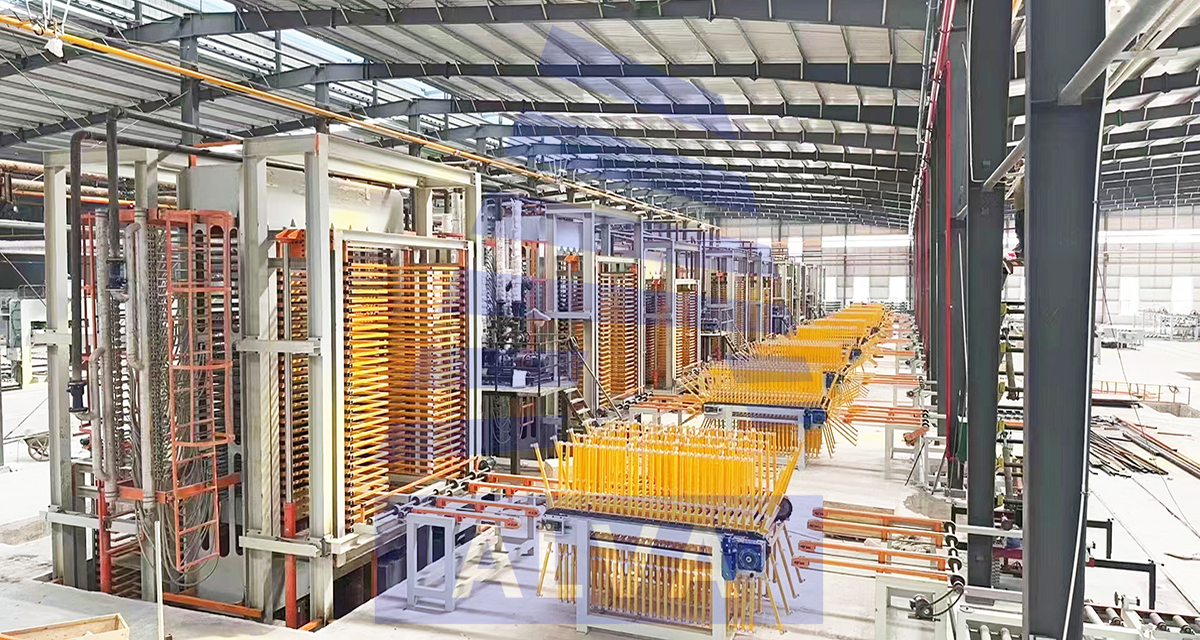
Alva hot presses mainly adopt hydraulic drive to complete mat lamination.
During production, assembled mats are fed into the hot press in the specified manner. Operators or automatic loading systems deliver mats between layers of hot platens. After the equipment is closed, the hydraulic system starts operation.
The hydraulic system drives working components to generate pressure, applying force from hot platens onto the mat. Meanwhile, the heating system supplies thermal energy to hot platens, and heat is gradually transferred into the mat through the platens.
As temperature and pressure meet process requirements, the adhesive cures progressively, forming stable bonding between veneers. Once the preset process time is reached, the pressing cycle completes. The hot platens open, and finished panels exit the hot pressing zone via manual or automatic panel unloading mechanisms.
The whole process follows this sequence:
Mat feeding → Hot platen closing → Hydraulic pressurization → Heat transfer → Adhesive curing → Pressure holding → Hot platen opening → Panel discharging
Different adhesives, wood species, veneer conditions and panel structures impose varying requirements for hot pressing parameters. Therefore, uniform temperature, pressure and time settings cannot be simply applied in actual production. Process parameters shall be formulated according to adhesive type, panel structure, veneer moisture content and product specifications.
This is the key reason why the hot press control system needs adjustable functions.
III. Main Structure of Alva Hot Press
A complete plywood hot press generally consists of a frame, hot platens, hydraulic system, heating system, control system, mat in/out device and relevant safety protection structures.
Equipment with different automation configurations differs in panel handling mechanisms and control modes, while the core hot pressing structure remains consistent.
1. Frame Structure
Hot presses must withstand heavy pressing loads for long-term operation, so the frame serves as the foundation for stable equipment performance.
Alva industrial hydraulic plywood hot presses adopt heavy-duty frame structures. After machining and assembly, these components form the complete machine. Official product materials introduce structural designs including crossbeams, main steel plates and integrated body frames, aiming to maintain structural stability under long operating hours.
The rigidity of the frame directly affects pressure transmission during hot pressing.
Obvious frame deformation during long-term operation may cause uneven force distribution across areas, impairing panel thickness and bonding quality. Accordingly, hot press design must consider not only rated pressure, but also the overall structural stability under pressure.
2. Hot Platens
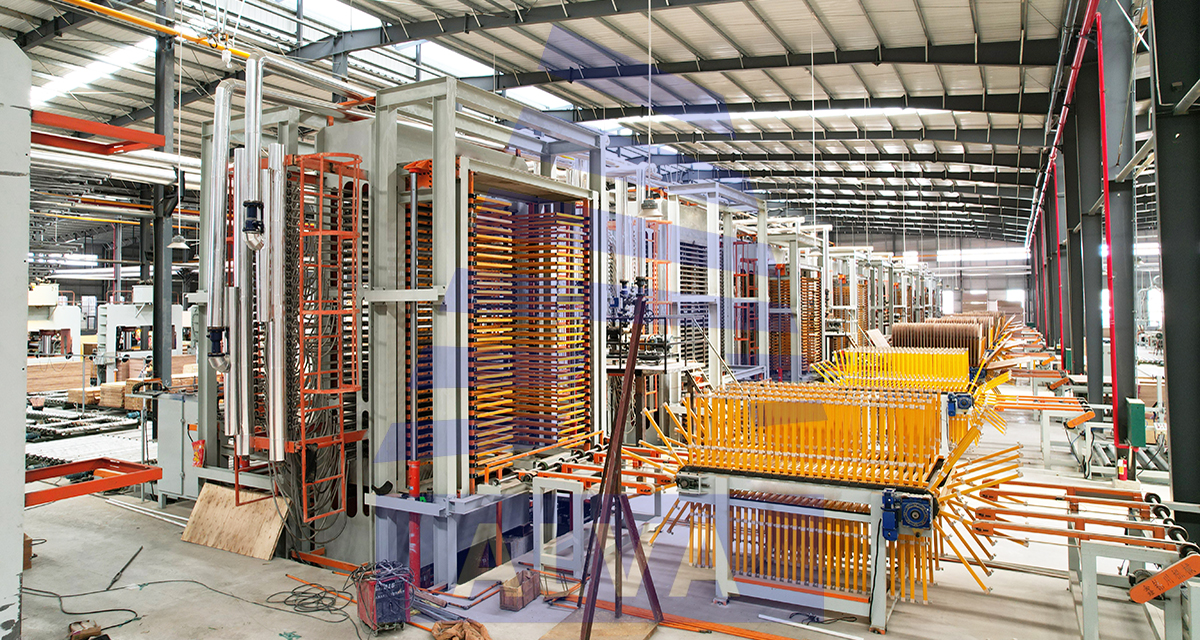
Hot platens are key components of the hot press that directly contact the mat, and the core parts responsible for heat transfer.
During production, heat generated by heating media or heating systems must be transferred to panels through hot platens. Therefore, flatness, structural condition and temperature distribution of hot platens all impact final panel quality.
Alva hot pressing equipment features hot platen structures suitable for plywood hot pressing processes, engineered to withstand pressure and heat under prolonged working conditions. Official product introductions emphasize that hot platens shall possess excellent pressure resistance and stable heating performance to meet continuous operation requirements in plywood production.
In practical production, the surface condition and flatness of hot platens need regular inspection. The area between platens must be kept clean to prevent residual glue or debris from damaging panel surfaces.
IV. Hydraulic System: Core Power System of Hot Press
Stable pressure is required during plywood hot pressing, making the hydraulic system an essential component of the hot press.
Alva industrial hydraulic plywood hot presses are hydraulically driven. A hydraulic station, hydraulic pumps, oil cylinders, pipelines and control elements work together to build, hold and release pressure.
The basic working sequence of the hydraulic system can be summarized as:
Hydraulic pump delivers hydraulic oil flow;
Hydraulic oil flows into the hydraulic circuit;
The control system regulates hydraulic components according to operating commands;
Oil cylinders generate power to drive hot platen movement;
Hot platens apply pressure to the mat;
Pressure holding phase starts once process requirements are achieved;
After pressing completion, the system relieves pressure and opens hot platens.
Pressure stability is critical for plywood manufacturing.
Unstable pressure build-up may result in inconsistent bonding in local panel areas. Severe pressure fluctuation during pressure holding will also compromise the final bonding effect. Hence, the hydraulic system of a hot press must maintain good sealing, stable operation and a reasonable maintenance cycle.
Alva integrates hydraulic control systems in hot press design. Its product documentation introduces integrated oil cylinder structures to guarantee stable machine operation and pressure retention performance.
V. Heating System Determines Heat Transfer in Hot Pressing
One major feature distinguishing hot presses from cold presses is the ability to supply heat while applying pressure.
Heat transfers from hot platens into the mat, enabling adhesive curing under proper process conditions.
Therefore, the heating system of hot press equipment is not simply designed for high temperature, but to deliver stable and controllable heat supply according to production technology.
In actual plywood production, the hot pressing process is affected by multiple factors:
Manufacturers shall formulate tailored hot pressing processes for their own products instead of copying parameters from other factories.
Alva hot presses combine hot platens and temperature control systems, allowing operators to adjust machine status to meet different panel production requirements.
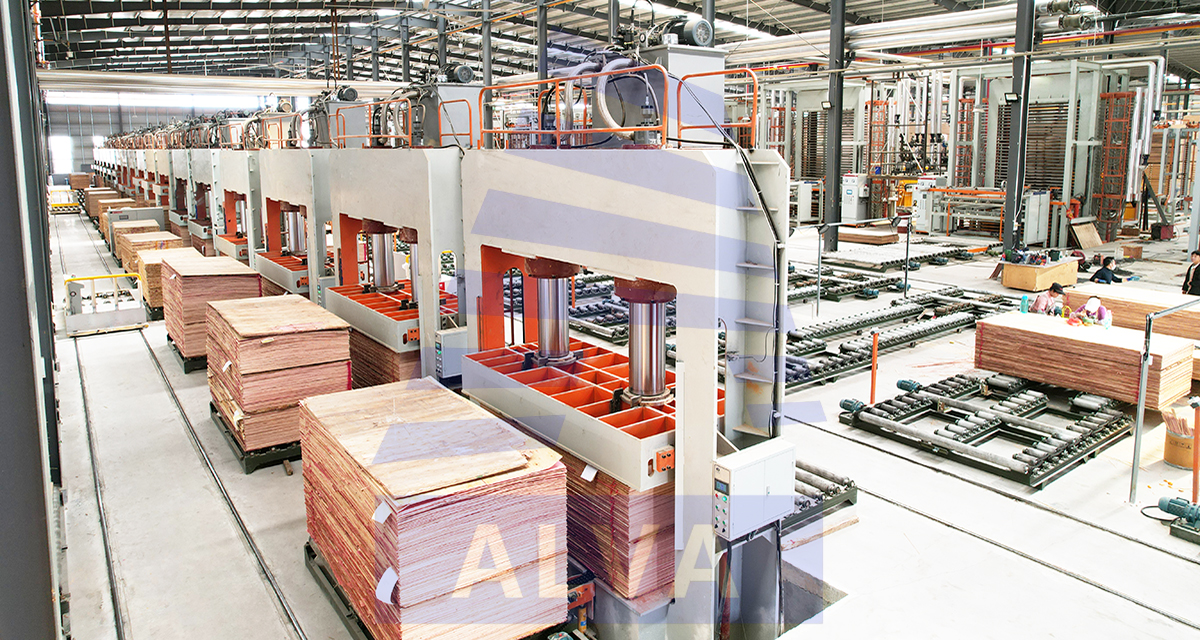
VI. Control System and Hot Press Process Management
Modern plywood production raises higher standards for equipment control.
The hot pressing cycle involves multiple movements: hot platen opening, closing, pressurization, pressure holding, pressure relief and platen opening. Full manual operation increases operator workload and makes it difficult to maintain consistent production quality.
Alva hot presses adopt corresponding control modes based on different equipment configurations.
Hot presses with manual panel loading are suitable for production modes requiring high manual involvement, with relatively straightforward machine structures. Operators undertake mat loading/unloading and coordinate production procedures.
Semi-automatic hot presses combine manual operation and automatic control. Some procedures are completed automatically by the machine to reduce repetitive manual work.
Fully automatic hot presses are further connected with automatic loading, hot pressing and unloading systems, enabling linkage between hot pressing and upstream & downstream equipment.
Alva’s current hot press product portfolio covers manual loading, semi-automatic and fully automatic models to satisfy configuration demands from different manufacturers.
For large-scale plywood production lines, hot presses should not be regarded as standalone equipment; they are designed as part of the whole production line.
VII. Coordination between Hot Press, Automatic Loading and Pre-pressing Equipment
Plywood production efficiency depends not only on the hot press itself, but also closely on the speed of upstream mat preparation.
In traditional production modes, workers manually carry assembled mats into the hot press for lamination. This places high demands on labor quantity, operator proficiency and on-site logistics arrangement.
With rising automation in plywood manufacturing, pre-pressing machines and automatic panel loaders become important components of hot pressing production lines.
Alva automatic mat feeding and pre-pressing equipment can connect veneer splicing, panel assembling and hot pressing processes, undertaking mat conveying, positioning and pre-forming to deliver mats in a more stable condition to the hot pressing station.
Pre-pressing does not replace hot pressing; it creates more stable mat conditions for subsequent hot pressing.
After pre-pressing, multi-layer veneers form a relatively stable mat structure, reducing layer shifting when entering the hot press and facilitating subsequent hot pressing operations.
Therefore, when planning a complete plywood production line, the whole process can be considered as:
Veneer rotary cutting → Veneer drying → Veneer sorting → Gluing → Panel assembling → Pre-pressing → Hot pressing → Trimming → Sanding → Finished product handling
Alva’s product portfolio covers many of these stages, enabling customized equipment matching according to clients’ actual production requirements.
VIII. Applicable Production Scenarios of Alva Hot Press
Hot presses are mainly used for hot forming of wood-based panels.
In plywood production, veneers processed via rotary cutting, drying and gluing are assembled into mats with specific structures. Hot pressing bonds veneer layers into integrated panels.
Depending on finished products, hot press equipment serves ordinary plywood and other panels with different bonding structures and production requirements.
Alva official materials state that its industrial hydraulic plywood hot presses can manufacture various types of plywood, including standard plywood and panels with different process specifications.
It should be noted that different panels require different equipment configurations and process parameters. Therefore, before purchasing a hot press, manufacturers shall provide information such as product type, panel structure, production process, veneer condition and production line layout. The equipment manufacturer will design solutions based on specific requirements.
IX. Main Factors Affecting Panel Quality in Hot Pressing
The hot press is only equipment; final product quality results from the combined effect of machinery, raw materials and processes.
Not all panel defects should be attributed to the hot press.
Veneer Condition
Veneer moisture content affects the bonding process.
Unsuitable veneer status for subsequent gluing and hot pressing may lead to bonding defects. Hence, veneers must be properly dried and sorted before entering hot pressing.
Veneer drying is treated as a key pre-hot-pressing procedure in Alva plywood lines. Dryers adjust veneer conditions to create favorable conditions for subsequent gluing and pressing.Gluing Condition
Uniform glue application determines interlayer bonding.
Insufficient glue may cause partial poor bonding, while excessive glue increases production costs and impairs panel properties.
Gluing equipment must match the hot pressing process.Panel Assembly Method
Plywood must be assembled with specified grain directions and layer counts.
Misalignment during assembling will cause structural deviation in panels after hot pressing. Therefore, pre-pressing and positioning equipment are practically significant for production.
Temperature Control
Stable heat transfer must be guaranteed during hot pressing.
Insufficient temperature hinders adhesive curing; unstable temperature control leads to inconsistent bonding across different areas.
Pressure Control
Pressure must match panel structure and adhesive process requirements.
Excessively high or low pressure will compromise production results, so pressure settings cannot be separated from actual product characteristics.
Hot Pressing Time
Different adhesive types and panel structures require different hot pressing processes.
In actual production, reasonable hot pressing time shall be determined according to adhesive manufacturers’ specifications and in-plant trial pressing results.
X. Equipment Configuration Types of Alva Hot Press
To adapt to diverse production organization modes for different enterprises, Alva hot presses are supplied in a series with varying automation levels instead of a single configuration.
Hot Press with Manual Panel Loading
Operators complete mat loading and unloading for manually loaded hot presses.
This configuration suits production environments with low automation demand and manual-dominated operation.
The machine features a straightforward structure, and manufacturers can configure it according to site space and production modes.
Semi-automatic Hot Press
Semi-automatic hot presses combine manual operation and automatic machine control.
The machine completes part of hot pressing movements automatically, while operators are mainly responsible for mat preparation, feeding and finished product handling.
This model reduces repetitive manual work while retaining high flexibility for on-site operation.
Fully Automatic Hot Press
Fully automatic hot presses target highly automated plywood production lines.
The machine can cooperate with automatic loading, pre-pressing, conveying and unloading systems, integrating hot pressing into a continuous production workflow.
Alva’s official hot press portfolio clearly includes fully automatic, semi-automatic and manual-loading hot presses.
XI. How Hot Press Connects with the Whole Plywood Production Line
The productivity of a hot press must match upstream and downstream equipment.
If upstream gluing and panel assembling speed is insufficient, the high processing capacity of the hot press cannot be fully utilized.
Conversely, if the hot press processing speed is slower than mat formation speed upstream, production waiting will occur.
Therefore, plywood production line design must consider overall matching between all equipment.
Alva plywood manufacturing equipment portfolio covers log processing, rotary cutting, veneer drying, splicing, gluing, panel assembling, pre-pressing, hot pressing, trimming and sanding machines. Production line planning can be customized around client production demands.
A typical process flow:
Log → Sawing → Rounding → Rotary cutting → Veneer drying → Veneer sorting → Gluing → Panel assembling → Pre-pressing → Hot pressing → Trimming → Sanding → Finished product
The hot press sits at the core forming stage.
In real projects, Alva focuses not only on standalone machines, but also on process connection between different equipment.
XII. Manufacturing and Quality Control of Alva Hot Press
Hot presses are industrial equipment for continuous long-time operation. Structural machining, welding, assembly, hydraulic installation and electrical control during manufacturing all affect final service performance.
Shandong Alva Machinery Group owns a woodworking machinery manufacturing system. Product production includes raw material processing, equipment assembly, surface treatment, electrical commissioning and finished product delivery. According to the group’s official documents, the company continuously develops and manufactures woodworking and plywood production machines, and implements corresponding production and quality management procedures.
For hot presses, manufacturing quality focuses on:
Frame structure machining
Hot platen machining and installation
Hydraulic system assembly
Oil cylinder and sealing system
Pipeline connections
Electrical control
Temperature control
Safety protection
Complete machine commissioning
After fabrication, equipment undergoes assembly and commissioning to verify normal coordination of hydraulic, heating, electrical and mechanical movements before delivery.
XIII. Importance of Daily Maintenance for Hot Press
Hot presses operate continuously under high temperature and pressure, so maintenance cannot be neglected.
First, regularly inspect the hydraulic system.
Check hydraulic oil condition, pipeline connections, oil cylinders and sealing parts; handle abnormalities promptly.
Second, inspect hot platens.
Hot platen surfaces must stay clean to avoid residual glue and debris that damage panel surface quality.
Third, inspect the heating system.
In case of abnormal temperature control, check relevant heating and control components in a timely manner.
Meanwhile, inspect the electrical system.
Including control cabinets, buttons, sensors, wiring and safety protection devices.
For automated hot pressing lines, also inspect conveying mechanisms, automatic loading and unloading devices to ensure smooth coordination of all movements.
Proper maintenance not only extends equipment service life, but more importantly, guarantees stable machine status during production.
XIV. Factors to Consider When Selecting a Hot Press
For enterprises planning to build or upgrade plywood production lines, hot press selection should not rely merely on standalone machine parameters; the whole production project must be considered.
Define target products
Different plywood types have distinct structures and bonding processes.
First clarify whether to produce standard plywood, construction formwork, film-faced panels or other panels.
Clarify veneer conditions
Veneer source, wood species, thickness, moisture content and processing methods all affect hot pressing technology.
Determine automation level
Manual production environments can adopt manual loading configurations.
Enterprises aiming to cut labor involvement can choose semi-automatic or fully automatic solutions.
Consider matching with upstream and downstream processes
The hot press must coordinate with gluing, panel assembling, pre-pressing, trimming and sanding equipment.
Workshop layout consideration
As core equipment of production lines, hot presses require rational planning based on workshop height, machine position, logistics direction and maintenance space.
Confirm energy source and heating mode
Energy conditions vary in different regions and factories; select a suitable heating system matching local actual conditions.
Focus on after-sales and technical service
Hot press installation, commissioning and process training require professional technicians.
Therefore, during procurement, pay attention not only to the machine itself, but also to the manufacturer’s technical support capacity.
XV. Alva’s Expansion from Standalone Machines to Complete Line Solutions
With the evolving production modes in the plywood industry, purchasing single equipment can no longer satisfy all client demands.
More and more manufacturers want a complete workflow from log input to finished panel output.
Alva Machinery Group’s product portfolio covers log sawing, rounding, rotary cutting, veneer drying, gluing, panel assembling, pre-pressing, hot pressing, trimming, sanding and stacking.
This product layout enables Alva to participate in production line planning according to client site conditions.
For example, for newly built plywood factories, complete production workflows can be designed starting from log processing. For enterprises already owning rotary cutters and dryers, equipment upgrades can be implemented for gluing, panel assembling, pre-pressing and hot pressing. For factories with basic production lines facing high labor costs, automatic loading, unloading and stacking equipment can be further added.
Alva positions itself not merely as a supplier of single hot presses, but to match equipment with production processes based on clients’ actual production conditions.
XVI. From Equipment Stability to Production Quality: Systematic Management of Hot Pressing Technology
Plywood quality is formed across the whole production chain, and hot pressing is one critical stage.
Upstream veneer quality determines the base of mats;
Drying status affects gluing and bonding;
Gluing quality influences interlayer adhesion;
Panel assembling determines panel structure;
Pre-pressing guarantees mat stability;
Hot pressing completes final bonding;
Subsequent trimming and sanding realize dimensional and surface finishing.
Therefore, although the hot press is core equipment, it cannot be evaluated independently from the whole production line.
Alva continuously improves its equipment portfolio covering log processing to plywood forming in the woodworking machinery sector. Through process connection between different machines, it provides woodworking machinery solutions tailored to diverse production requirements. The group’s product system covers most major procedures in plywood manufacturing.
XVII. Conclusion: Stable Hot Pressing Technology Supports Plywood Production
For plywood manufacturers, a hot press is not just a machine for heating and pressing; it serves as a vital production link connecting upstream veneer processing and downstream panel treatment.
A properly selected hot press requires perfect coordination among mechanical structure, hydraulic system, hot platens, heating system, electrical control and automated connections. Meanwhile, it must match the adhesive, veneer material, panel structure and production rhythm adopted by the enterprise.
Shandong Alva Machinery Group continuously improves its equipment portfolio including rotary cutting, drying, gluing, pre-pressing, hot pressing, trimming, sanding and automated conveying systems to meet plywood and woodworking machinery demands. Customized equipment configuration schemes are provided according to production processes and workshop conditions.
As an important component of plywood production lines, hot presses continue to undertake core procedures of mat heating, pressurization and adhesive forming.
For enterprises planning new plywood production lines, upgrading existing hot presses or raising production automation, Alva can carry out comprehensive planning for hot presses and supporting equipment based on raw materials, product types, production processes, workshop layout and automation requirements.
Based on woodworking machinery manufacturing, guided by production technology, and focusing on stable equipment operation and clients’ practical production demands, Shandong Alva Machinery Group supplies hot presses and related woodworking machinery for plywood and wood processing enterprises at home and abroad.
From veneer production to mat assembling; from pre-forming to hot-press bonding; from standalone machines to complete line supporting, Alva Machinery keeps improving its product and service around the wood processing industrial chain, delivering equipment manufacturing and technical support for plywood manufacturers.

 English
 العربية
 Français
 Русский
 Español
 Português
 Deutsch
 italiano
 日本語
日本語 한국어
한국어 Nederlands
 Tiếng Việt
 ไทย
ไทย Polski
 Türkçe
 አማርኛ
አማርኛ ພາສາລາວ
 ភាសាខ្មែរ
 Bahasa Melayu
 ဗမာစာ
ဗမာစာ தமிழ்
தமிழ் Filipino
 Bahasa Indonesia
 magyar
 Română
 Čeština
 Монгол
 қазақ
қазақ Српски
 हिन्दी
 فارسی
فارسی Kiswahili
 Slovenčina
 Slovenščina
 Norsk
Norsk Svenska
 українська
 Ελληνικά
 Suomi
Suomi Հայերեն
 עברית
עברית Latine
 Dansk
Dansk اردو
اردو Shqip
Shqip বাংলা
বাংলা Afrikaans
 Māori
Māori অসমীয়া
 Беларуская мова
 Català


