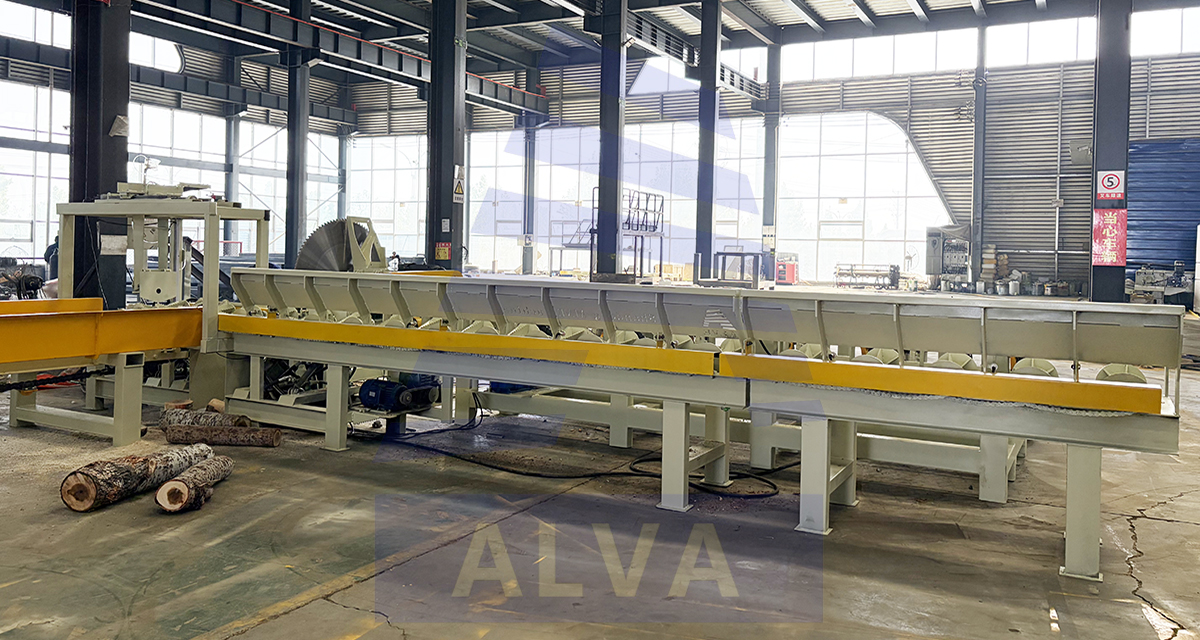
1. Product Overview
The steel roller conveyor is a key conveying equipment in the wood processing industry, designed for continuous and stable transportation of logs, semi-finished wood and finished products in the veneer peeling machine production line. It serves as the core link connecting upstream and downstream processes in the production line, realizing the seamless transfer of materials between different processing stations, such as log feeding, peeling processing and finished product output.
As an indispensable auxiliary equipment in the woodworking production line, its conveying stability, load capacity and adaptability directly affect the continuity and efficiency of the entire production process. The steel roller conveyor is developed with a modular design concept, which can be flexibly combined and adjusted according to the layout and process requirements of different veneer peeling production lines. It supports various conveying modes such as horizontal conveying, inclined conveying and turning conveying, meeting the conveying needs of different production line structures.
The equipment is designed and manufactured in strict accordance with industrial conveying equipment standards, with strong adaptability to the woodworking industry production environment, and has obtained market recognition in multiple regions around the world. It is a reliable conveying solution for the global woodworking industry, especially for veneer peeling production lines.
2. Core Technology and Design Specifications
2.1 Structural Design and Mechanical Performance
The main frame of the steel roller conveyor is made of high-strength steel, which has been treated with anti-rust and anti-corrosion, adapting to the humid and multi-dust working environment in wood processing plants. The conveying rollers are made of high-quality steel, with surface treatment such as wear-resistant and anti-slip, ensuring stable conveying of logs and semi-finished wood, and reducing material slipping and damage during conveying.
The roller support structure adopts a reinforced design, which can bear the load of logs of different specifications and maintain stable operation under long-term heavy load conditions. The connection parts of the frame are processed with high precision, ensuring the straightness and levelness of the conveying surface, avoiding material deviation and jamming during conveying.
The driving system adopts a chain or belt transmission structure, which is equipped with a speed regulating device to adjust the conveying speed according to the production rhythm of the veneer peeling machine, realizing the matching of conveying speed and processing speed. The transmission parts are equipped with a protective cover to prevent wood chips and dust from entering, reducing the failure rate of the equipment.
2.2 Safety Design and Compliance Requirements
The steel roller conveyor is designed in accordance with industrial conveying equipment safety standards, with a comprehensive safety protection system. The equipment is equipped with emergency stop devices at multiple positions along the conveying line, which can quickly stop the equipment in case of abnormal conditions, ensuring the safety of operators and materials.
The exposed rotating parts of the rollers are equipped with protective devices to prevent operators from touching the moving parts by mistake. The electrical system is designed with IP protection levels to adapt to the power consumption safety requirements of the industrial environment, preventing electrical faults caused by the intrusion of wood chips and moisture.
The equipment design and manufacturing comply with international safety standards for conveying equipment, covering mechanical protection, electrical safety, noise control and other aspects. All key safety components have passed third-party testing and certification, ensuring that the equipment meets the safety regulations of different regions when used in the veneer peeling production line. Clear safety warning signs are set on the equipment, with multilingual markings to adapt to users from various countries and regions.
2.3 Automation and Control Technology
The steel roller conveyor is equipped with a standardized control system, which can be connected with the control system of the veneer peeling machine to realize coordinated control of conveying and processing. The control system supports manual, semi-automatic and automatic operation modes, which can be adjusted according to the production process requirements.
The equipment is equipped with a material detection device, which can monitor the position and status of materials in real time, and automatically adjust the conveying speed or stop conveying when abnormal conditions such as material jamming occur. The control system has a fault self-diagnosis function, which can monitor the operating status of the driving system, rollers and other key components in real time, and prompt fault information when abnormalities occur, facilitating quick troubleshooting.
The equipment interface adopts a general industrial protocol design, which is compatible with different brands of veneer peeling machines and other woodworking equipment, meeting the transformation and upgrading needs of users' existing production lines and reducing the cost of equipment integration.
3. Production Manufacturing and Quality Control
3.1 Manufacturing Process and Technical Standards
The production and manufacturing of the steel roller conveyor adopt standardized technological procedures, and the whole process from raw material procurement to finished product delivery follows a strict quality management system. Raw materials such as steel and rollers are selected from suppliers that meet international standards, and all raw materials pass incoming inspection to ensure that their material performance and specifications meet the design requirements.
The frame and roller parts are processed by CNC equipment, and the key dimensions are verified by high-precision testing equipment to ensure the interchangeability and assembly accuracy of the parts. The equipment adopts modular assembly technology, which first completes the assembly and debugging of each unit module, and then carries out the overall assembly of the equipment to ensure the coordinated operation of each system.
Performance tests such as no-load operation test, load test and conveying accuracy test are carried out synchronously during the assembly process to verify whether the conveying stability, speed regulation performance and load capacity of the equipment meet the design specifications.
3.2 Quality Inspection and Certification System
Finished steel roller conveyors undergo multiple rounds of quality inspection before delivery, covering mechanical performance, electrical safety, conveying accuracy, noise control and other dimensions. The inspection process abides by the testing standards for industrial conveying equipment, and professional testing equipment is used for data collection and analysis to ensure that all indicators of the equipment meet the design requirements.
Qualified equipment is delivered with complete test reports and qualification certificates, clarifying the performance parameters and compliance descriptions of the equipment, and providing support for users' market access. The steel roller conveyor has passed a number of international certifications, including EU CE certification, North American safety certification and market access certification in some Southeast Asian countries, qualifying for entry into major global woodworking machinery markets.
The certification process strictly follows the local regulatory requirements, and comprehensively verifies the safety performance, electromagnetic compatibility, environmental protection indicators and other aspects of the equipment to ensure that the equipment can be used compliantly in the target market's veneer peeling production lines.
3.3 Supply Chain and Production Support
The production of the steel roller conveyor adopts a global supply chain management mode, and the core components are preferentially selected from suppliers with international certifications to ensure the stable quality and continuous supply of the components. The production base implements a standardized production management system, which has dual capabilities of mass production and customized production.
The production plan can be adjusted according to the user's production line layout and process requirements to ensure the delivery cycle of the equipment. At the same time, the production base has established a complete spare parts inventory system to provide rapid after-sales support for global users and minimize the downtime of the production line.
4. Adaptability to the International Woodworking Machinery Market
4.1 Overview of the Global Woodworking Conveying Equipment Market
With the steady development of the global woodworking machinery market, the demand for supporting conveying equipment is also increasing. As the key equipment connecting the production line, the conveying equipment needs to adapt to different production line layouts, processing speeds and material specifications, and the market has put forward higher requirements for its stability, adaptability and automation level.
Different regions have different requirements for conveying equipment according to the characteristics of the woodworking industry. The Asia-Pacific region has a large demand for veneer peeling production lines, and requires conveying equipment to have strong adaptability and cost performance; the European market has strict requirements for the safety performance and environmental protection indicators of conveying equipment; the North American market focuses on the reliability and maintenance convenience of equipment; emerging markets such as Southeast Asia and Africa require conveying equipment to be stable and easy to maintain, adapting to the local production environment.
4.2 International Market Adaptability of the Product
First is compliance and standard adaptation. The equipment design fully considers the regulatory requirements of different regions, supports the customization of electrical systems with different voltages and frequencies, and adapts to the power supply standards of the target market. The safety protection, noise control and other indicators of the equipment can be adjusted according to local regulations to meet the market access requirements of different countries and regions.
The design documents, test reports and certification materials of the equipment adopt international universal formats to facilitate users to complete the local market access procedures. Second is adaptation to environment and working conditions. The equipment can adapt to different climatic conditions and production environments, and provide customized solutions for working conditions such as high humidity, multi-dust and high temperature, such as enhanced anti-rust treatment, dust-proof electrical cabinets and high-temperature resistant rollers.
The equipment can adapt to different production line layouts, and can be combined into horizontal conveying lines, inclined conveying lines and turning conveying lines according to the process requirements of the veneer peeling machine, meeting the conveying needs of different production line structures. Third is operation and maintenance adaptation. The control system of the equipment supports multilingual interfaces, which can be configured with the language version of the target market according to user needs, facilitating the operation of local operators.
The maintenance manual adopts a combination of pictures and texts to clarify the key maintenance steps and component descriptions, and is equipped with common maintenance tools and spare parts to reduce the maintenance difficulty of users. In addition, the equipment is designed for easy maintenance, and the key components such as rollers and driving parts adopt modular design, which is convenient for quick disassembly and replacement, reducing maintenance time and cost.
4.3 Application Scenarios in Veneer Peeling Production Lines
In the log feeding stage of the veneer peeling production line, the steel roller conveyor is used to transport logs from the storage area to the feeding port of the veneer peeling machine, realizing the continuous feeding of logs. The conveying speed can be adjusted according to the processing speed of the veneer peeling machine to ensure the matching between feeding and processing.
In the peeling processing stage, the equipment can be connected with the output end of the veneer peeling machine to transport the peeled veneer and wood cores to the next processing station, such as veneer sorting, cutting and wood core recycling. The conveying stability of the equipment ensures that the veneer is not damaged during conveying, maintaining the quality of the veneer.
In the finished product output stage, the steel roller conveyor transports the processed veneer or wood cores to the stacking area or storage area, realizing the automatic output of finished products. The equipment can be combined with other conveying equipment to form a complete conveying system, meeting the conveying needs of different processes in the veneer peeling production line.
5. Product Advantages and Industrial Value
5.1 Core Product Advantages
The steel roller conveyor has excellent stability and reliability. Adopting high-strength steel frame and wear-resistant rollers, and passing strict quality inspection and working condition tests, it has the ability to operate continuously for a long time, reducing the failure rate and ensuring the stable operation of the veneer peeling production line.
It has strong universality and adaptability. The modular design enables the equipment to be flexibly combined and adjusted according to the layout and process requirements of different veneer peeling production lines, adapting to the conveying needs of different specifications of logs and semi-finished wood, and supporting the connection with different brands of veneer peeling machines.
The equipment has high compliance and market adaptability, and strictly follows the international standards for conveying equipment. It has passed multiple international certifications, qualifying for entry into the major global woodworking machinery markets, and providing compliance guarantee for users' market expansion.
It also has the advantages of easy maintenance and economy. The universal and modular design ensures that the key components such as rollers and driving parts are easy to purchase and replace, with simple maintenance procedures, reducing maintenance costs and equipment downtime, and improving the economic efficiency of the production line.
5.2 Industrial Value and Application Significance
As the key conveying equipment in the veneer peeling production line, the performance of the steel roller conveyor directly affects the production efficiency and product quality of the production line. Efficient and stable conveying equipment can realize the seamless connection of each process in the production line, reduce material waiting time, and improve the overall production efficiency.
The stable conveying process can avoid material damage and deviation, ensuring the quality of logs and veneer, and reducing the scrap rate. The automated conveying mode reduces manual intervention, reduces labor costs and safety risks, and promotes the automation and intelligent upgrading of the veneer peeling production line.
Against the trend of high efficiency and standardized development of the global woodworking industry, the steel roller conveyor provides reliable conveying solutions for the veneer peeling production lines of global woodworking enterprises with its standardized design, international compliance and stable performance. It helps enterprises improve production efficiency, expand international markets, and promotes the standardized and sustainable development of the global woodworking industry.
6. After-sales Service and Support System
6.1 Global After-sales Service Network
The manufacturer has established a global after-sales service network covering major markets around the world, and has set up service centers and spare parts warehouses in multiple regions to provide rapid after-sales response support for users. The service centers are equipped with professional technical personnel, who have the capabilities of equipment installation and commissioning, fault maintenance and technical training.
A combination of on-site service and remote technical support is adopted to solve various problems encountered by users during the use of the equipment in the veneer peeling production line.
6.2 Technical Support and Training Service
The manufacturer provides users with equipment installation and commissioning guidance services, assisting users in completing the installation, debugging and parameter setting of the equipment through on-site or remote means to ensure that the equipment is smoothly put into operation in the production line. At the same time, professional operation training services are provided, covering equipment operation procedures, safety specifications, daily maintenance and other contents, helping operators quickly master the use and maintenance methods of the equipment.
The manufacturer provides detailed maintenance manuals and technical documents, clarifying the maintenance items and cycles of different stages of the equipment, and provides regular return visits to understand the operation status of the equipment, provide maintenance suggestions and technical support, and extend the service life of the equipment.
6.3 Spare Parts Supply and Equipment Upgrade Service
The manufacturer has established a complete spare parts supply system to provide long-term supply guarantee for the wearing parts and key components of the equipment. Users can purchase spare parts through the local service center or directly from the manufacturer to meet the daily maintenance needs of the equipment in the production line.
In addition, the manufacturer keeps track of the technological development trend of conveying equipment, and provides equipment upgrade services for users. The control system, driving system and other functional modules can be upgraded and transformed according to the development needs of the user's production line, improving the performance and adaptability of the equipment, and meeting the subsequent production upgrade needs of users.
7. Conclusion
The steel roller conveyor, as an indispensable key equipment in the veneer peeling production line, plays an important role in the development of the global woodworking industry. With its modular design, international compliance, stable performance and comprehensive after-sales service system, the equipment adapts to the conveying needs of different regions and different types of veneer peeling production lines around the world, providing reliable conveying solutions for users.
With the continuous development of the global woodworking machinery market, the manufacturer will further optimize the product design, improve the automation level, environmental protection performance and market adaptability of the equipment, and provide higher-quality equipment and services for global woodworking enterprises. It will help promote the standardization, high efficiency and sustainable development of the woodworking industry, and jointly drive the progress and upgrading of the global wood processing industry.

 English
 العربية
 Français
 Русский
 Español
 Português
 Deutsch
 italiano
 日本語
日本語 한국어
한국어 Nederlands
 Tiếng Việt
 ไทย
ไทย Polski
 Türkçe
 አማርኛ
አማርኛ ພາສາລາວ
 ភាសាខ្មែរ
 Bahasa Melayu
 ဗမာစာ
ဗမာစာ தமிழ்
தமிழ் Filipino
 Bahasa Indonesia
 magyar
 Română
 Čeština
 Монгол
 қазақ
қазақ Српски
 हिन्दी
 فارسی
فارسی Kiswahili
 Slovenčina
 Slovenščina
 Norsk
Norsk Svenska
 українська
 Ελληνικά
 Suomi
Suomi Հայերեն
 עברית
עברית Latine
 Dansk
Dansk اردو
اردو Shqip
Shqip বাংলা
বাংলা Afrikaans
 Māori
Māori অসমীয়া
 Беларуская мова
 Català


