1. Overview of the Enterprise and Supporting Equipment of the Production Line
Shandong Alva Machinery Group Co., Ltd. focuses on the research, development, manufacturing and service of complete sets of wood processing equipment. The company owns standardized production bases and a sound quality management system, and provides integrated log processing solutions for customers engaged in board processing, wood-based panel manufacturing, solid wood building materials and other industries. The small wood strip log veneer peeling production line developed by the company is an automated complete set of equipment designed for the resource utilization of small and medium-diameter logs. It can realize continuous operations including log sawing, rounding, veneer peeling, width sizing and chopping, as well as sorting and stacking, so as to complete the efficient conversion from raw logs to standardized small wood strips.
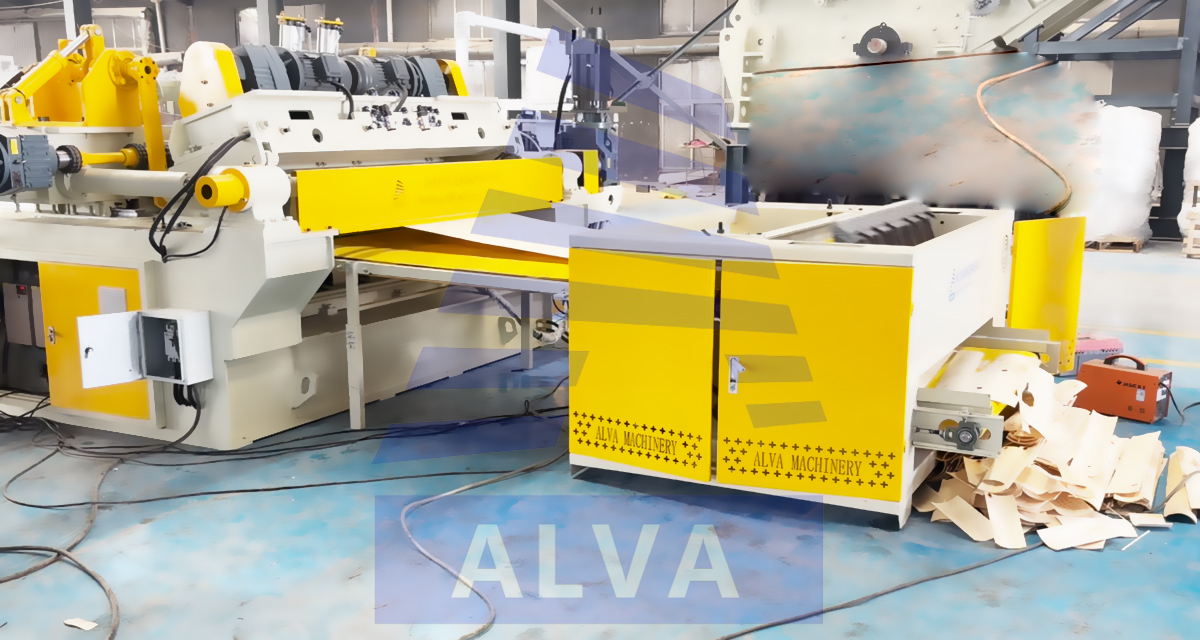
The entire production line consists of multiple special equipment operating in coordination. As a key unit after the veneer peeling process, the chopping cutter directly receives continuous veneers output by the veneer lathe and cuts them into standard small wood strips according to the set width. It serves as one of the core equipment connecting the veneer peeling process and the finished product sorting process. Its cutting accuracy, operational stability and linkage adaptability directly affect the dimensional consistency and surface quality of finished small wood strips, as well as the overall efficiency of the production line. It is an important guarantee for large-scale and standardized production.
Compared with traditional manual cutting and simple cutting equipment, the supporting chopping cutter of this production line is fully adapted to the working conditions of automated continuous operation. Adopting mechanical, standardized and linkage design, it can match the discharging speed of the veneer lathe. It effectively solves the problems of large dimensional deviation, low efficiency and poor safety caused by manual cutting, and provides regular blanks for subsequent sorting and stacking procedures, meeting the large-scale production demands of wood processing enterprises.
2. Overall Structure and Configuration of the Chopping Cutter
The supporting chopping cutter of the production line is special woodworking equipment for width sizing cutting. Designed in accordance with the principles of heavy-duty industrial application and modularization, it features a compact structure and convenient assembly, disassembly and commissioning, suitable for assembly line continuous operation. The whole machine is composed of seven core modules: frame, chopping mechanism, feeding and conveying mechanism, drive system, positioning and calibration mechanism, electrical control system and safety protection mechanism. All modules operate independently and cooperate precisely with each other. The equipment has a low failure rate and facilitates daily operation and later maintenance.
The frame is integrally welded with thickened section steel. The overall annealing process is applied after welding to eliminate welding stress and prevent frame deformation and displacement during long-term high-frequency cutting. The frame has high overall rigidity and stable load-bearing performance. It can effectively offset mechanical impact and vibration generated in the cutting process and ensure the structural stability of the equipment during long-term continuous operation. The frame surface is treated with sand blasting for rust removal and electrostatic spraying for anti-corrosion, featuring good wear resistance and corrosion resistance to adapt to the dusty and continuous working environment of workshops. Standard mounting holes are reserved at the bottom of the frame for level calibration, so as to maintain stable cutting accuracy.
The chopping mechanism is the core working unit of the equipment, which is composed of cutter body, base assembly, lifting cutting assembly and buffer limit assembly. The cutter body is forged from high-strength alloy steel and processed by quenching and tempering heat treatment. It has high hardness, good toughness and excellent wear and impact resistance, capable of long-term high-frequency cutting of wood veneers. The cutting edge remains sharp without edge chipping or rolling. The cutter body is installed in a fixed and precise structure with high-precision positioning clamping grooves. The assembly clearance is small and the positioning accuracy is high. No offset or shaking occurs during cutting, which guarantees accurate cutting dimensions. The cutter base is made of integrated cast steel with strong load-bearing capacity. It can withstand impact from frequent cutting and will not deform after long-term operation.
The feeding and conveying mechanism adopts synchronous transmission design matching the assembly line. It is fully connected with the front veneer lathe and the rear stacking equipment to realize uniform, stable and continuous feeding of veneers. The transmission assembly combines high-strength rollers and silent chains, running smoothly without jamming or offset. The feeding speed is highly synchronized with the cutting action to avoid veneer wrinkling, deviation and inconsistent cutting width. A tension adjusting assembly is equipped to fine-tune the transmission clearance according to operational wear and maintain long-term stable operation of the transmission system.
The drive system is equipped with a special servo drive, which features fast response and high control accuracy. It realizes accurate start-stop, constant-speed operation and speed regulation of cutting actions. The servo drive can automatically adjust the cutting frequency according to the veneer conveying speed of the production line to achieve intelligent linkage operation. Frequent manual adjustment is not required, and the equipment adapts to production demands at different operating speeds. Compared with conventional motor drives, the servo drive has a wider speed regulation range, higher control accuracy and better operational stability. It reduces energy consumption and mechanical wear, and extends the service life of the equipment.
The positioning and calibration mechanism is a key component to ensure uniform product specifications. It adopts a mechanical precise positioning structure matched with limit sensors to accurately control the cutting width of veneers. The positioning parameters can be adjusted flexibly to meet the width sizing requirements of small wood strips in different specifications. The adjustment is convenient and the positioning is accurate without cumulative dimensional error. During veneer feeding, the positioning device corrects material position in real time to prevent deviation and dislocation, and unify the cutting accuracy of each operation.
The electrical control system adopts an integrated numerical control module with neat wiring layout. It is equipped with multiple protection functions against short circuit, overload and phase loss to ensure safe and stable operation. The control system can be linked with the main control system of the entire production line to realize automatic coordinated operation. It supports parameter preset, one-key start and stop and fault self-check, featuring simple operation. All operational parameters, cutting rhythm and positioning dimensions can be uniformly adjusted through the control module to meet the requirements of standardized and automated production.
The safety protection mechanism adopts full-range protection design, including fully enclosed guard for the cutting area, feeding baffles, emergency stop devices and anti-pinch protection components. The guard prevents wood chips from splashing and avoids potential safety hazards caused by personnel touching the working area by mistake. The emergency stop devices respond quickly to cut off equipment operation immediately under abnormal conditions, fully ensuring the safety of equipment and operators.
3. Working Principle and Technological Process of the Chopping Cutter
Based on the principles of precise servo control, synchronous feeding and fixed-point cutting, the chopping cutter operates in deep coordination with upstream and downstream equipment of the production line to complete automatic width sizing cutting of wood veneers. The overall process is highly automated and standardized with no manual intervention required, supporting 24-hour non-stop production of the assembly line. The complete technological process includes five stages: veneer conveying, precise positioning, synchronous cutting, finished product discharging and waste cleaning.
In the veneer conveying stage, continuous veneers processed by the front veneer lathe are stably delivered to the feed end of the chopping cutter. The feeding and conveying mechanism runs at a constant speed to keep veneers flat and free from wrinkling and deviation. Materials are continuously sent to the cutting station, realizing seamless connection with the previous veneer peeling process. It guarantees continuous material transportation of the entire production line and prevents material accumulation and supply interruption.
In the precise positioning stage, veneers are automatically corrected and positioned for width after entering the equipment. Sensors detect the feeding position of veneers in real time and transmit data to the numerical control system. The system locks the cutting position according to the preset width and fine-tunes material position automatically to ensure unified cutting points. The whole positioning process is completed automatically with fast response and high accuracy, eliminating dimensional deviation caused by manual adjustment.
In the synchronous cutting stage, when veneers reach the preset cutting position, the control system activates the servo drive system to drive the cutter body to move down and complete the cutting action stably. The cutter body runs smoothly with uniform stress. The sharp cutting edge cuts wood veneers thoroughly at one time. The cutting surface is flat without burrs, chipping or tearing, and no secondary grinding is needed. The cutting action is precisely synchronized with the veneer feeding speed to realize dynamic continuous cutting. It maintains stable product quality while ensuring production efficiency. The cutter body resets automatically after cutting and waits for the next instruction to carry out cyclic operation.
In the finished product discharging stage, standard small wood strips after cutting are quickly sent out of the cutting station by the rear conveying mechanism and delivered to the stacking equipment of the production line for subsequent stacking and storage. The discharging process is smooth and efficient without jamming or accumulation, fully matching the operating rhythm of the automated assembly line and ensuring the continuity of the entire production process.
In the waste cleaning stage, a small amount of leftover materials and wood chips generated during cutting are discharged through reserved chip removal channels. The supporting dust and impurity removal system of the production line collects and processes these wastes centrally. It keeps the interior and working area of the equipment clean, prevents chip accumulation from affecting cutting accuracy and equipment service life, and realizes centralized recycling of wastes to improve resource utilization rate.
4. Core Technical Features and Application Advantages
As the core cutting equipment of the small wood strip log veneer peeling production line, the self-developed chopping cutter of Alva Machinery applies mature mechanical design and numerical control linkage technology to adapt to continuous wood processing conditions. It has outstanding advantages including high structural stability, superior cutting accuracy, wide adaptability, convenient maintenance and reliable safety performance, fully meeting the large-scale production needs of small and medium-sized wood processing enterprises.
First, the equipment has stable structure and excellent fatigue resistance. Adopting heavy-duty steel structure design and stress relief annealing treatment for the frame, it has higher rigidity and stability than ordinary cutting equipment. It can withstand high-frequency and continuous cutting impact for a long time without deformation or shaking. Core components such as cutter body, base and transmission shaft are made of high-strength wear-resistant materials and processed by precision machining and heat treatment. These parts feature good wear resistance, impact resistance and fatigue resistance. The equipment has an extremely low failure rate, adapts to long-term non-stop industrial production and reduces downtime for maintenance.
Second, it delivers high cutting accuracy and stable finished product quality. The combination of precise servo drive and mechanical positioning minimizes dimensional error. It ensures uniform specifications of finished products in each batch and solves the problem of uneven products caused by traditional cutting equipment. The alloy cutter body and stable cutting action form flat cutting surfaces without tearing and burrs. It improves the appearance quality and yield of finished products, reduces secondary working procedures and saves production time and cost.
Third, it achieves strong linkage performance and adapts to automated production lines. Customized for the matching production line, all parameters, operating rhythm and conveying specifications of the chopping cutter are precisely matched with the entire veneer peeling line. It realizes fully automatic linkage operation with veneer lathes, conveying equipment and stacking equipment without separate manual operation and commissioning, achieving unmanned continuous assembly line operation. The cutting rhythm and dimensions can be adjusted flexibly according to production capacity and material specifications. The equipment is applicable to cutting wood veneers of different materials, thicknesses and widths with wide adaptability.
Fourth, the equipment is easy to operate and low in maintenance cost. Equipped with an integrated numerical control system, the operation interface is intuitive. Operators can complete parameter adjustment, equipment start-stop and fault checking with simple operations, which has low technical requirements for staff. The modular overall layout facilitates disassembly and replacement of wearing parts. Daily maintenance only includes regular chip cleaning, transmission part lubrication and cutter body inspection. No complicated maintenance procedures are required, which greatly reduces later operation and maintenance costs.
Fifth, complete safety protection is configured to ensure operational safety. Multiple safety protection structures are installed on the equipment. The fully enclosed cutting area prevents wood chip splashing and accidental contact. Emergency stop devices and anti-jam protection components respond to abnormal working conditions effectively to avoid equipment faults and safety accidents. The electrical system is equipped with comprehensive protection functions to cope with electrical faults such as overload, short circuit and phase loss, protecting core components and extending the overall service life of the equipment.
Sixth, the equipment achieves high production efficiency and remarkable energy saving effect. The servo drive system has fast response and compact cutting rhythm, fully matching the high-speed continuous production requirements of the assembly line and improving the overall capacity of the production line. In addition, the servo drive features intelligent energy saving and automatically adjusts power output according to operating load. It consumes less energy than traditional drive equipment and reduces long-term energy costs for enterprises.
5. Coordinated Operation Value with the Entire Production Line
The automated and efficient operation of the small wood strip log veneer peeling production line relies on precise coordination of equipment in each process. As the intermediate cutting hub, the chopping cutter connects the front veneer peeling process and the rear stacking process. It is the key equipment to ensure smooth operation of the production line and standardized finished products. Stable operation of the chopping cutter effectively links upstream and downstream processes, avoids material retention, process disconnection and unqualified product specifications, and guarantees closed-loop continuous operation of the production line.
In terms of production rhythm coordination, the cutting speed and operating frequency of the chopping cutter can automatically adapt to the discharging speed of the front veneer lathe and dynamically match the overall production capacity of the line. It avoids material accumulation caused by delayed cutting and idling energy waste caused by excessive cutting speed, and maximizes production efficiency and equipment utilization. Meanwhile, finished products with unified specifications after cutting directly meet the operating requirements of the rear automatic stacking equipment. The whole production line realizes full-process automatic operation without manual secondary sorting and trimming, which greatly improves the automation level.
In terms of product quality control, the high-precision cutting capacity unifies the dimensional standard of all finished products. It eliminates uneven dimensions and defects caused by manual cutting and simple equipment, and enhances the overall product quality and market competitiveness. Stable cutting quality reduces defective rate and raw material waste, improves the comprehensive utilization rate of logs, and conforms to the development trend of high-efficiency and environmental-friendly wood processing industry.
In terms of production line maintenance coordination, the chopping cutter has low failure rate, high stability and convenient maintenance. It reduces the probability of shutdown of the entire production line and ensures long-term continuous production. Its standardized structural design is perfectly compatible with the dust removal system, waste recycling system and main control system of the production line. It realizes unified working condition management and centralized waste treatment, optimizes the workshop production environment and raises the standardized production level of enterprises.
6. Industry Application Scenarios and Industrial Value
With the advantages of high precision, stability and efficiency, the chopping cutter supporting the small wood strip log veneer peeling production line of Alva Machinery is widely applied in wood-based panel processing, solid wood building material production, furniture accessory processing, packaging wood strip processing and other fields. It is the core supporting equipment for high-efficiency resource utilization of small and medium-diameter logs and has high industrial application value.
In the wood-based panel processing industry, the equipment cuts veneers from veneer peeling into wood strip raw materials with unified specifications, which are used for the production of plywood, blockboard, laminated board and other wood-based panels. Standardized raw material specifications improve the splicing precision and surface flatness of panels, and promote the quality and yield of wood-based panel products. In the field of solid wood building material processing, standard small wood strips after cutting can be directly used to produce construction lumber, decorative wood strips and solid wood profiles. The uniform specifications and neat appearance reduce subsequent grinding and trimming procedures and improve the processing efficiency of building materials.
In the field of furniture and packaging accessory processing, standard wood strips produced by the equipment can meet the production demands of furniture internal supports, packaging buffer lumber and craft accessories. The finished products have high precision and no defects and can be put into subsequent processing directly, effectively cutting the accessory processing cost of enterprises. Leftover materials generated during processing can be recycled to produce biomass fuel and wood chip boards. It maximizes the utilization rate of log resources, reduces resource waste and environmental pollution, and complies with relevant policies of green processing industry.
From the perspective of industrial development, traditional wood processing mainly relies on manual cutting and simple equipment, which has many drawbacks such as low efficiency, poor precision, high loss and insufficient safety, and cannot adapt to modern large-scale production. The application of the automatic chopping cutter of Alva Machinery completely replaces the extensive traditional processing mode and realizes mechanized, standardized and automatic operation of wood cutting procedures. It promotes the transformation of wood processing industry from labor-intensive mode to intelligent and high-efficiency mode. The equipment features stable performance, low maintenance cost and high output capacity. It reduces the comprehensive production cost of enterprises, improves production efficiency and market competitiveness, and provides strong equipment support for the high-quality, green and automatic development of wood processing industry.
7. Daily Inspection and Maintenance Specifications
To ensure long-term precise, stable and efficient operation of the chopping cutter and extend its service life, standardized daily and periodic maintenance must be implemented. Maintenance work shall be carried out in accordance with graded inspection modes including daily check, weekly check and monthly check.
Pre-operation Daily Inspection
Before starting up every day, operators shall conduct a comprehensive inspection on equipment appearance, protection devices, transmission parts and cutter body. Check whether safety guards and baffles are intact and whether emergency stop devices are sensitive and effective. Inspect the cutting edge of the chopping cutter to confirm no chipping, rolling or excessive wear. Examine transmission chains and rollers to ensure smooth operation without jamming, loosening or deviation. Clean wood chips and sundries in the cutting area, feed end and discharge end to keep the working area tidy and prevent impurities from affecting cutting accuracy and equipment operation. Conduct no-load trial operation after inspection. The equipment can be put into formal production only if no abnormal vibration or noise is found.
Regular Lubrication
Add special lubricating oil to moving parts such as transmission chains, bearings, sliding assemblies and lifting components regularly in accordance with maintenance standards. Lubrication reduces component wear and ensures smooth transmission and cutting actions. Control the oil dosage to prevent oil contamination from absorbing wood chips. Inferior lubricating oil is prohibited to avoid component rusting and jamming. Check the wear of lubricated parts regularly and replenish or replace lubricating oil timely to maintain stable mechanical performance.
Cutter Body Maintenance and Inspection
The cutter body is a key wearing part. Check the sharpness and fixing state of the cutting edge periodically. Stop the equipment for grinding if edge wear, uneven cutting surface or cutting jamming occurs. Replace the cutter body in time when the wear is serious. Keep the mounting surface clean during disassembly and assembly of the cutter body, and fasten all bolts firmly. Ensure accurate installation without loosening, so as to avoid dimensional deviation and potential safety hazards caused by cutter body offset during cutting.
Electrical System Maintenance
Clean dust and sundries inside the electric control cabinet regularly. Check whether wiring terminals are fastened and wires are damaged or aged to prevent electrical faults such as loose connection, short circuit and electric leakage. Verify the normal state of control system parameters and protection devices to ensure effective operation of protection functions against overload, phase loss and short circuit. Do not open the electric control cabinet in humid environment to prevent electrical components from moisture damage and maintain safe and stable operation of the electrical system.
Transmission System Maintenance
Check the tension and wear of transmission chains and rollers regularly. Adjust chain tightness timely and replace severely worn or deformed transmission parts. Remove wood chips and oil stains on transmission components to ensure smooth transmission and prevent jamming and slipping which affect cutting rhythm and accuracy.
Maintenance for Long-term Shutdown
Cut off the main power supply completely when the equipment is out of service for a long time. Thoroughly clean wood chips, sundries and oil stains inside and outside the equipment. Apply anti-rust oil on vulnerable parts such as cutter bodies, bearings and transmission components for anti-corrosion treatment. Store the equipment in a dry, ventilated and dust-free environment, and avoid erosion by moisture and corrosive gas to keep the equipment in good condition for quick restart and operation later.
8. Conclusion
The chopping cutter supporting the small wood strip log veneer peeling production line of Shandong Alva Machinery Group Co., Ltd. is an automatic high-precision cutting equipment specially developed for continuous wood cutting conditions. With stable structural design, precise servo control, complete safety protection and convenient maintenance, it fully meets the demands of full-process automatic production for veneer peeling processing of small and medium-diameter logs. As the core cutting hub of the entire production line, the equipment solves the industry problems of low precision, low efficiency, high loss and high labor cost in traditional wood cutting processes. It improves the standardization of finished small wood strips through accurate width sizing and automatic linkage operation, and raises the overall production efficiency and product quality of the production line.
Featuring solid structure, stable performance, wide adaptability and low maintenance cost, the chopping cutter adapts to long-term high-intensity continuous industrial operation. It takes into account production efficiency, product quality and operational safety. Meanwhile, the design of waste recycling and energy-saving operation helps enterprises realize green and low-carbon production. The in-depth coordination between the chopping cutter and other equipment of the veneer peeling line realizes full-process closed-loop automatic operation including log sawing, rounding, veneer peeling, precision cutting and finished product stacking. It greatly improves the utilization rate of log resources, reduces the comprehensive production cost of enterprises, and provides core equipment support for large-scale, standardized and intelligent production of wood processing enterprises.
In the future, Shandong Alva Machinery Group Co., Ltd. will continue to focus on the field of wood processing equipment. The company will keep optimizing the structural design, control program and manufacturing technology of the chopping cutter and the entire veneer peeling production line, and continuously improve the automation level, processing accuracy and operational stability of the equipment. It will continue to provide high-performance, highly adaptable and cost-effective complete sets of wood processing equipment for the industry, and facilitate the high-quality, intelligent and green upgrading of domestic wood processing industry.

 English
 العربية
 Français
 Русский
 Español
 Português
 Deutsch
 italiano
 日本語
日本語 한국어
한국어 Nederlands
 Tiếng Việt
 ไทย
ไทย Polski
 Türkçe
 አማርኛ
አማርኛ ພາສາລາວ
 ភាសាខ្មែរ
 Bahasa Melayu
 ဗမာစာ
ဗမာစာ தமிழ்
தமிழ் Filipino
 Bahasa Indonesia
 magyar
 Română
 Čeština
 Монгол
 қазақ
қазақ Српски
 हिन्दी
 فارسی
فارسی Kiswahili
 Slovenčina
 Slovenščina
 Norsk
Norsk Svenska
 українська
 Ελληνικά
 Suomi
Suomi Հայերեն
 עברית
עברית Latine
 Dansk
Dansk اردو
اردو Shqip
Shqip বাংলা
বাংলা Afrikaans
 Māori
Māori অসমীয়া
 Беларуская мова
 Català


