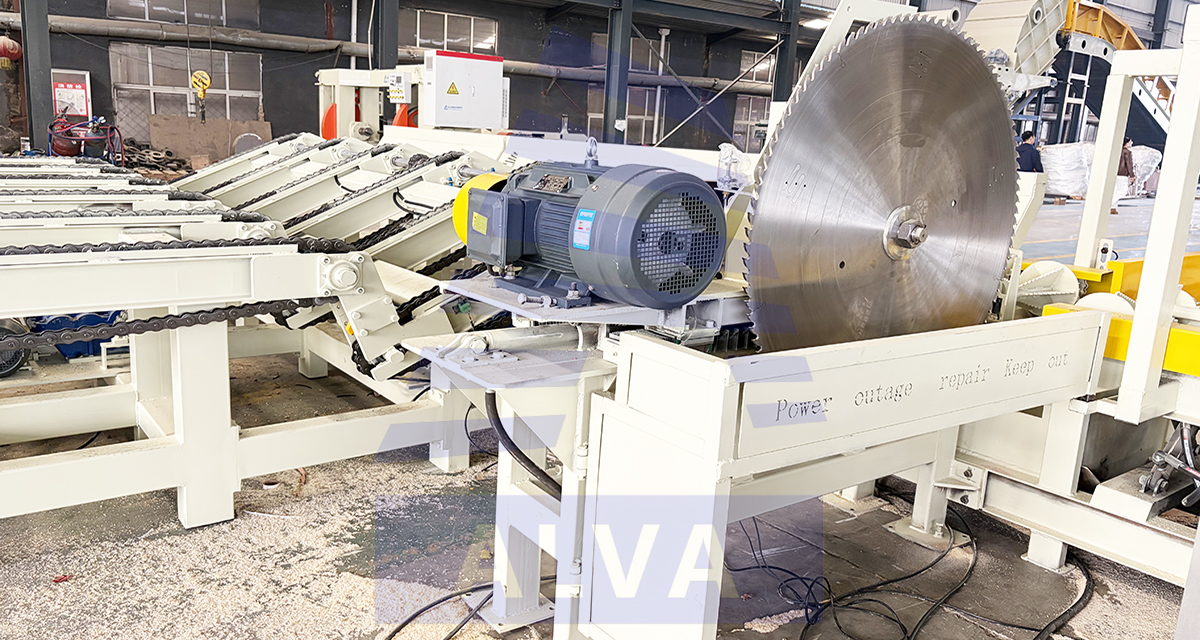
1. Product Overview
The log sawing machine is the core pre-process equipment in the wood processing industrial chain, undertaking the essential functions of fixed-length cutting and primary processing grading of logs. It is widely applied in furniture manufacturing, construction timber, wood-based panel production, timber export processing and other related fields. Targeting logs as the processing object, the equipment completes fixed-length cutting of long logs through automatic conveying, precise positioning and sawing execution units, providing standardized blanks for subsequent procedures such as material splitting, slicing and drying.
As the primary processing equipment in the wood processing workflow, its structural stability, processing accuracy and safety performance directly affect the operational efficiency and finished product quality of the entire production line, making it fundamental equipment in the woodworking machinery industry.
Developed with a modular design concept, the log sawing machine series can adapt to the processing demands of logs with different diameters, lengths and tree species, and is compatible with both manual feeding and automatic production line docking modes. It meets diversified application requirements ranging from small timber processing factories to large-scale centralized production bases.
In the links of design, manufacturing and testing, the equipment strictly complies with domestic and international woodworking machinery industry standards and features strong adaptability to the global market. It has obtained market access recognition in multiple regions around the world and serves as general processing equipment tailor-made for users in the global woodworking industry.
2. Core Technology and Design Specifications
2.1 Structural Design and Mechanical Performance
The main body of the equipment adopts heavy-duty steel structure welding technology, and all key stress-bearing components undergo stress relief treatment to ensure structural stability under long-term high-load operation. The sawing unit is driven by a high-power motor matched with a high-precision spindle system, which guarantees stable sawing operation and reduces the impact of vibration on processing accuracy.
The conveying system adopts a chain transmission structure combined with an automatic positioning device to realize accurate feeding and positioning of logs, adapting to fixed-length processing requirements of various specifications. Key components of the equipment follow standardized design. Saw blades, bearings, motors and other wearing parts adopt universal specifications, facilitating maintenance and replacement for global users.
The rack surface is treated with anti-rust spraying to adapt to harsh production environments with high humidity and heavy dust, extending the service life of the equipment. The transmission system adopts a fully enclosed protective structure to reduce erosion of mechanical parts by wood chips and dust, lower failure rates and ensure continuous operation capacity.
2.2 Safety Design and Compliance Requirements
The log sawing machine is designed in strict accordance with woodworking machinery safety specifications to build a full-process safety protection system. It is equipped with multiple safety protection devices, including protective fences in the sawing area, emergency stop buttons, power failure protection devices and misoperation early warning systems, effectively avoiding potential safety hazards during operation.
The electrical system is designed with IP protection levels to meet industrial power consumption safety standards and prevent electrical faults caused by intrusion of dust and moisture. The equipment design and manufacturing conform to a number of international safety standards covering mechanical protection, electrical safety, noise control and emergency response.
All key safety components pass inspection and certification by third-party institutions to ensure compliance with local safety regulations when the equipment is put into use in different regions. Clear safety warning signs are set in the operation area with multilingual markings to adapt to users from various countries and regions and reduce the risk of misoperation.
2.3 Automation and Control Technology
The equipment is equipped with a standardized control system, supporting switching among manual, semi-automatic and fully automatic operating modes to flexibly adjust the workflow according to production demands. The control system has a parameter storage function, which can preset processing parameters for logs of different specifications and realize one-click switching, cutting down manual adjustment time and improving production efficiency.
Built with a fault self-diagnosis system, it monitors the operating status of key components in real time. The equipment will automatically stop and prompt fault information under abnormal conditions, enabling rapid troubleshooting and maintenance. The control system supports signal docking with upstream log conveying equipment and downstream processing equipment, allowing access to automatic production lines and realizing continuous operation from log conveying and sawing to finished product transportation.
The interface adopts a general industrial protocol design and is compatible with equipment of different brands, meeting the renovation and upgrading needs of users’ existing production lines and reducing equipment integration costs.
3. Production Manufacturing and Quality Control
3.1 Manufacturing Process and Technical Standards
The production and manufacturing of the log sawing machine adopt standardized technological procedures. The whole process from raw material procurement to finished product delivery follows strict quality management and control systems. Raw materials select steel and mechanical components that meet international standards, and all key parts pass incoming inspection to ensure material performance and specifications comply with design requirements.
Numerically controlled equipment is adopted for component processing, and high-precision testing instruments are used to verify key dimensions, ensuring interchangeability and assembly accuracy of all parts. Modular step-by-step assembly technology is applied in equipment assembly. Pre-assembly and debugging of each unit are completed first, followed by integrated assembly of the whole machine to ensure coordinated operation of all systems.
Performance tests including no-load operation test, load test and safety function test are conducted synchronously during assembly to verify whether the operational stability and performance indicators of the equipment meet design specifications.
3.2 Quality Inspection and Certification System
Finished equipment undergoes multiple rounds of quality inspection before delivery, covering mechanical performance, electrical safety, processing accuracy, noise control and other dimensions. The inspection process abides by woodworking machinery industry testing standards, and professional testing equipment is used for data collection and analysis to ensure all indicators comply with design regulations.
Qualified equipment is delivered with complete test reports and qualification certificates, clarifying performance parameters and compliance descriptions, and providing support for users’ market access. The log sawing machine series has passed a number of international certifications, including EU CE certification, North American safety certification and market access certification in some Southeast Asian countries, qualifying for entry into major global woodworking machinery markets.
The certification process strictly follows local regulatory requirements, conducting comprehensive verification on equipment safety performance, electromagnetic compatibility, environmental protection indicators and other aspects to ensure compliant application in target markets.
3.3 Supply Chain and Production Support
The equipment production adopts a global supply chain management mode. Core components are preferentially sourced from suppliers with international certifications to guarantee stable quality and sustainable supply of parts. The production base implements a standardized production management system with dual capabilities of mass production and customized production.
Production plans can be adjusted according to user demands to ensure order delivery cycles. Meanwhile, the production base has established a complete spare parts inventory system to provide rapid response and after-sales support for global users and minimize equipment downtime.
4. Adaptability to the International Woodworking Machinery Market
4.1 Overview of the Global Woodworking Machinery Market
The global woodworking machinery market maintains a steady growth momentum. Driven by downstream industries such as furniture manufacturing, construction timber and wood-based panel production, the market demand for efficient, precise and safe woodworking equipment keeps rising. At the same time, the market puts forward increasingly higher requirements for equipment automation, environmental performance and compliance.
Different regions set differentiated requirements on safety standards, electrical specifications, noise control and other aspects of woodworking machinery according to local regulations and industrial characteristics. As an important market for woodworking machinery, the Asia-Pacific region witnesses remarkable growth in demand for mid-to-high-end automated equipment, while attaching importance to equipment cost performance and adaptability.
The European market imposes strict regulations on equipment safety performance, environmental protection indicators and technical specifications, emphasizing full-life-cycle compliance. The North American market focuses on operational safety and maintenance convenience, with high requirements for standardization and universality of equipment. Emerging markets such as Southeast Asia and Africa lay emphasis on equipment stability and cost control, as well as easy maintenance and local adaptation capabilities.
4.2 International Market Adaptability of the Product
First is compliance and standard adaptation. The equipment design fully considers regulatory requirements of different regions and supports customization of electrical systems with different voltages and frequencies to adapt to power supply standards of target markets. Indicators including safety protection, noise control and environmental emission can be adjusted in accordance with local regulations to meet market access rules of various countries and regions.
Design documents, test reports and certification materials adopt international universal formats to facilitate users to complete local market access procedures. Second is adaptation to environment and working conditions. The equipment can adapt to production environments under various climatic conditions, providing customized solutions for working conditions of high temperature, high humidity and heavy dust, such as enhanced anti-rust treatment, dust-proof electrical cabinets and high-temperature adaptive components.
The mechanical structure can match log characteristics in different regions and meet sawing demands of tropical hardwood, temperate softwood and other tree species, guaranteeing processing effect and equipment stability. Third is operation and maintenance adaptation. The control system supports multilingual interfaces and can be configured with language versions of target markets according to user needs, facilitating operation by local staff.
The maintenance manual adopts a combination of pictures and texts to clarify key maintenance procedures and component instructions. Standard tools and spare parts are equipped to lower maintenance difficulties. In addition, the equipment is designed for easy maintenance. Key components adopt modular design for quick disassembly and replacement, reducing maintenance time and costs.
4.3 Application Scenarios in Target Markets
In the furniture manufacturing industry, the log sawing machine is used for fixed-length cutting of long logs to provide standardized blanks for subsequent plate processing and solid wood furniture manufacturing. It is compatible with production demands of panel furniture, solid wood furniture and other products, and can form automatic production lines with multi-blade saws, planers and cutting machines to improve overall production efficiency.
In construction timber processing, the equipment completes fixed-length cutting of logs to provide timber raw materials with unified specifications for construction projects, adapting to wood processing demands in housing construction, bridge engineering, wood structure buildings and other scenarios. In wood-based panel production, it undertakes fixed-length cutting of logs to provide raw materials for the production of fiberboard, particleboard, plywood and other wood-based panel products, conforming to technological requirements of different specifications and ensuring stable raw material supply.
For timber export processing enterprises, the equipment realizes standardized fixed-length processing of logs. Processed blanks meet specification requirements of target markets, facilitating subsequent transportation and deep processing and improving added value and market competitiveness of timber products.
5. Product Advantages and Industrial Value
5.1 Core Product Advantages
The equipment features outstanding stability and reliability. Adopting heavy-duty steel structure and high-quality core parts, it passes strict quality inspection and working condition tests, possessing the capacity of long-term continuous operation, reducing failure rates and ensuring stable operation of production lines.
It has high universality and adaptability. The modular design enables the equipment to adapt to log processing demands of various specifications and tree species, and supports docking with multiple automatic production lines, meeting production scenario requirements of different users and cutting equipment procurement costs.
With high compliance and market adaptability, it strictly follows international woodworking machinery standards and passes multiple international certifications, qualifying for entry into major global woodworking machinery markets and providing compliance guarantee for users’ market expansion.
It also delivers easy maintenance and economic benefits. The universal and modular design ensures easy procurement and replacement of key parts with simplified maintenance procedures, lowering maintenance costs and equipment downtime, and improving economic efficiency in application.
5.2 Industrial Value and Application Significance
As essential pre-process equipment in the wood processing chain, the performance of the log sawing machine affects the production efficiency, finished product quality and cost control of wood processing enterprises. Efficient and stable log sawing equipment reduces log waste, improves wood utilization rate and cuts raw material costs for enterprises.
Standardized fixed-length processing guarantees processing accuracy of subsequent procedures and stabilizes finished product quality. The automated operation mode reduces manual intervention, lowers labor costs and safety risks, and promotes automation and intelligent upgrading of the wood processing industry.
Against the trend of high efficiency, environmental protection and standardized development of the global wood processing industry, the log sawing machine provides reliable pre-processing solutions for global woodworking enterprises with standardized design, international compliance and stable performance. It helps enterprises improve production efficiency, expand international markets, and promotes standardized and sustainable development of the global wood processing industry.
6. After-sales Service and Support System
6.1 Global After-sales Service Network
The manufacturer has established a global after-sales service network covering major markets worldwide, setting up service centers and spare parts warehouses in multiple regions to provide rapid after-sales response. Professional technical personnel are arranged at service centers, capable of equipment installation and commissioning, fault maintenance and technical training.
A combination of on-site service and remote technical support is adopted to solve various problems encountered by users during equipment operation.
6.2 Technical Support and Training Service
Guidance on equipment installation and commissioning is provided for users. On-site or remote assistance is offered to complete equipment installation, debugging and parameter setting, ensuring the equipment is put into operation smoothly. Meanwhile, professional operation training is provided, covering operating procedures, safety specifications and daily maintenance, helping operators quickly master equipment use and maintenance methods.
Detailed maintenance manuals and technical documents are provided to clarify maintenance items and cycles at different stages. Regular return visits are arranged to monitor equipment operation status and offer maintenance suggestions and technical support, extending the service life of the equipment.
6.3 Spare Parts Supply and Equipment Upgrade Service
A complete spare parts supply system is established to provide long-term supply guarantee for wearing parts and key components. Users can purchase spare parts through local service centers or directly from the manufacturer to meet daily maintenance demands.
In addition, the manufacturer keeps track of technological development in the woodworking machinery industry and provides equipment upgrading services. Functional modules such as control systems can be upgraded and renovated according to user demands to enhance equipment performance and market adaptability and meet subsequent production upgrading needs.
7. Conclusion
The log sawing machine occupies a vital position in the development of the global woodworking industry as basic equipment in the wood processing industrial chain. With standardized design, international compliance, stable performance and a comprehensive after-sales service system, the product adapts to wood processing demands in different regions and scenarios across the globe, delivering reliable pre-processing solutions for users.
With the continuous development of the global woodworking machinery market, the manufacturer will further optimize product design, upgrade equipment automation, environmental protection performance and market adaptability, and provide higher-quality equipment and services for global woodworking enterprises. It will help promote the standardization, high efficiency and sustainable development of the industry, and jointly drive the progress and upgrading of the global wood processing industry.

 English
 العربية
 Français
 Русский
 Español
 Português
 Deutsch
 italiano
 日本語
日本語 한국어
한국어 Nederlands
 Tiếng Việt
 ไทย
ไทย Polski
 Türkçe
 አማርኛ
አማርኛ ພາສາລາວ
 ភាសាខ្មែរ
 Bahasa Melayu
 ဗမာစာ
ဗမာစာ தமிழ்
தமிழ் Filipino
 Bahasa Indonesia
 magyar
 Română
 Čeština
 Монгол
 қазақ
қазақ Српски
 हिन्दी
 فارسی
فارسی Kiswahili
 Slovenčina
 Slovenščina
 Norsk
Norsk Svenska
 українська
 Ελληνικά
 Suomi
Suomi Հայերեն
 עברית
עברית Latine
 Dansk
Dansk اردو
اردو Shqip
Shqip বাংলা
বাংলা Afrikaans
 Māori
Māori অসমীয়া
 Беларуская мова
 Català


