
 |


| Quantity: | |
|---|---|


 | Product Introduction |
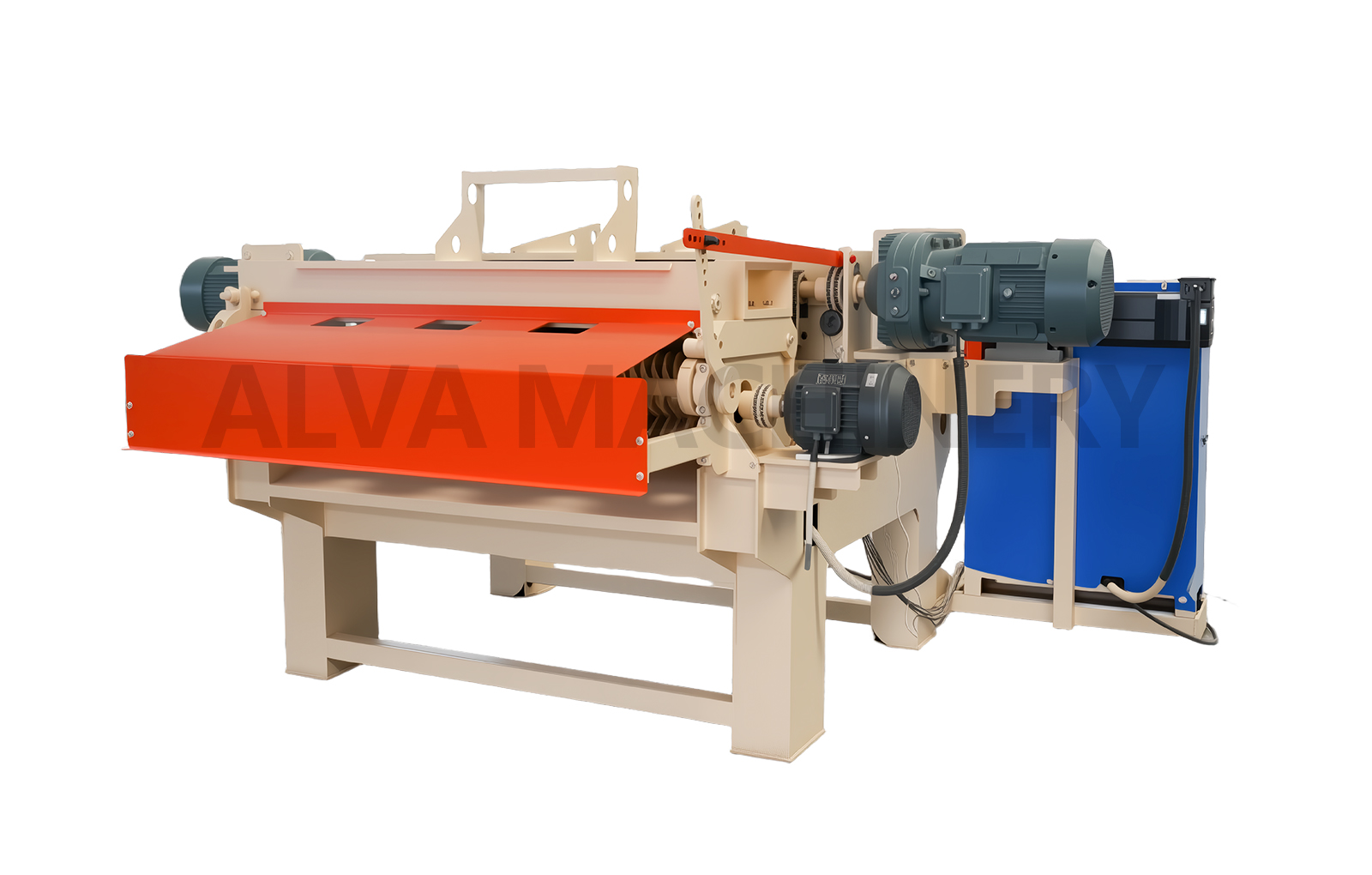
ALVA OSB Veneer Peeling Machine is a core key equipment in the production process of Oriented Strand Board (OSB). It is used for the refined and standardized rotary cutting of wood raw materials. Exclusively designed for the OSB production process, the technical parameters and operation mechanism of this equipment are in line with the core requirements of wood raw material processing and subsequent board forming.
The core function of the OSB rotary cutter is wood raw material processing, with processing objects including logs, wood sections and reconstituted wood blanks. Through the coordinated operation of the knife set and the feeding system, the equipment can rotary-cut the above-mentioned raw materials into wood strands with uniform thickness and controllable length. Such strands are the basic raw materials for OSB production, and their specification accuracy is directly related to the processing quality and efficiency of subsequent processes.
The strands processed by the OSB rotary cutter will be directly transported to the strand drying process, providing processing objects with uniform shape for this process; the dried strands enter the glue application process, and the regular raw material shape can ensure the stability of glue adhesion; after glue application, the strands enter the oriented paving process, and the uniform physical parameters provide support for the consistency of paving density; finally, in the hot-pressing forming process, the strands that meet the standards are a prerequisite for ensuring that the physical properties of the boards meet the standards.
As a key pre-equipment in OSB production, the operation stability and processing accuracy of the OSB rotary cutter directly affect the production capacity of the entire production line and the core indicators such as strength, density and flatness of the final OSB boards. It is an indispensable process equipment in the large-scale production of OSB.
| Product Display |
| Product Workflow |

| Product Parameter |
| Designation | Unit | Arguments |
| Log processing dimensions | mm | 500*1400mm |
| Size of rotary cutter | mm | 1500*180*16mm |
| Diameter of cylinder | mm | 180mm |
| Linear speed | m/min | 50m/min |
| Reference output | m³/day | 120m³/day |
| Hydraulic system power | kw | 5.5kw |
| Single roller power | kw | 1-11kw |
| Single roll reducer | 350 | |
| Double roller power | kw | 1*11kw |
| Double roll reducer | 350 | |
| Product dimensions | mm | 4000*2200*1800mm |
| Weight | kg | 4000kg |
| Comment | Widen the aggravating | |
| Total power | kw | 27.5kw |
| Product Advantages |
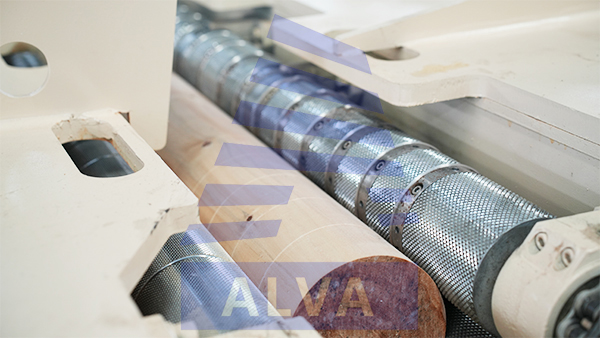
The equipment adopts a dual-roller feeding + adjustable rotary cutting gap design. It can handle whole logs as well as reconstituted wood blanks made from spliced leftover materials — whether it’s wet wood or hard wood, the anti-slip texture of the feeding rollers ensures stable material gripping, and the rotary cutting knife set automatically adjusts the cutting pressure to match the raw material’s hardness. This eliminates issues like material jamming or knife chipping, allowing processing plants to avoid being limited to a single type of raw material and flexibly utilize various wood resources.

It is equipped with an industrial-grade three-phase asynchronous motor, which delivers strong power output and adapts to different production capacity needs. It also features an intelligent overload protection device: when the raw material is too hard or feeding gets stuck, the motor can buffer automatically — this prevents motor damage and protects the equipment’s transmission components. This power system boasts excellent continuous trouble-free operation time, with longer maintenance intervals than ordinary motors, greatly reducing downtime losses for the production line.
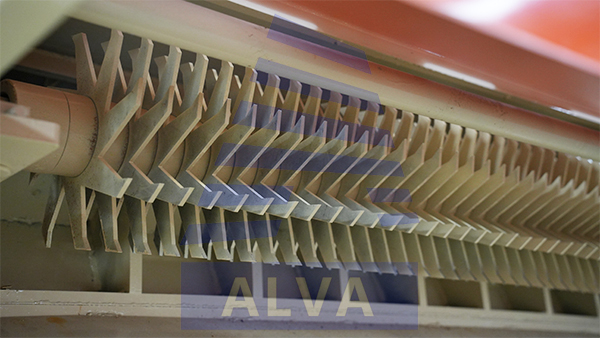
This knife set uses a cemented carbide-coated blade edge, which is more durable than ordinary knives. Meanwhile, the spiral arrangement design of the knife set makes cutting force more even, enabling continuous cutting — the strand production efficiency is higher than that of traditional flat-knife structures. Coupled with the quick-release design of the knives, blade replacement takes less time, further reducing the equipment’s non-operational time and helping the production line achieve high output with minimal downtime for efficient operation.

The strands produced by this rotary cutter have uniform thickness and regular dimensions, and their shape can be flexibly adjusted according to different OSB board specifications — from fine strands for decorative boards to wide strands for structural boards, all can be cut precisely. These regular strands distribute more evenly during the subsequent paving process: this not only avoids uneven local density in the boards, but also improves the surface flatness of the boards after hot-pressing, directly reducing the consumables and working hours required for the subsequent sanding process.


