1. Overview of Industry Background and Overseas Market Layout
The global plywood and solid wood veneer processing industry is continuously transforming towards automated and integrated production lines. Wood processing enterprises in Europe have set stringent standardized requirements for the stability, overall adaptability and continuous operation performance of complete sets of log processing equipment. Shandong Alva Machinery Group Co., Ltd. has been deeply engaged in the research, development and manufacturing of complete woodworking equipment for years. The Group focuses on the R&D and production of full-process equipment covering log pre-treatment, veneer peeling, cutting and stacking. Multiple rounds of structural optimization and production line process adaptation have been completed for overseas clients in light of differences in log materials, factory working conditions and production techniques across regions.
Relying on a mature complete equipment design system, full-machine factory inspection procedures and cross-border installation and commissioning service system, the Group’s complete veneer peeling production lines have gradually covered overseas markets including Southeast Asia, Central Asia, Eastern and Western Europe, consistently providing one-stop automated wood processing solutions for overseas wood factories.
In recent years, demands for upgrading and renovation among local European wood processing enterprises have kept rising. The traditional scattered single-machine operation mode is plagued by heavy labor input, disjointed working procedures, inconsistent finished veneer quality and relatively high comprehensive production costs. Most local processing plants have demands to replace old equipment with fully automated complete production lines. The overseas technical and sales teams of Shandong Alva Machinery Group carried out on-site factory survey, research on raw log parameters, production capacity planning and equipment layout design in response to the production demands of European clients. A customized fully automatic complete log veneer peeling production line matching local working conditions was delivered, covering the whole workflow including complete machine production, no-load and material-carrying joint debugging before delivery, export packaging, cross-border logistics transportation, on-site installation, full-line commissioning and operator training. At present, the complete production line has finished full-line commissioning and formally entered operation at the production plant of the European client. All equipment units run in stable linkage, and the effect of full-process automated operation has met the production standards preset by the client. No persistent malfunctions occurred during the operation period after launch, and the complete set of equipment has received comprehensive written and on-site recognition from the European cooperative client.
2. Description of Overall Technological Process of the Complete Log Veneer Peeling Production Line
The fully automatic log veneer peeling production line delivered to the European client adopts an integrated continuous operation system. Minimal manual intervention is required for the whole process from raw log entry to automatic stacking of finished veneers. Special equipment for each working procedure is connected in sequence to realize assembly-line operations including log shaping, veneer forming, fixed-size cutting and finished product stacking. The complete list of equipment on the full production line is as follows: Log Saw, Material Storage Platform, Rounding Machine Feeding Conveyor, Log Rounding Machine, Horizontal Conveyor, Veneer Peeling Machine Feeding Conveyor, Veneer Peeling Machine, Cutting Machine, Stacking Machine.
Each equipment unit of the full production line is equipped with an independent operation control system, together with a central linkage control system that supports two operation modes: independent start-stop of single machines and synchronous linkage operation of the whole line, adapting to two production scenarios including phased processing and full-load continuous production.
As the first procedure equipment of the production line, the Log Saw undertakes the sectional processing of incoming raw logs. It cuts logs of uneven lengths into standard wood segments matching subsequent rounding and peeling procedures, eliminating hidden operational troubles such as feeding jams and uneven equipment stress caused by inconsistent log lengths, and laying a raw material foundation for stable continuous operation of the whole production line. The Log Saw is equipped with independent auxiliary feeding and discharging structures that can connect with the factory log storage area to automatically transport raw materials to the sawing station. Segmented wood segments are automatically conveyed to the Material Storage Platform for the next procedure.
The Material Storage Platform serves as an intermediate buffer and storage unit of the whole production line. It receives standard wood segments output from the Log Saw, completes temporary storage and ordered distribution of raw materials, balances operation rhythm differences between front and rear procedures, and avoids material accumulation and equipment blockage resulting from excessive feeding speed of front procedures and insufficient processing efficiency of rear procedures. An automatic material pushing mechanism is installed on the platform to deliver wood segments to the Rounding Machine Feeding Conveyor at a uniform speed in accordance with the production line operation rhythm, realizing quantitative and ordered supply of raw materials and guaranteeing uninterrupted operation of the subsequent rounding procedure.
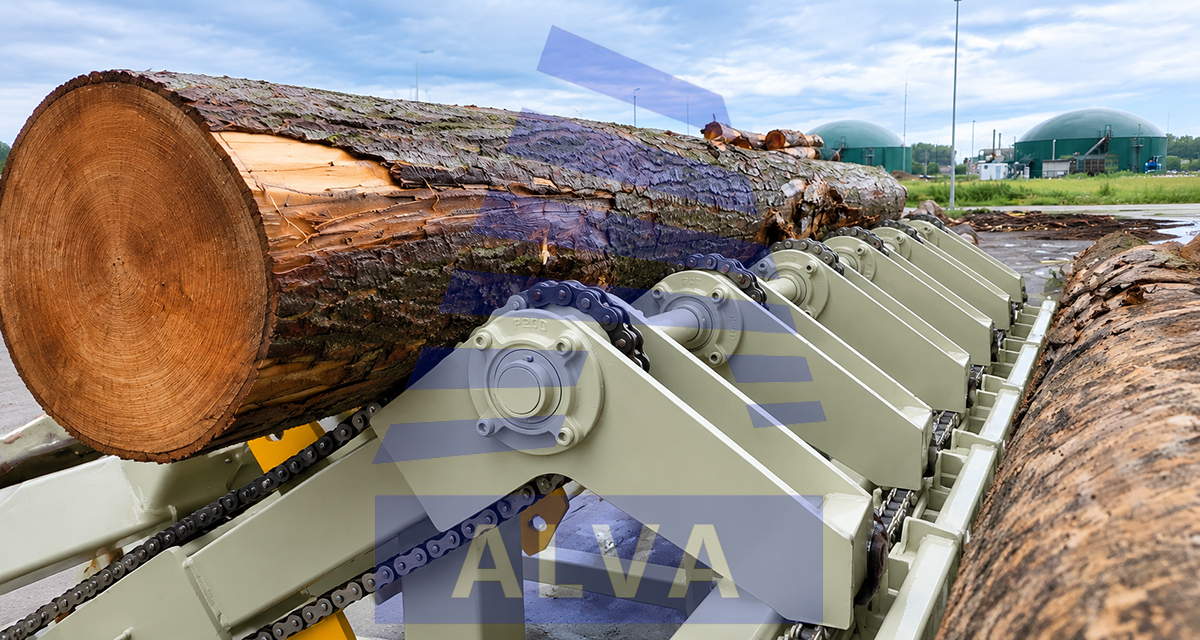
The Rounding Machine Feeding Conveyor is responsible for material transfer from the Material Storage Platform to the rounding station. Its conveying structure fits the characteristics of cylindrical wood segments, with anti-slip and anti-roll design to prevent rolling and deviation of wood segments during transportation. Raw materials are stably delivered to the rounding processing station at a uniform speed, enabling seamless material connection between working procedures, reducing manual material transfer links, and lowering raw material loss caused by manual collision and material falling.
The Log Rounding Machine is the core equipment for log pre-treatment. It performs rounding processing on irregular logs with surface bumps, residual bark and irregular cross-sections to convert unprocessed logs into regular cylindrical blanks. It eliminates abrasion and impact on peeling cutters and spindle structures brought by surface protrusions and hard knots on raw logs, greatly improving the flatness of veneer sheets produced by peeling, reducing the wear rate of core components of peeling equipment and extending the service life of complete machines. Regular cylindrical blanks processed by the rounding machine are transferred to the front section of the peeling station via the Horizontal Conveyor.
The Horizontal Conveyor receives discharged materials from the Log Rounding Machine and completes smooth horizontal transfer of regular wood blanks. Its flat and smooth conveying table fits the transportation demand of cylindrical wood blanks, with adjustable start-stop rhythm matching the feeding speed of the Veneer Peeling Machine Feeding Conveyor. Acting as a transitional conveying unit between rounding and peeling procedures, it balances operation beats of the two core pieces of equipment and ensures continuous and stable supply of wood blanks to the main peeling machine.
The Veneer Peeling Machine Feeding Conveyor accurately transports regular wood blanks to the spindle processing station of the veneer peeling machine. A positioning mechanism calibrates wood blanks to the center, ensuring central axis alignment after blanks enter the main peeling machine, avoiding uneven veneer thickness and sheet deviation during peeling. The automatic feeding structure replaces manual log loading, lowering labor intensity in factories and eliminating potential safety hazards caused by manual handling of heavy raw logs.
The Veneer Peeling Machine is the core forming equipment of the whole production line, adopting spindle peeling structure design. Double spindles lock and fix wood blanks, and a servo control system regulates peeling thickness to stably cut out continuous and intact veneer sheets. The main body of the equipment is solid and robust with low vibration during operation, producing uniformly thick and smooth veneer sheets free of obvious burrs that meet the demand of thin veneer production for small wood strips. Continuous veneers produced are automatically conveyed to the Cutting Machine station for subsequent fixed-size cutting procedures.
The Cutting Machine receives continuous veneers output from the Veneer Peeling Machine and executes fixed-size cutting operations relying on supporting cutters. Long continuous veneers are cut into uniform small wood pieces in accordance with finished product size requirements of clients. Cutting movements are uniform and stable, producing neat cutting edges without tearing or burrs. Small finished wood pieces after cutting are automatically conveyed to the Stacking Machine station.
As the terminal finished product collection unit of the whole production line, the Stacking Machine automatically layers and stacks standard small wood pieces after cutting in neat piles convenient for subsequent packaging, storage and transportation. Manual sorting of veneers at the finished product stage is fully eliminated, drastically reducing labor input in finished product finishing links and improving the closed-loop automation degree of the full production line.
All equipment units of the complete production line are uniformly matched with the self-developed supporting electronic control system of Alva. Electrical components adopt accessories complying with EU electrical safety standards. Multi-language operation interfaces including Chinese, English, German and French are available to fit operation habits of local European operators. Complete safety protection structures of the equipment conform to EU machinery safety specifications, fully equipped with full-area protective baffles, emergency stop buttons and photoelectric safety induction devices to prevent safety accidents caused by operator contact with moving components during equipment operation. All machines undergo continuous material-carrying joint debugging tests before delivery, with linkage and single-machine operation parameters fully calibrated to stable ranges. Professional moisture-proof and shock-proof packaging is completed before export to ensure no component deformation or electrical system damp faults after long-distance ocean transportation.
3. Comprehensive Operation Performance and Client Feedback of the European Plant
After the complete log veneer peeling production line arrived at the European client’s factory, overseas technical engineer teams dispatched by Alva Machinery stayed on site to complete full-set equipment installation. The whole workflow including single-machine assembly, pipeline wiring, equipment horizontal calibration, linkage system commissioning, no-load trial run and continuous material-carrying trial production was implemented in sequence. Systematic training was provided for factory operators, equipment maintenance staff and production management personnel of the client. Training contents covered basic single-machine operation, full-line linkage start-stop setting, standardized daily equipment cleaning and maintenance, independent troubleshooting of minor common faults and replacement procedures of vulnerable parts, ensuring factory staff can independently complete daily operation and basic maintenance of the production line.
Since the full line was formally put into production, smooth linkage has been realized across all working procedures from log cutting to finished wood piece stacking without frequent jamming, material blockage or shutdown malfunctions. The automated workflow has drastically cut the number of fixed on-site operators. Raw material comprehensive utilization rate and qualified veneer yield have both reached the client’s expected standards. Uniformly sized small finished wood pieces with stable sheet quality can be directly used in downstream deep processing procedures of plywood and solid wood panels without secondary manual trimming, helping the client cut costs for secondary finished product processing.
Person in charge of the European client’s factory and production technical supervisors have communicated feedback with Alva’s overseas service team multiple times, delivering positive evaluation on the integrated design, stable operation performance, automation level of the complete production line, as well as on-site installation and commissioning services and after-sales technical training. The client stated that compared with the previous scattered single-machine operation mode adopted in the factory, the complete veneer peeling production line delivered by Alva features clear procedure connection logic and sound automated structures with controllable long-term operation and maintenance costs, adapting to long-term continuous production working conditions in local areas. The multi-language control system and standardized safety protection design of the equipment conform to local European production management specifications. Dispatched engineers provided professional and detailed on-site commissioning and training to enable factory staff to quickly master operation skills. After launch, the complete set of equipment effectively improved the overall production efficiency of the factory, reduced comprehensive operation costs and delivered stable finished product quality that can sustain continuous supply for downstream wood product orders in local markets. The client also expressed willingness to maintain in-depth equipment procurement cooperation with Shandong Alva Machinery Group during subsequent factory production line expansion and upgrading, and recommend Alva’s complete veneer peeling production line solutions to local wood industry peers.
4. Overseas Complete Equipment Service System and Corporate Development Philosophy of Alva Machinery
Since establishment, Shandong Alva Machinery Group Co., Ltd. has taken the R&D and manufacturing of automated complete veneer peeling production lines and integrated equipment matching for wood processing enterprises at home and abroad as its core business direction, adhering to an industrial chain operation model covering independent structural R&D of equipment, self-adaptation of electronic control systems, full-process factory inspection of complete machines and localized overseas after-launch services. The Group has built independent R&D laboratories, complete machine assembly workshops, joint debugging test workshops for full production lines and storage areas for exported equipment packaging. Exclusive sales, technical and after-sales teams have been set up respectively for domestic and overseas markets, forming a full-cycle customer service system covering early-stage on-site survey for equipment planning, mid-stage production and manufacturing, later-stage cross-border delivery and lifelong technical follow-up support.
For overseas markets including Europe, Southeast Asia and Central Asia, the Group continuously optimizes overseas adaptability of equipment in multiple dimensions including mechanical structure, electrical standards, safety protection, operation languages, generalization of vulnerable parts, cross-border logistics packaging and on-site overseas technical services. Customized exclusive complete production line layout schemes can be formulated in accordance with clients’ factory floor areas, raw log types, target finished product specifications, daily production demands and local electrical voltage safety standards, avoiding one-size-fits-all delivery of standardized universal production lines and fully matching personalized production demands of every overseas client.
In terms of equipment quality control, all single machines and complete production lines of the Group undergo material-carrying joint debugging tests of standard duration before delivery. Operating parameters of all moving components, electronic control systems, cutting tools and conveying mechanisms are fully calibrated and recorded, and equipment can only be arranged for export packaging after passing inspection to strictly control factory failure rates and reduce equipment shutdown probability after launch at client factories from the source. For overseas after-sales services, the Group has established overseas vulnerable part storage and allocation channels that enable rapid cross-border re-supply of regular vulnerable parts such as cutters, conveyor belts and bearings in European regions. Two after-sales guarantee channels including online remote video technical guidance and on-site maintenance by overseas engineers are available to ensure rapid disposal of production line malfunctions for overseas clients and minimize downtime duration.
Facing the global wood processing market, Shandong Alva Machinery Group continues to deepen the track of automated complete log veneer peeling equipment, iterating automated structures of production lines, optimizing long-term stable operation performance of equipment and improving full-process supporting overseas services. Relying on mature delivery cases of complete production lines, reliable equipment quality and all-round overseas technical services, the Group keeps expanding overseas cooperative markets, providing high-adaptability, high-stability and high-automation one-stop log veneer peeling production line solutions for wood processing enterprises at home and abroad.

 English
 العربية
 Français
 Русский
 Español
 Português
 Deutsch
 italiano
 日本語
日本語 한국어
한국어 Nederlands
 Tiếng Việt
 ไทย
ไทย Polski
 Türkçe
 አማርኛ
አማርኛ ພາສາລາວ
 ភាសាខ្មែរ
 Bahasa Melayu
 ဗမာစာ
ဗမာစာ தமிழ்
தமிழ் Filipino
 Bahasa Indonesia
 magyar
 Română
 Čeština
 Монгол
 қазақ
қазақ Српски
 हिन्दी
 فارسی
فارسی Kiswahili
 Slovenčina
 Slovenščina
 Norsk
Norsk Svenska
 українська
 Ελληνικά
 Suomi
Suomi Հայերեն
 עברית
עברית Latine
 Dansk
Dansk اردو
اردو Shqip
Shqip বাংলা
বাংলা Afrikaans
 Māori
Māori অসমীয়া
 Беларуская мова
 Català


