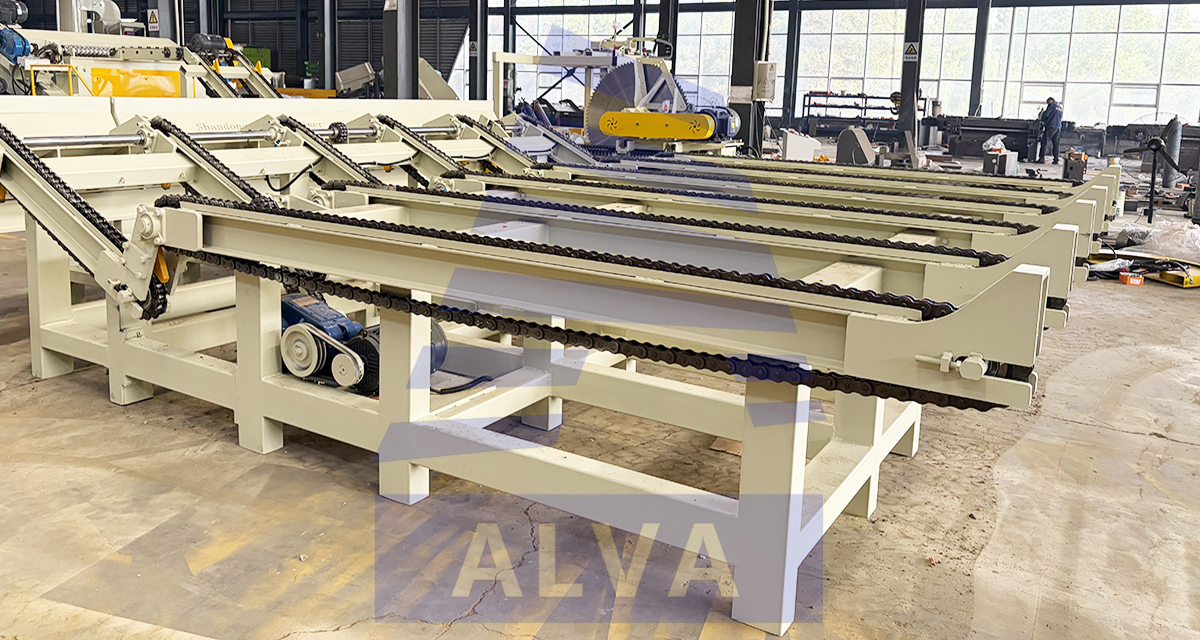
1. Overview of the Enterprise and Production Line
Shandong Alva Machinery Group Co., Ltd. is a professional manufacturer engaged in the research, development and production of wood processing machinery and equipment, and a key equipment supplier in the fields of veneer peeling and wood strip processing across the country. The company has built standardized production bases and complete supply chain systems, and implemented full-process quality control covering equipment design, component machining, complete machine assembly and factory commissioning. Its products are widely applied in plate processing, wood-based panel manufacturing, solid wood building materials and other related industries.
The small wood strip log veneer peeling production line is a complete processing solution independently developed by the company for small and medium-diameter logs. It can complete continuous operations including log feeding, conveying, sawing, veneer peeling and sorting, and realize the efficient processing of logs into veneers and small wood strips. As one of the core process equipment of the entire production line, the single-blade sawmill undertakes the work of fixed-width and fixed-thickness sawing of logs. It provides standardized blanks for the subsequent veneer peeling process, and serves as a crucial guarantee for the processing accuracy and operational stability of the whole production line.
2. Overall Design and Structural Composition of the Single-blade Sawmill
The 1.2m blade log single-blade saw is a horizontal fixed sawing equipment. The whole machine adopts welded steel structure frame, which undergoes stress relief annealing treatment to ensure stable operation during long-term service. The complete equipment is composed of frame assembly, conveying mechanism, sawing mechanism, drive system, safety protection devices and electrical control unit. All components are connected by bolts and positioning pins, which facilitates on-site installation, commissioning and routine maintenance in the later stage.
The frame assembly adopts a box-type structural design, and is fabricated with thick steel plates through welding. The surface is treated with sand blasting for rust removal and spraying, delivering good impact resistance and corrosion resistance. Anchor bolt mounting holes are reserved at the bottom of the frame. Operators can calibrate the installation level of the equipment with a level gauge to reduce vibration and displacement during operation. The interior of the frame is reserved with installation space for saw blades, motors and transmission components, and equipped with chip removal channels to realize centralized collection of wood chips generated in the sawing process.
The conveying mechanism adopts the chain plate conveying mode, which can be seamlessly connected with the conveying equipment of the preceding and subsequent processes of the production line. The conveying chain plate is assembled with high-strength chains and wear-resistant plates, and anti-slip baffles are arranged on the surface. The conveying speed can be adjusted according to log specifications to ensure steady transportation of logs to the sawing station. A tensioning device is configured for the conveying mechanism to adjust the tightness of the chain, so as to avoid conveying failures caused by loose or offset chains.
The sawing mechanism is the core functional unit of the equipment, consisting of saw blade, saw shaft, bearing pedestal and feeding device. The saw blade has a diameter of 1.2 meters. Made of high-manganese alloy, it features high hardness and wear resistance, and is applicable to the sawing of logs with different moisture contents and wood textures. The saw shaft is made of alloy steel after quenching and tempering treatment. High-precision bearing pedestals are installed at both ends of the saw shaft to reduce radial runout during operation and guarantee sawing accuracy. The feeding device adopts a mechanical positioning structure. Operators can adjust the sawing position according to actual processing requirements to complete fixed-width and fixed-thickness sawing of logs.
The drive system is composed of the main motor, pulley and transmission belt. The main motor is rated at 15kW with 4 poles, which can output stable rotating speed and provide sufficient cutting power for the saw blade. The transmission mechanism is fully enclosed for protection, preventing wood chips and dust from entering internal transmission parts. A tension pulley is equipped to adjust the tightness of the transmission belt and reduce slipping and vibration in the transmission process.
Safety protection devices include saw blade guard, feeding guard rail and emergency stop devices. The saw blade guard is a welded steel structure, covering the non-working area of the saw blade to prevent splashing wood chips and accidental contact by personnel. The feeding guard rails are installed on both sides of the conveying mechanism, which can limit log deviation and keep operators away from the sawing area. Emergency stop devices are arranged on the operation side and both sides of the equipment. Once triggered, the power supply will be cut off immediately to ensure operational safety.
The electrical control unit is an independent control cabinet. It is internally equipped with contactors, thermal relays, circuit breakers and other electrical components, with complete protection functions against overload, short circuit and phase loss. Flame-retardant cables are adopted for control lines and arranged in wiring ducts to lower line interference and improve operational reliability. The control panel is fitted with start-stop buttons, indicator lights and fault display components, enabling operators to monitor the operating status and troubleshoot faults in a timely manner.
3. Working Principle and Technological Process
The operation of the single-blade sawmill is closely linked with the preceding and subsequent processes of the production line. The overall working process is divided into five stages: log feeding, conveying and positioning, sawing operation, finished material conveying and wood chip collection.
In the log feeding stage, the feeding device at the front end of the production line transports logs to the inlet of the single-blade sawmill’s conveying mechanism. The chain plate drives the logs to move forward, and the logs enter the sawing area through the feeding guard rails. The anti-slip baffles on the conveying mechanism prevent logs from rolling during transportation and ensure logs enter the sawing station in a stable posture.
In the conveying and positioning stage, the logs are adjusted by the positioning device of the conveying mechanism to align the central line of logs with that of the saw blade, so as to avoid deflection in sawing. The mechanical baffle type positioning device can adjust the baffle spacing according to log diameters to adapt to logs of different specifications. When logs reach the sawing station, the photoelectric sensor of the conveying mechanism detects the material position and sends signals to the control unit to prepare for sawing.
In the sawing operation stage, operators start the main motor. The main motor drives the saw shaft and saw blade to rotate via pulleys. After the saw blade reaches the rated speed, the conveying mechanism drives logs to feed forward at a constant speed, and the saw blade performs cutting operation. Wood chips generated in the process are discharged through the chip removal channels at the bottom of the frame and collected by the supporting dust removal device of the production line to keep the working environment clean. The feeding speed matches the rotating speed of the saw blade, so as to obtain smooth sawing surfaces and reduce edge chipping and burrs.
After sawing, the processed log blanks are transported out of the sawing station by the conveying mechanism and delivered to the next equipment of the production line. The speed of the chain plate can be adjusted according to the overall production rhythm to match the operating speed of upstream and downstream equipment and ensure continuous operation of the whole production line. Waste materials and unqualified blanks generated in sawing are separated by the sorting device of the conveying mechanism to avoid affecting the processing of subsequent procedures.
In the wood chip collection stage, wood chips are delivered to the dust removal pipeline through the chip removal outlets, and collected and processed by the special dust removal system of the production line. The collected wood chips can be reused as biomass fuel or raw materials for plate processing, realizing comprehensive utilization of resources. The air volume of the dust removal fan matches the output of wood chips, ensuring timely discharge of chips and preventing material accumulation inside the equipment.
4. Technical Characteristics and Advantages
As key equipment of the production line, the single-blade sawmill possesses prominent technical characteristics and comprehensive application advantages.
First of all, the equipment has excellent structural stability. The frame is fabricated with thick steel plates and processed by stress relief annealing, so it will not deform or crack after long-term continuous operation. The saw shaft and bearing pedestals are processed and assembled with high precision, which effectively reduces radial runout of the saw blade, maintains stable sawing accuracy and slows down the wear of the saw blade.
Secondly, the equipment features wide adaptability. The conveying mechanism and sawing positioning device can be adjusted according to logs with different diameters and lengths, meeting the sawing requirements of small and medium-diameter logs and producing blanks of various specifications. The specially designed saw blade is applicable to logs with different moisture contents and wood properties, reducing edge chipping and blade jamming during sawing and improving the yield of finished products.
Thirdly, the equipment maintains high operational stability. The 15kW 4-pole main motor delivers steady power output. The fully enclosed transmission structure and tensioning devices prevent wood chips and dust from interfering with transmission components and lower the failure rate. The electrical control unit is equipped with complete protection functions, which can automatically respond to faults such as overload, short circuit and phase loss and prevent equipment damage caused by electrical failures.
Fourthly, the equipment is easy to operate and maintain. The control panel is integrated on the control cabinet with clearly arranged buttons and indicator lights, facilitating operation and status monitoring. Sufficient maintenance space is reserved for wearing parts including saw blades, transmission belts and bearings. Operators can complete inspection and replacement work without disassembling large components, cutting maintenance costs and downtime.
Fifthly, complete safety protection is configured. The saw blade guard, feeding guard rails, emergency stop devices and other multiple protective structures effectively avoid accidental contact with operating parts and prevent potential safety hazards caused by splashing wood chips. All electrical circuits and moving transmission parts are enclosed, isolating operators from live components and running mechanisms and fully guaranteeing on-site operation safety.
5. Coordinated Operation with the Production Line
The single-blade sawmill works in coordination with other equipment of the small wood strip log veneer peeling production line to form a complete log processing flow. Materials are continuously transferred between each process via conveying mechanisms to ensure high-efficiency operation of the whole line.
Logs are delivered from the front-end feeding equipment to the single-blade sawmill. After standard sawing, qualified blanks are sent to the veneer peeling machine for further processing. The processed veneers and small wood strips are then transported to the sorting equipment for classification by specifications and quality.
The conveying speed and sawing efficiency of the single-blade sawmill can be adjusted according to the overall production capacity of the line to match the operating rhythm of veneer peeling machines, sorting equipment and other units, avoiding material accumulation or material shortage. The electrical control system of the single-blade sawmill can be connected to the general control system of the production line. PLC linkage control is adopted to realize automatic operation of all processes and improve the overall automation level and production efficiency.
In addition, the chip removal system of the single-blade sawmill is connected to the centralized dust removal system of the production line. Wood chips generated in sawing can be discharged and collected in a timely manner to keep the equipment and workshop clean. The matched air volume of the dust removal system ensures ideal chip collection effect and reduces dust pollution in the working area.
6. Application Scenarios and Industrial Value
The single-blade sawmill and the supporting small wood strip log veneer peeling production line are mainly used in wood-based panel manufacturing, solid wood building material processing, biomass energy and other industries. They can process small and medium-diameter logs into standard veneers and small wood strips and maximize the utilization rate of log resources.
In the wood-based panel manufacturing industry, the standardized blanks processed by the single-blade sawmill can be made into veneers of different thicknesses through veneer peeling machines, which are widely used in the production of plywood, blockboard, oriented strand board and other wood-based panels. The fixed-width and fixed-thickness sawing effectively controls the specification deviation of blanks, reduces the processing difficulty of subsequent veneer peeling procedures and improves the qualification rate of veneer products.
In the solid wood building material processing industry, the sawn small wood strips can be used to produce solid wood flooring, furniture frames, construction formwork and other products. Standardized blank specifications lay a foundation for automatic processing of subsequent procedures and improve the machining accuracy and consistency of finished products. The strong adaptability of the equipment can meet the production demands of building materials with diversified specifications and adapt to the changing market requirements.
In the biomass energy industry, recycled wood chips and processing waste can be made into biomass fuel and pellet fuel, realizing resource recycling and reducing resource waste and environmental pollution. The supporting chip collection system can provide stable raw material supply for biomass energy production.
From the perspective of industrial development, the application of the single-blade sawmill and supporting production line improves the comprehensive utilization rate of small and medium-diameter logs. It promotes the wood processing industry to develop towards high efficiency, environmental protection and automation. The stable operation performance and low operating and maintenance costs help processing enterprises cut comprehensive production costs and enhance market competitiveness.
7. Equipment Maintenance Specifications
Standard daily and periodic maintenance shall be implemented to maintain long-term stable operation of the single-blade sawmill. Relevant specifications are formulated as follows.
Daily inspection shall be carried out before each shift. Operators need to check the integrity of power supply, electrical circuits, transmission belts and saw blade guards, and verify the normal function of emergency stop devices and safety guard rails. Check the tightness of the conveying chain plate and clear wood chips and sundries on the equipment surface and conveying mechanism to keep the equipment clean.
Regular lubrication is required. Inject lubricating oil to saw shaft bearings, chain tensioning devices and other parts on a regular basis in accordance with equipment specifications to reduce component wear and extend service life. The type of lubricating oil and refueling cycle shall comply with the requirements of the operation manual, and inferior lubricants are prohibited.
Inspect the wear condition of the saw blade periodically. Replace or grind the saw blade timely if tooth wear, tooth breakage or blade deformation is found, so as not to affect sawing accuracy and working efficiency. Ensure the mounting surface of the saw shaft and saw blade is clean during installation, and fasten the saw blade firmly to eliminate potential safety hazards caused by loose components.
Check the tightness and wear degree of transmission belts regularly. Adjust the tension or replace worn, cracked belts in a timely manner. Remove wood chips and sundries on pulleys and transmission parts to guarantee transmission efficiency and prolong the service life of belts.
Conduct regular inspection on the internal components and circuits of the electrical control cabinet. Clean dust inside the cabinet and check whether wiring terminals are loose to avoid poor contact or short circuit. Verify the setting values of thermal relays, circuit breakers and other protective devices to ensure all protection functions work normally.
If the equipment is out of service for a long time, cut off the power supply completely. Remove all wood chips and sundries inside and outside the equipment, and apply anti-rust oil on saw blades, bearings and other vulnerable parts against rust. The storage environment shall be kept dry and ventilated, and damp and corrosive gas shall be avoided.
8. Conclusion
The small wood strip log veneer peeling production line and its supporting 1.2m blade log single-blade sawmill launched by Shandong Alva Machinery Group Co., Ltd. provide reliable processing solutions for small and medium-diameter log processing. Equipped with a 15kW 4-pole main motor, the single-blade sawmill delivers stable power output to adapt to continuous production of the whole line. It completes standardized sawing of logs and provides high-quality blanks for subsequent veneer peeling processes, ensuring the processing efficiency and finished product quality of the entire production line.
Designed and manufactured in strict accordance with industrial standards, the equipment features reliable structure, stable performance and complete safety protection, while taking operational convenience and maintainability into consideration. It can adapt to various working conditions and meet diversified production demands. Through coordinated operation with other equipment on the line, the single-blade sawmill realizes continuous and automatic log processing, improves resource utilization efficiency and reduces overall operating costs for enterprises. It provides solid equipment support for the high-efficiency and green development of the wood processing industry.
Shandong Alva Machinery Group Co., Ltd. will continue to optimize equipment design and manufacturing techniques, improve product lines and after-sales service systems. The company will deliver more adaptable and reliable wood processing machinery to customers, and make contributions to the high-quality development of the wood processing industry.

 English
 العربية
 Français
 Русский
 Español
 Português
 Deutsch
 italiano
 日本語
日本語 한국어
한국어 Nederlands
 Tiếng Việt
 ไทย
ไทย Polski
 Türkçe
 አማርኛ
አማርኛ ພາສາລາວ
 ភាសាខ្មែរ
 Bahasa Melayu
 ဗမာစာ
ဗမာစာ தமிழ்
தமிழ் Filipino
 Bahasa Indonesia
 magyar
 Română
 Čeština
 Монгол
 қазақ
қазақ Српски
 हिन्दी
 فارسی
فارسی Kiswahili
 Slovenčina
 Slovenščina
 Norsk
Norsk Svenska
 українська
 Ελληνικά
 Suomi
Suomi Հայերեն
 עברית
עברית Latine
 Dansk
Dansk اردو
اردو Shqip
Shqip বাংলা
বাংলা Afrikaans
 Māori
Māori অসমীয়া
 Беларуская мова
 Català


