 | Product Introduction |
ALVA hot-press veneer dryer is a special drying equipment designed for thin wood veneers in the wood processing field. It is mainly applied in the production processes of plywood and decorative veneers. Its core function is to rapidly and uniformly reduce the moisture content of veneers after rotary cutting or slicing, so that they can meet the process requirements of subsequent procedures such as gluing and veneering, while minimizing problems like warping, cracking and deformation during the veneer drying process.
| Product Display |
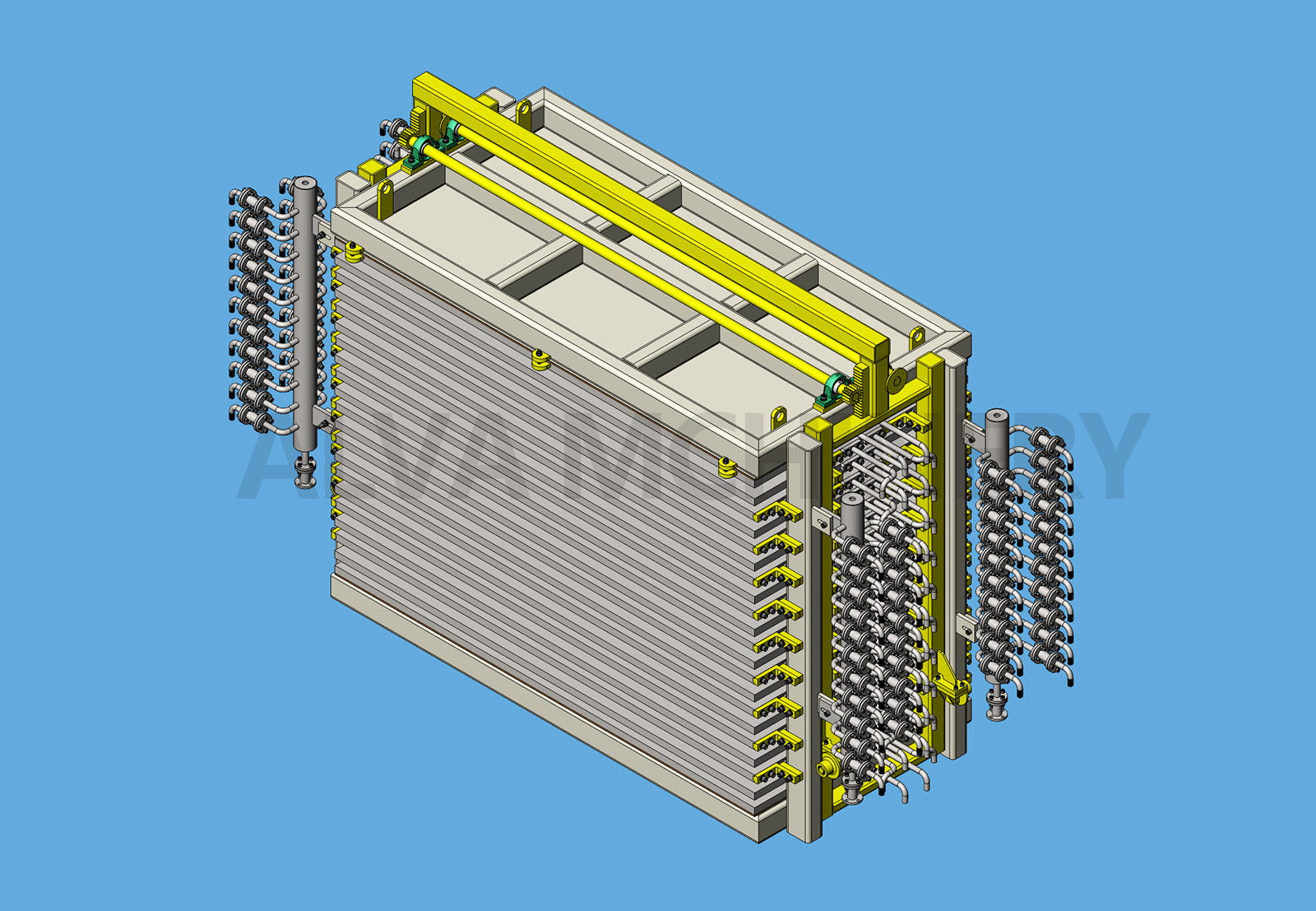
| Product Parameter |
| Veneer Dryer Parameters |
| Name | Parameter | Remarks |
| Model No. | BY214X8/1-20-00 |
|
| Nominal Pressure | 1000 KN |
|
| Board Feeding Direction: Horizontal | Horizontal |
|
| Number of Layers | 20 Layers |
|
| Interlayer Spacing | 10mm |
|
| Number of Hot Press Plates | 21 |
|
| Plate Size | 1370×2700×42mm | Double Inlet and Double Outlet, Chrome-plated Surface |
| Hydraulic Cylinder Diameter & Quantity | Φ160X100mm | Heli High-pressure Hydraulic Cylinder |
| Power | 5.5KW |
|
| Machine Weight | 27 Tonnes |
|
| Overall Dimensions | 4200mmX1370mmX2500mm |
|
| Croe Working Principle |
This equipment achieves the drying function based on the dual mechanisms of contact heat conduction and press plate shaping. The working process is as follows:
1.Feeding and Positioning
Veneers to be dried are accurately fed into the gap between the multi-layer hot press plates via the conveying system. The surface of the veneers must be kept flat to prevent wrinkles from affecting the drying effect.
2.Heat Conduction Drying The hot press plates are internally equipped with heat-conducting oil channels or steam chambers, which are heated to a preset temperature by an external heat source. Heat is directly transferred to the interior of the veneers through the contact surface between the hot press plates and the veneers, causing the moisture inside the veneers to vaporize rapidly.
3.Pressure Control and Shaping The equipment is equipped with a hydraulic or pneumatic pressure system that applies a constant low pressure to the hot press plates. This pressure is much lower than that of a hot press machine, and its purpose is not for gluing, but to fix the shape of the veneers and prevent warping or buckling during the moisture vaporization process.
4.Moisture Removal and Completion The vaporized steam is discharged through the pre-set air vents on the surface of the hot press plates or the moisture exhaust fans installed on the side of the equipment. When the moisture content of the veneers drops to meet the process standards, the hot press plates separate, and the veneers are conveyed to the next process by the discharging system.
| Equipment Structure Composition |
The hot-press veneer dryer is an integrated piece of equipment, mainly consisting of the following five core modules:
1.Hot Press Plate System
As the core component of the equipment, it is composed of multiple parallel-arranged metal press plates. The press plates are mostly made of heat-resistant cast iron or aluminum alloy, and their surfaces are polished to ensure uniform contact with veneers. The number of press plate layers is designed according to production capacity requirements; more layers mean a higher processing capacity per unit time.
Heating and Temperature Control Module
There are two mainstream heating methods: heat-conducting oil heating and steam heating:
2.Heat-conducting oil heating: Heat-conducting oil is heated by a heat-conducting oil furnace and then delivered to the hot press plate channels by a circulating pump. This method features high temperature control precision, with temperature fluctuation kept within a narrow range.
3.Steam heating: Boiler steam is introduced into the hot press plate chambers, enabling fast heating speed and low cost, which is suitable for small and medium-sized wood processing factories.
The module is equipped with an intelligent temperature controller, which can accurately set and adjust the temperature according to the material and thickness of veneers.
Pressurization and Transmission Module
It adopts hydraulic or pneumatic drive: hydraulic drive is suitable for large-scale multi-layer equipment with stable pressure; pneumatic drive is mostly used for small-sized equipment with flexible operation. The transmission system is responsible for controlling the opening and closing speed and spacing of the hot press plates to ensure smooth feeding and discharging of veneers.
4.Conveying and Positioning System
It includes a feeding conveyor belt, a discharging conveyor belt and a veneer positioning device. The positioning device uses photoelectric sensors or mechanical limiters to ensure the accurate positioning of veneers between the hot press plates, avoiding uneven drying caused by veneer deflection.
5.Moisture Removal and Control System
The moisture removal system is composed of moisture exhaust fans and air-permeable pipelines, which can timely discharge vaporized steam and prevent moisture accumulation inside the equipment from affecting drying efficiency. The control system adopts a PLC programmable logic controller, which can preset parameters such as drying temperature, pressure and time to realize automatic operation, and is also equipped with a fault alarm function.

 English
 العربية
 Français
 Русский
 Español
 Português
 Deutsch
 italiano
 日本語
日本語 한국어
한국어 Nederlands
 Tiếng Việt
 ไทย
ไทย Polski
 Türkçe
 አማርኛ
አማርኛ ພາສາລາວ
 ភាសាខ្មែរ
 Bahasa Melayu
 ဗမာစာ
ဗမာစာ தமிழ்
தமிழ் Filipino
 Bahasa Indonesia
 magyar
 Română
 Čeština
 Монгол
 қазақ
қазақ Српски
 हिन्दी
 فارسی
فارسی Kiswahili
 Slovenčina
 Slovenščina
 Norsk
Norsk Svenska
 українська
 Ελληνικά
 Suomi
Suomi Հայերեն
 עברית
עברית Latine
 Dansk
Dansk اردو
اردو Shqip
Shqip বাংলা
বাংলা Afrikaans
 Māori
Māori অসমীয়া
 Беларуская мова
 Català


